Unpredictability by Design: Zen Buddhism & Philosophy to Embrace Systemic Change with Agency
The Disruptive Futures Institute marks five years of pioneering a unique approach to strategic foresight — one rooted in Zen Buddhism, Eastern, and existential philosophies.

As disruption becomes the new normal, the Disruptive Futures Institute marks five years of pioneering a unique approach to strategic foresight — one rooted in Zen Buddhism, Eastern, and existential philosophies.
“Our frameworks challenge the traditional Western pursuit of stability and certainty,” explains Roger Spitz, Founding Chair of the Disruptive Futures Institute. “True resilience comes from embracing impermanence as a superpower — not from trying to control the uncontrollable or predict the unpredictable.”
Our Expanding Liminal Present

As the space between present and future collapses, foresight, which once distanced us from tomorrow, must evolve. We need to enhance our tools and our imagination to navigate systemic disruption. The tidy taxonomy of Possible, Plausible, Probable, and Preferable futures is blurring as the impossible manifests with growing frequency.
Foresight must go beyond anticipation. It’s creating, emerging, deciding, and responding dynamically within living systems. Perhaps the future of foresight lies in cultivating actionable urgency: the ability to experience the present with agency and informed optimism.
Mujō (無常) teaches us the profound importance of change and impermanence. By accepting that nothing lasts forever and that everything in our lives is in a constant state of flux, we gain a powerful perspective. This philosophical understanding directly aids our ability to improvise and invent. It helps us to see things afresh, without being bound by the way they have always been. To meaningfully investigate the future, we must first understand the present, or “nowness.” Mujō provides a vital lens for understanding this transience.
Today, few can focus beyond the next news cycle. But looking farther into the future is necessary for survival. As the world will be radically transformed over the coming years, there is no alternative but to understand what key features to look out for, what fragments of the future are emerging today — sometimes prematurely and unannounced. Thinking across different time horizons provides an opportunity to explore these possibilities.
According to Zen Buddhism, neither the past nor the future exist — there is only nowness. But even so, truly experiencing the present is compatible with the future. Embracing nowness allows one to emerge with more clarity for the futures.
Technology today is blurring the lines of the past, present, and future. With AI-negotiated legal contracts, bioprinted organs, and flying cars, is the present spilling prematurely into the future? Or is the future encroaching on the present with dystopian pandemics, climate-driven wildfires, and bad actors hacking military infrastructure?
In our UNknown, Volatile, Intersecting, Complex, and Exponential (UN-VICE) world, the lines between the present and future are becoming blurred. The liminal states between time periods are themselves growing, as present and future realities intersect. The choices we make today about how we will engage with the future intimately affect the present.
The Paradox of Impermanence
Understanding the interplay between constants and novelty is crucial as we navigate increasingly unpredictable futures. In evaluating these forces, we must consider their proportions and relationships. A constant compared to what, when, since when, where, or for whom?
In 1937, Salvador Dalí created two iconic surrealist works — The Metamorphosis of Narcissus and Swans Reflecting into Elephants — both rooted in his paranoiac-critical method and fascination with illusion. Metamorphosis of Narcissus reimagines the Greek myth, using mirrored imagery to shift from human form to a stone hand holding a flower. Swans Reflecting into Elephants employs the same visual trickery, turning swans and their reflections into elephants against a familiar Catalonian landscape, blending perception and delusion.
Perhaps constants and discontinuities are mirror images of one another — two sides of the same coin. The reflection of disruption is a constant, and vice versa.
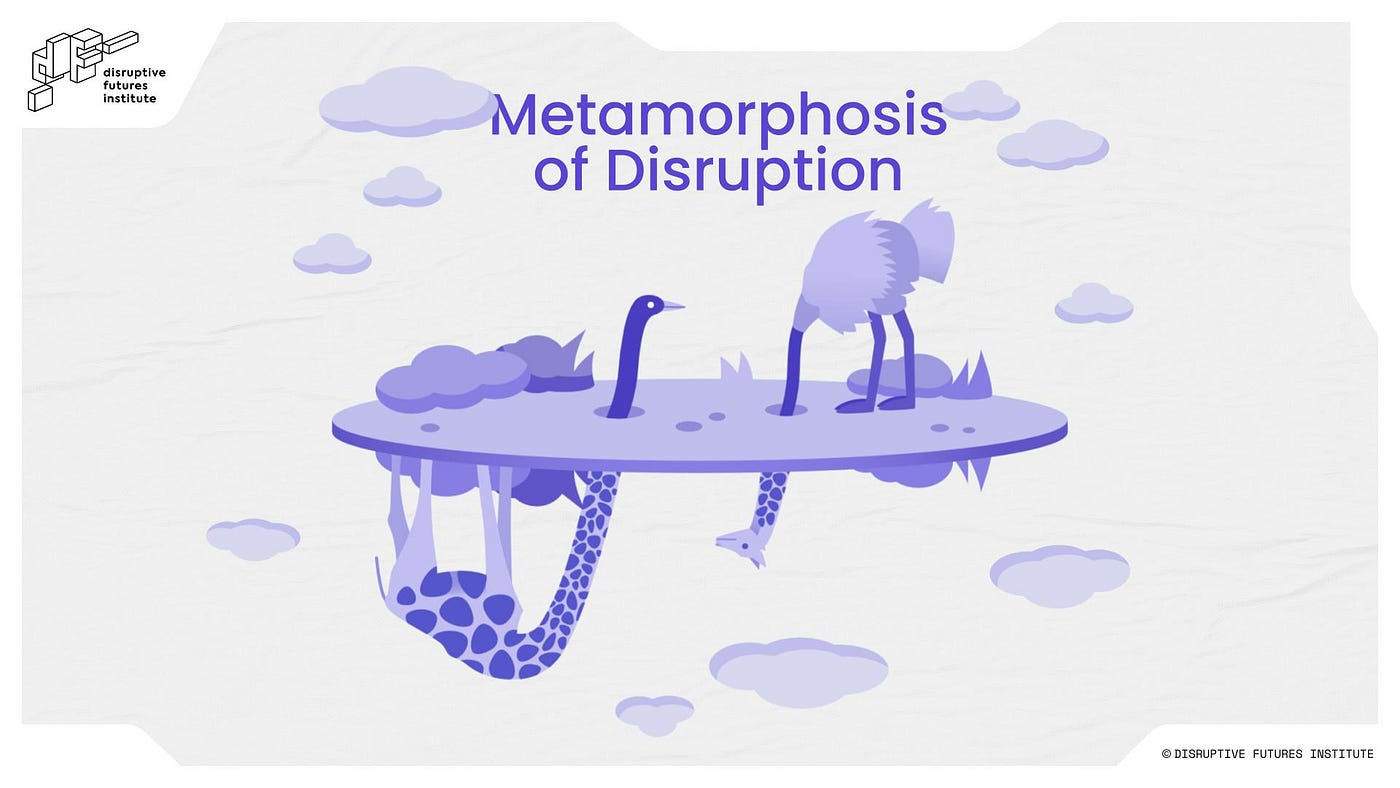
As we investigate change, the paradoxes, tensions, interplay, and liminal nature of disruption reflect underlying constants. Only time reveals what changes and what endures.
If we consider disruption not as isolated or episodic, but as a steady state, is there truly a difference between disruptions and constants? Have we been misled by the illusion of stability, predictability, and certainty — a world free from constant disruption?
This interplay echoes ancient wisdom. As we have seen, in Japanese, mujō means impermanence: everything is constantly in flux. Impermanence is called Anicca in Pali, the sacred language of Theravāda Buddhism. Anicca is an essential doctrine shared equally in Buddhism and Hinduism. In the teachings of the Buddha, life itself is comparable to a river that appears to have continuous and unified flow, but it is never the same water. It is the same concept of impermanence when the Greek philosopher Heraclitus said that “…no man ever steps in the same river twice, for it is not the same river and he’s not the same man.”
This paradox challenges our longing for predictability. We crave a linear, controllable world, but patterns increasingly defy interpretation. The illusion of stability — whether in markets, climates, or personal lives — collapses under scrutiny. Perhaps we’ve misread the reflection, mistaking constant change for isolated disruption.
We must explore new pathways with awareness that some things will constantly emerge, while others may disappear or change at different rates. But we can ultimately drive our futures, because above all, we are human.
Philosophy and Zen Buddhism
Our approach at the Disruptive Futures Institute blends real-world case studies with transformative educational experiences to address key areas of adaptive foresight, systems innovation, and sustainable change. Updated continuously with our latest insights, the Disruptive Futures Institute has a holistic focus including:
Eastern Philosophy & Zen Buddhism: To leverage invention, impact, and meaning, through Existential & Eastern philosophies.
Existential Philosophy & Techistentialism: Ethical & Existential Foresight for understanding the future of Artificial Intelligence and decision-making.
During our journey, we realized how disruption is simply mujō: constant change all the time. The concept of impermanence is akin to disruption. Nothing is permanent — except impermanence. Practical learnings from these themes, with a particular focus on how to adopt shoshin (a beginner’s mind), are developed throughout our work, publications, and programs at the Disruptive Futures Institute.
Blending philosophy with foresight, the Disruptive Futures Institute grounds its work in existentialist thought: uncertainty is not a limitation, but a condition of freedom. Leaders have agency to shape futures through choices and action. By embracing the unknown, they emerge more resilient and more human in the midst of systemic disruption.
Techistentialism: Agency in a Technological World
Today, humanity faces technological and existential conditions that can’t be separated. We define this phenomenon as “Techistentialism.” Our existential condition is an uncertain one, considering the inherent dualities and paradoxes of life. Our techistential condition is no different.
The paradox of technology — its magic and hazards — gives it a unique status. As German existential philosopher Martin Heidegger suggests, technology “drives out every other possibility of revealing.” Technology is so dominant that it can eclipse all other ways we understand the world.
Existentially, we each have the agency to explore contingency — the idea that possible events are uncertain. Choice exists because of contingency. Our freedom as individuals is determined through our choices. If everything were predetermined, fixed by design, we would lack choice and power.
Standing on the shoulders of Heidegger and Søren Kierkegaard, Jean-Paul Sartre powerfully articulated the human condition: “existence precedes essence.” By this, Sartre meant that our agency emerges through choice. While existence is indeterminate and thus unknowable, we are always defining our essence as it emerges and moving in the direction we define. But if technology is determining outcomes on our behalf, our agency is curtailed and our choices may be beyond our control.
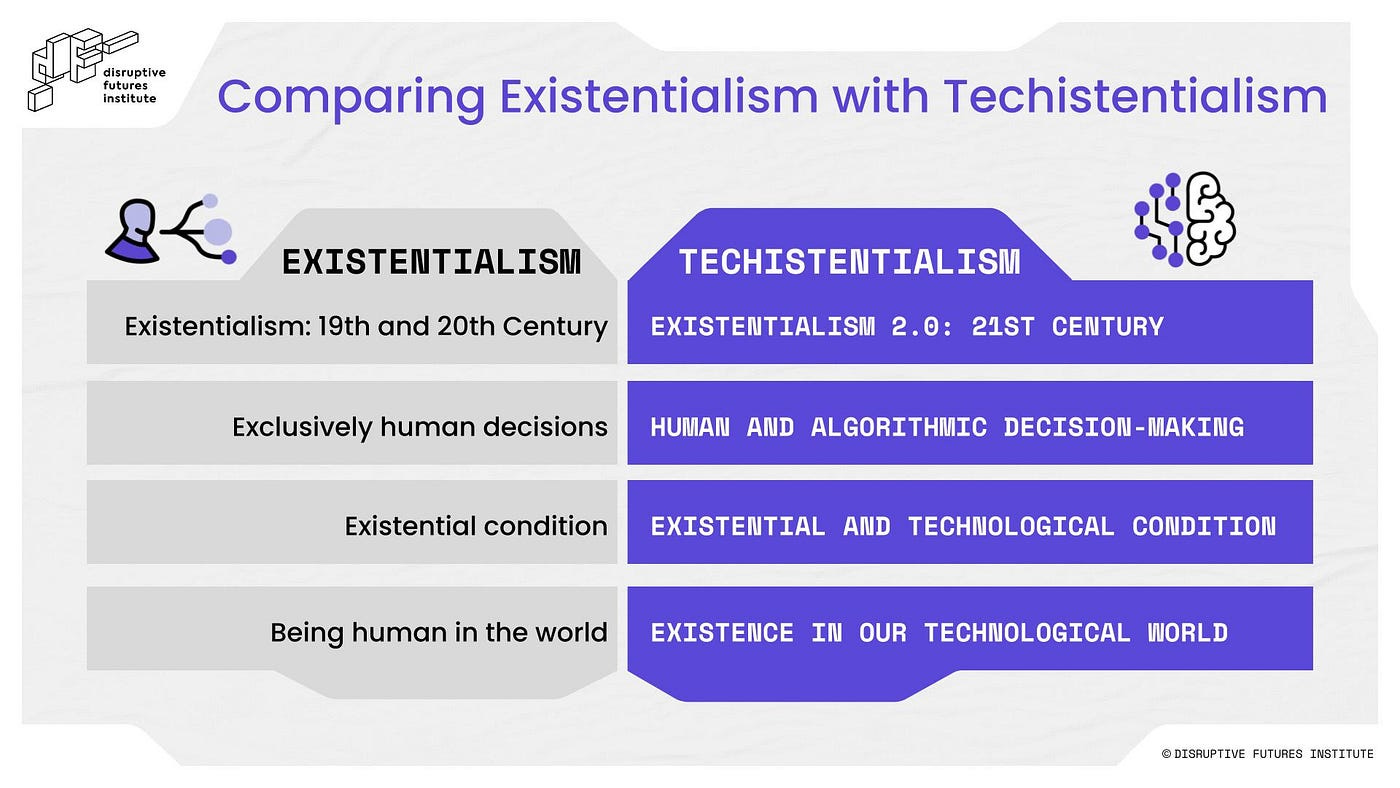
Technology is shaping society by influencing decision-making and enabling manipulation at scale (for instance, through social media and misinformation). Through AI, technology is challenging us in a realm historically specific to humans. As AI develops, machines will become increasingly autonomous in making decisions. Here, the use of technology confronts the existential dimension. Here, we stand on the edge of our free will. Computationally rational technology is no longer neutral because it drives away contingency and choice.
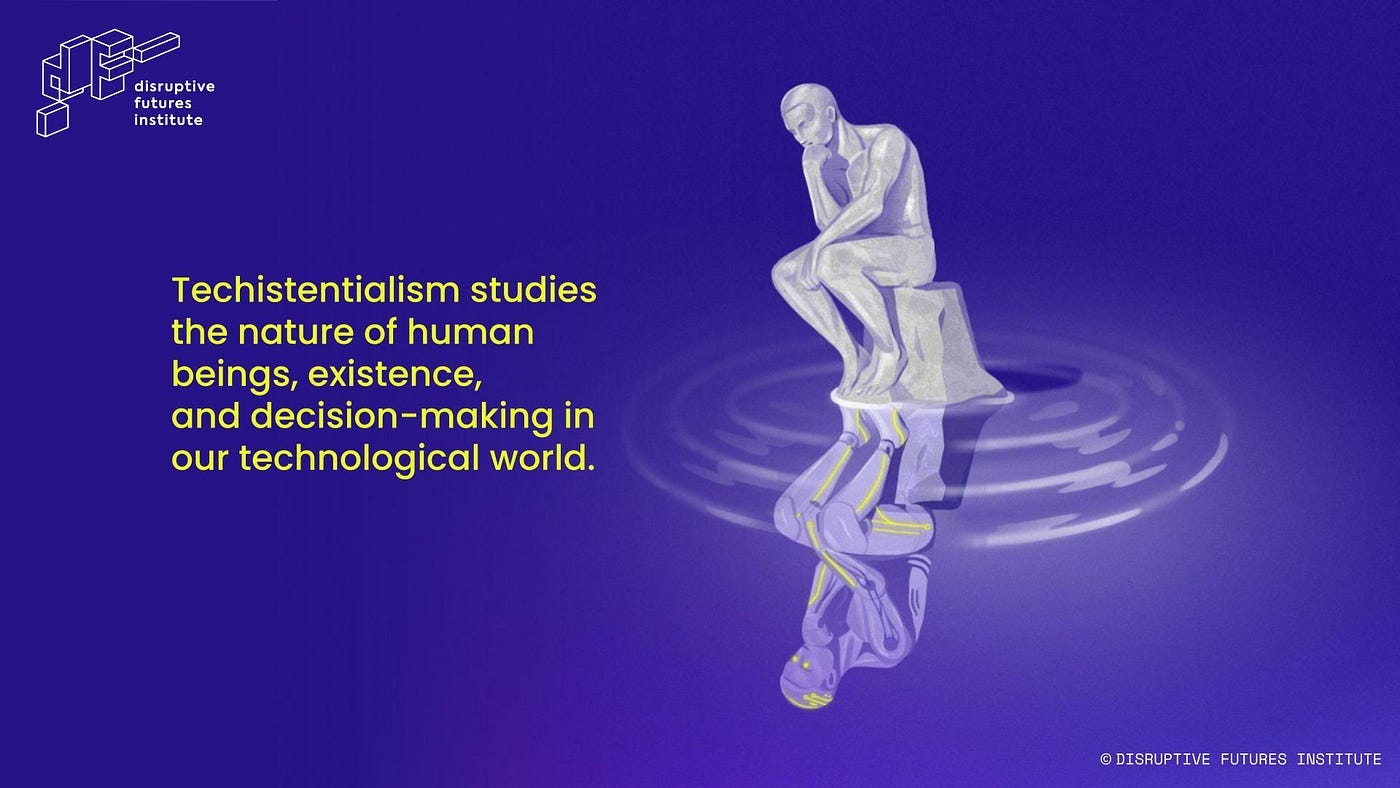
Techistentialism studies the nature of human beings, existence, and decision-making in our technological world.
Could Superstupidity be as Dangerous as Superintelligence?
More recently than the existential philosophers of the 19th and 20th centuries, Nick Bostrom defined an existential risk as “…one that threatens the premature extinction of Earth-originating intelligent life or the permanent and drastic destruction of its potential for desirable future development.”
While there is an ongoing debate as to whether AI could cause human extinction, it has a wide spectrum of other potential existential impacts. The curtailing of humanity’s agency is one of these risks.
As multiple systems interact, it becomes increasingly difficult to discern how algorithms make decisions, which exposes us to both human and machine errors. Complex systems in technology (robots, supercomputers, nuclear plants, networks, weapons) have many moving parts that can be prone to failure. Have we developed overreliance on increasingly complex dynamic systems? How easy would it be for an autonomous machine (or human) to make a consequential mistake that goes undetected?
“Superstupidity” could be as much of an existential risk as artificial superintelligence (ASI). Theoretically, ASI could possess humanity’s combined cognitive capacity. In contrast, superstupidity could take on multiple features, including overreliance on the underlying “intelligence” of these systems. For instance, believing that AI can be a proxy for our own understanding and decision-making as we delegate more power to algorithms is superstupid. Perhaps AI is also superstupid, and may cause mistakes, wrong decisions, or misalignment. Further, consider AI ineptitude. What might appear as incompetence may simply be algorithms acting on bad data. This can result in bias, privacy violations, and immoral AI. As with humans, more or better data may not help machines make improved decisions.
Determining whether AI is on the road to superintelligence or superstupidity may not matter as much as ensuring that humanity does not rely on AI without a solid understanding of the consequences.
Maybe the existential risk is not machines taking over the world, but rather the opposite, where humans start responding like idle machines — unable to connect the emerging dots of our UN-VICE world.
Mindset Shifts for Relevancy
To ensure superstupidity is not our future, updating our education system and shifting our mindsets must become existential priorities. Effective education should be measured not in test scores, but in whether it prepares humanity to be future‑ready for the complex and unpredictable 21st century. Education should inspire passion, nurture curiosity, emphasize uncertainty, develop range, and use critical thinking to expose unquestioned assumptions and false dichotomies. Most importantly, it must cultivate new relationships with inquiry, experimentation, and failure — inseparable companions of creativity. These qualities are not optional; they are essential if we are to problem‑solve ourselves out of the most existential risks. Today’s standard knowledge will never solve tomorrow’s surprises.
Just as fluency in mathematics once became a universal requirement, learners today must become fluent in the uses and abuses of technology. The ability to distinguish truth from fiction, information from disinformation, and entertainment from addiction will determine who becomes enslaved by emerging technologies — and who harnesses them with intention and agency.
Learning, however, cannot end with the completion of formal schooling. It is an ongoing, lifelong rhythm of learning, unlearning, and relearning — from the playground to the boardroom. In this post‑playbook era, resilience requires humility and adaptability as much as knowledge. It becomes a quest for learning how to unlearn and learn.
This is where the 6 i’s framework — rooted in Zen Buddhism, philosophy, and adaptive foresight — becomes indispensable. Intuition, Inspiration, Imagination, Improvisation, Invention, and Impossible give us the language and tools to reclaim agency for curiosity, experimentation, and creative re‑visioning. In what we call our Techistential and UN‑VICE world, these practices help leaders and learners not only navigate systemic disruption but also thrive within it by embracing impermanence, resilience, and the freedom of uncharted possibility.
The 6 i’s Framework
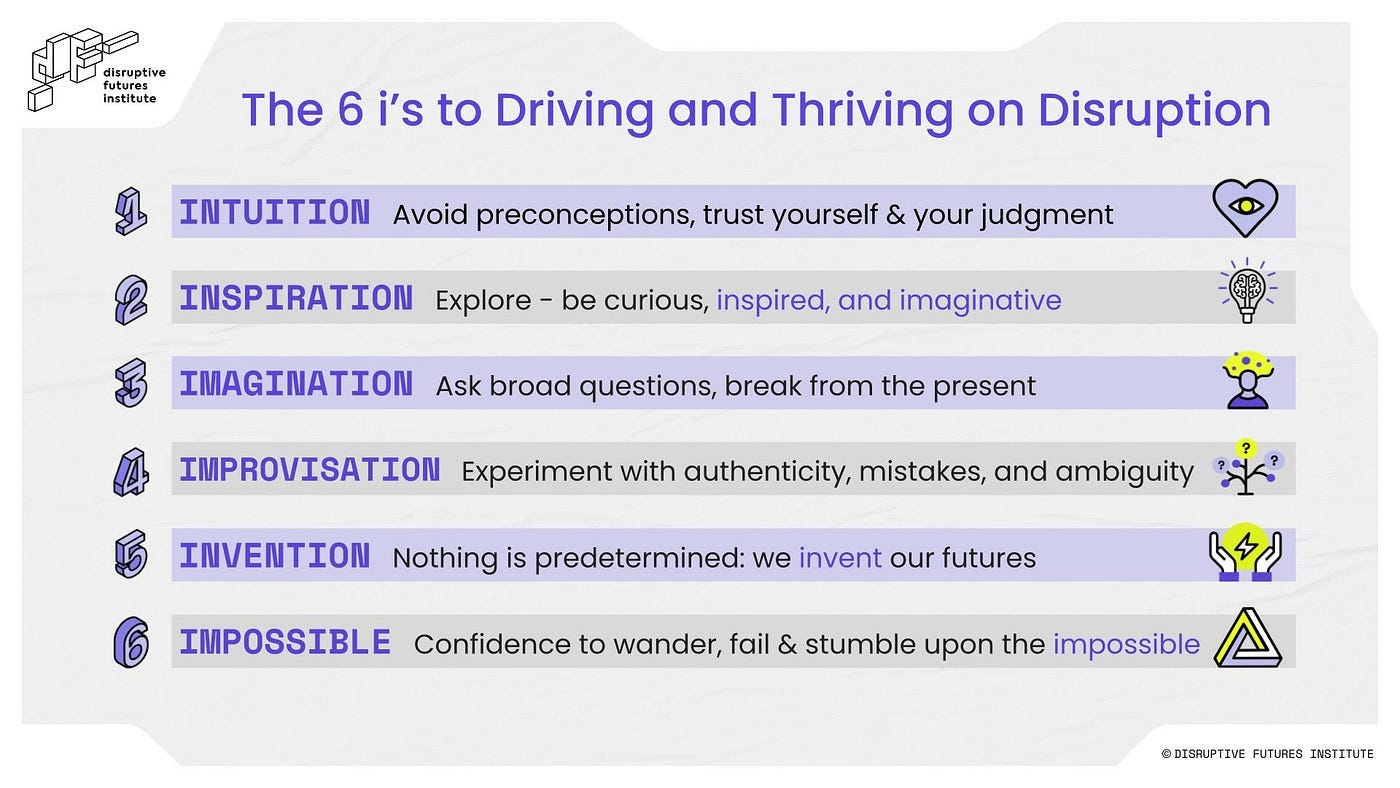
There are many tools in the futurist’s toolkit, including some that have become less relevant with time. Thus, we offer our own 6 i’s to thriving on disruption — Intuition, Inspiration, Imagination, Improvisation, Invention, and Impossible. We can master the language of systemic disruption with the 6 i’s, which together provide highly relevant perspectives to understand and anticipate the uncertain futures, and drive change to our advantage.
Intuition
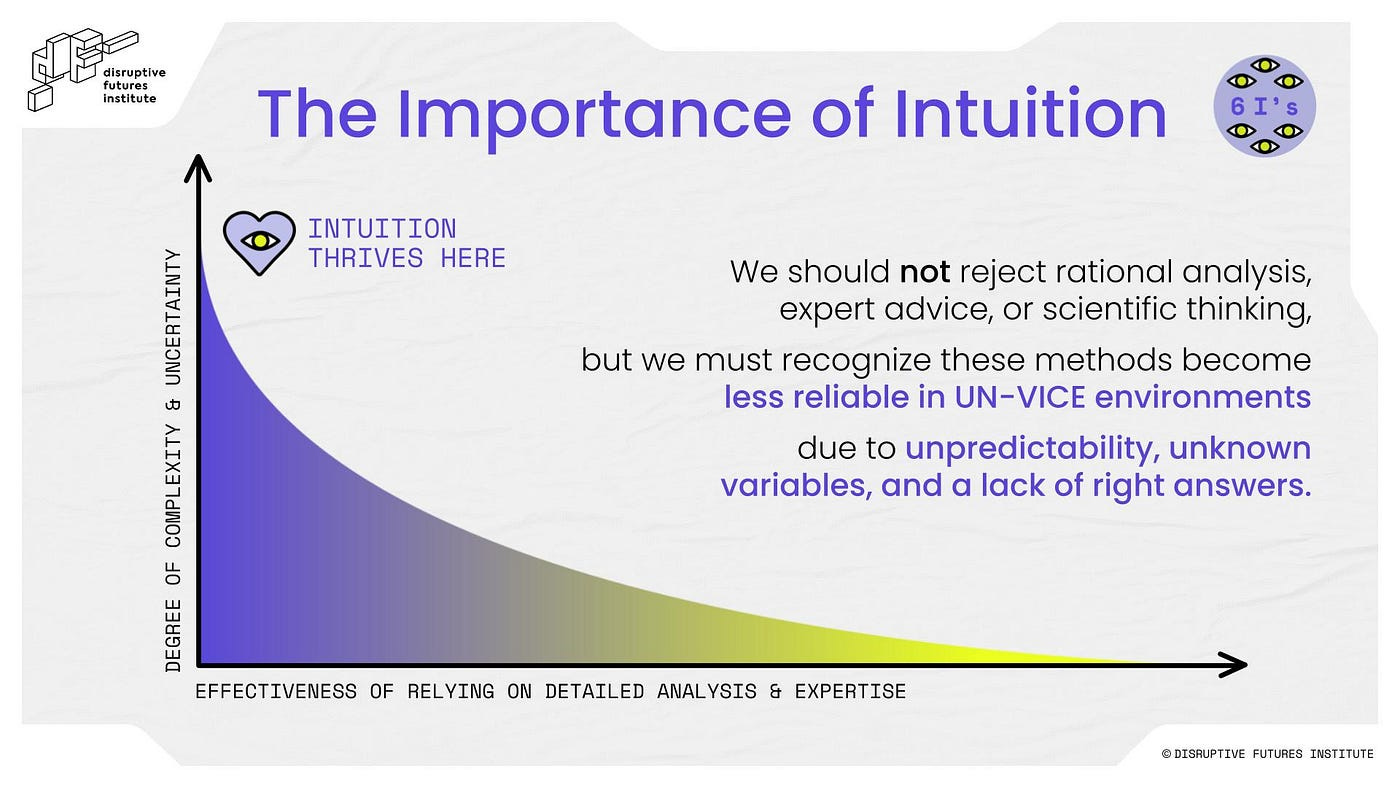
The effectiveness of relying on detailed and rational analysis is inversely proportional to the degree of complexity and uncertainty. We should not reject rational analysis, expert advice, nor scientific thinking, but recognize these methods will increasingly lack all the answers, due to unpredictability and extent of unknown, dynamic, and interconnected variables in deeply complex situations.
Inspiration
Diversity of people, domains, and perspectives is a key driver to inspiration — which is what enables us to follow our passions and embrace emergence. Our laws of inspiration are: Passion, Diversify, Novelty, Make connections, and Embrace serendipity.
Imagination
“Imagination is more important than knowledge,” according to Albert Einstein, and imagination is a crucial skill in planning our possible futures. Working through “What If?” scenarios and asking “How Might We?” is an imaginative approach used by the world’s leading companies.
Improvisation
Improvisation can help us become more spontaneous, and unlock the courage to reveal our true character. As we head into the uncertain futures, and traditional models become less relevant, improvisation can be a key to unlocking new insights and connections. The more you practice thinking on your feet and the more you prepare for future scenarios, the better you get at improvising when they arise.
Invention
While innovation is a material improvement that builds on something which already exists, invention is really the creation of novelty — something that did not exist before. Innovation and invention, as well as failure and invention, go hand in hand in the open futures.
Impossible
Once we are inspired to drive change, we no longer see it as impossible. Our existing assumptions shift to driving experimentation and improvisation to invent what seemed impossible. New ideas often feel impossible until they become part of everyday life.
The 6 i’s to thriving on disruption are always available. There is no right or wrong time and it is never too early nor too late. While the past is behind you, the future is uncertain and unknown, allowing you the agency to drive it. The 6 i’s should not be considered as separate or stand-alone. They mutually reinforce each other as they interact to bring you novel experiences and exposure to new ideas. They will broaden your networks and expose you to new ecosystems.
Most important of all, harnessing the 6 i’s will allow serendipity through the emergence of new ideas where logic, analysis, and strategy would fall short. It is no coincidence that driving and thriving on disruption also encompasses 6 i’s.
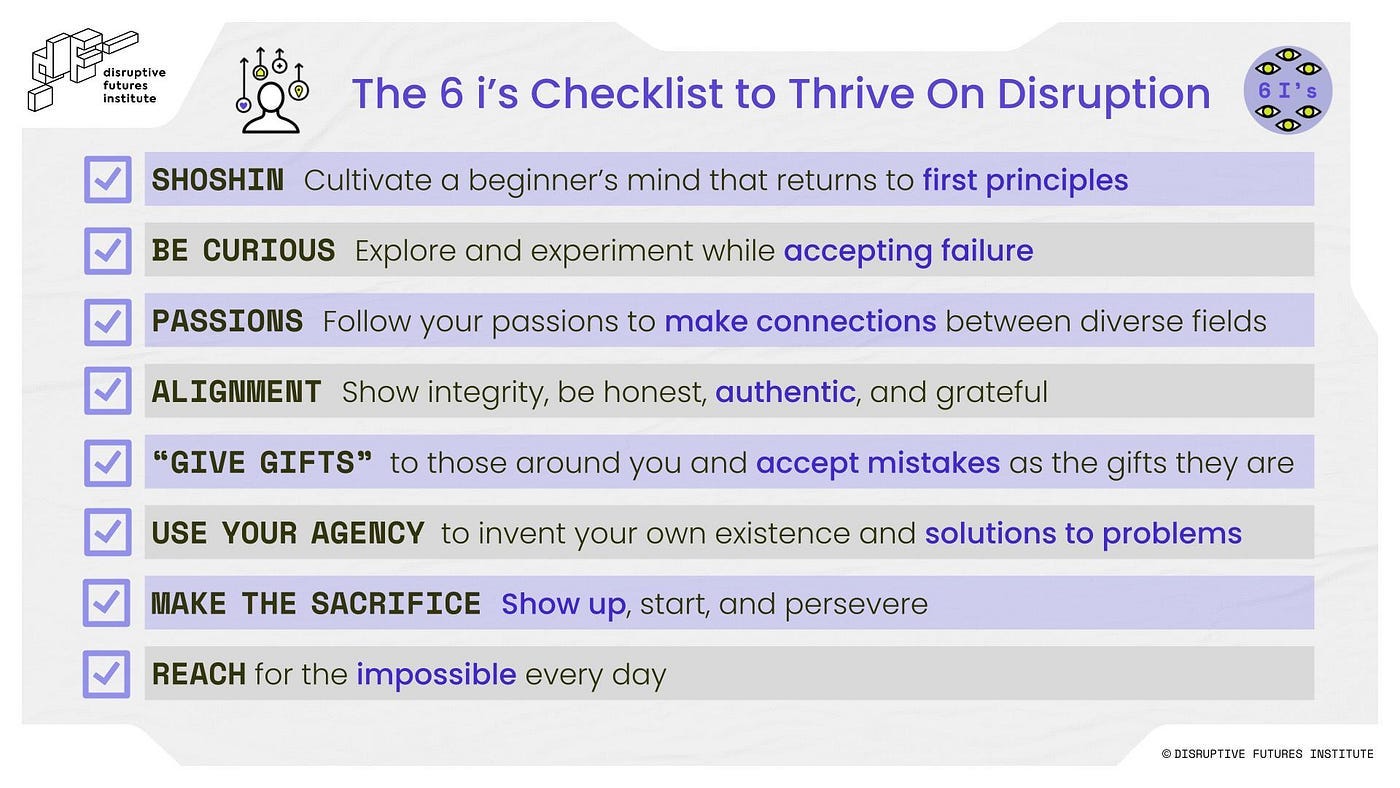
Intuition: Experiment and accept failure, particularly through reversible decisions.
Inspiration: Follow your passions and embrace emergence.
Imagination: Set aside space for relaxation and time for exploratory play.
Improvisation: See mistakes as gifts, and rather than taking for yourself, gift to others with authenticity and trust.
Invention: Cross-pollinate fields and embrace failure in yourself and your activities.
Impossible: Build from first principles, with a beginner’s mind.
Eastern Philosophy & Zen Buddhism: From 6 i’s to One Integrated “We”
When we aim to improve our comfort with impermanence, transformation, and change, we can learn from a set of tactics developed and refined over millennia. Eastern philosophy and Zen Buddhism can help us harness the power of the 6 i’s, and integrate this framework into one “We.”
For each of us as individuals and collectively as humankind, greater practice of shoshin (beginner’s mind) would improve our intuition, imagination, and capacity invention, while a comfort with mujō (impermanence) would aid our improvisation and enable us to achieve a more inspiring ikigai (flourishing or valuable life) than we ever thought possible.
Next, let’s dive into the detail behind these concepts.
Shoshin (初心): Beginner’s Mind
“In the beginner’s mind there are many possibilities, but in the expert’s mind there are few.” - Shunryu Suzuki, Zen Mind, Beginner’s Mind
From sho (初), meaning the first time, and shin (心), meaning mind and spirit, the Japanese concept of shoshin (beginner’s mind) articulates the value of approaching each situation with an open, accepting, curious mind.
While a beginner’s mind most obviously connects to the i’s of intuition and invention, it also aids its practitioners in improvisation by being in the moment and achieving the impossible from first-principles thinking.
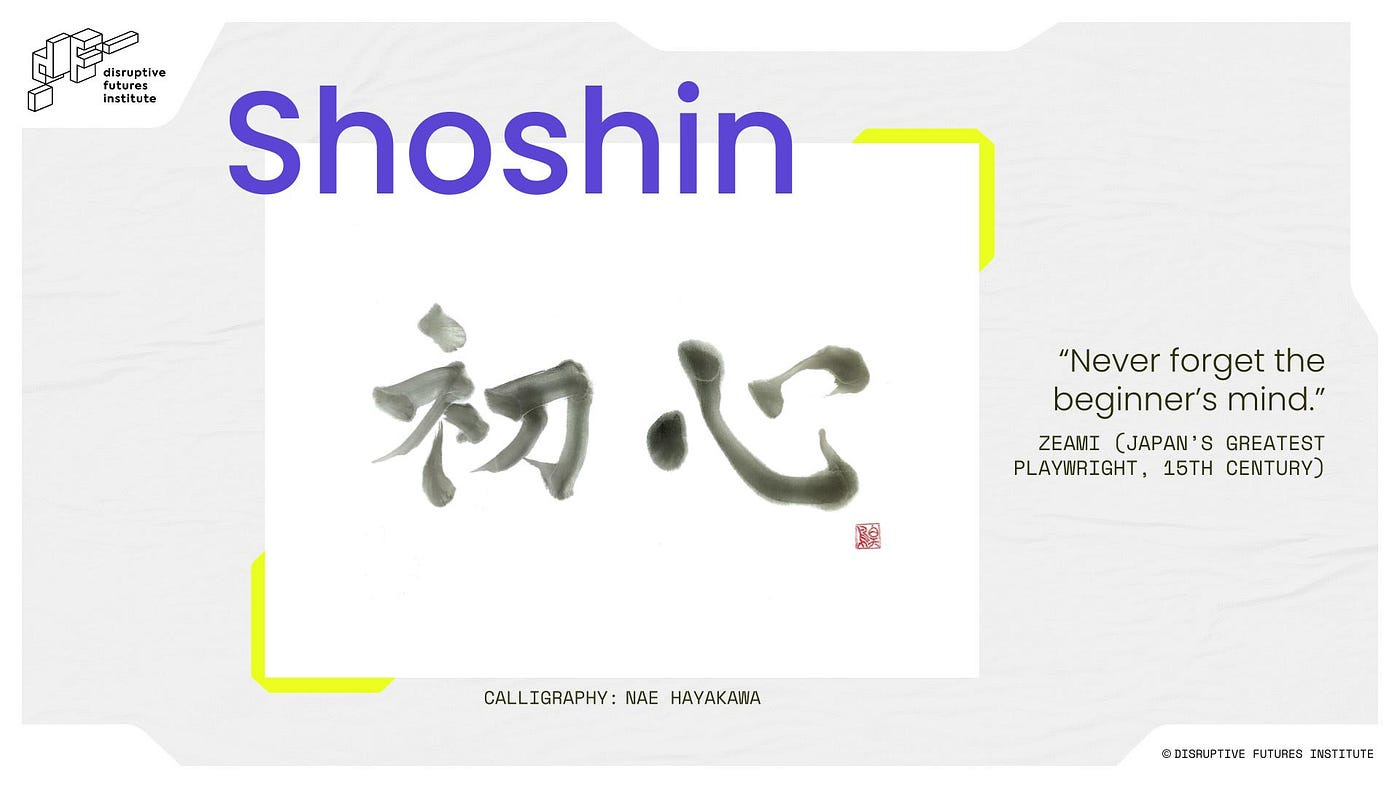
Shoshin is the Japanese concept of beginner’s mind, that articulates the value of approaching each situation with an open, accepting, curious mind. While a beginner’s mind most obviously connects to the i’s of intuition and invention, it also aids its practitioners in improvisation by being in the moment, and achieving the impossible from first-principles thinking — a problem-solving technique that teaches us to deepen our understanding by decomposing a problem or a thing into its most foundational elements.
As individuals and collectively as humankind, greater practice of shoshin would improve our intuition, imagination, and capacity for invention.
The Stages and Concepts of Shoshin
The three stages of shoshin are:
Zehi (是非) — Trial and error: Meaning “by all means,” which entails developing one’s skill through trial and error with a beginner’s mind.
Tokidoki (時々) — New challenges: Meaning “sometimes,” which implies that the journey to expert level requires continually taking on new challenges with a beginner’s mind.
Rougo (老後) — Continuous learning: Meaning “old age” or “retirement,” suggests that, with a beginner’s mind, there is no true retirement or end to learning.
The Stanford d.school for design thinking recommends its pupils assume a beginner’s mind, replacing assumptions with fresh eyes to increase the amount of empathy a designer can incorporate. Stanford’s d.school has compiled the following advice on assuming a beginner’s mind in business:
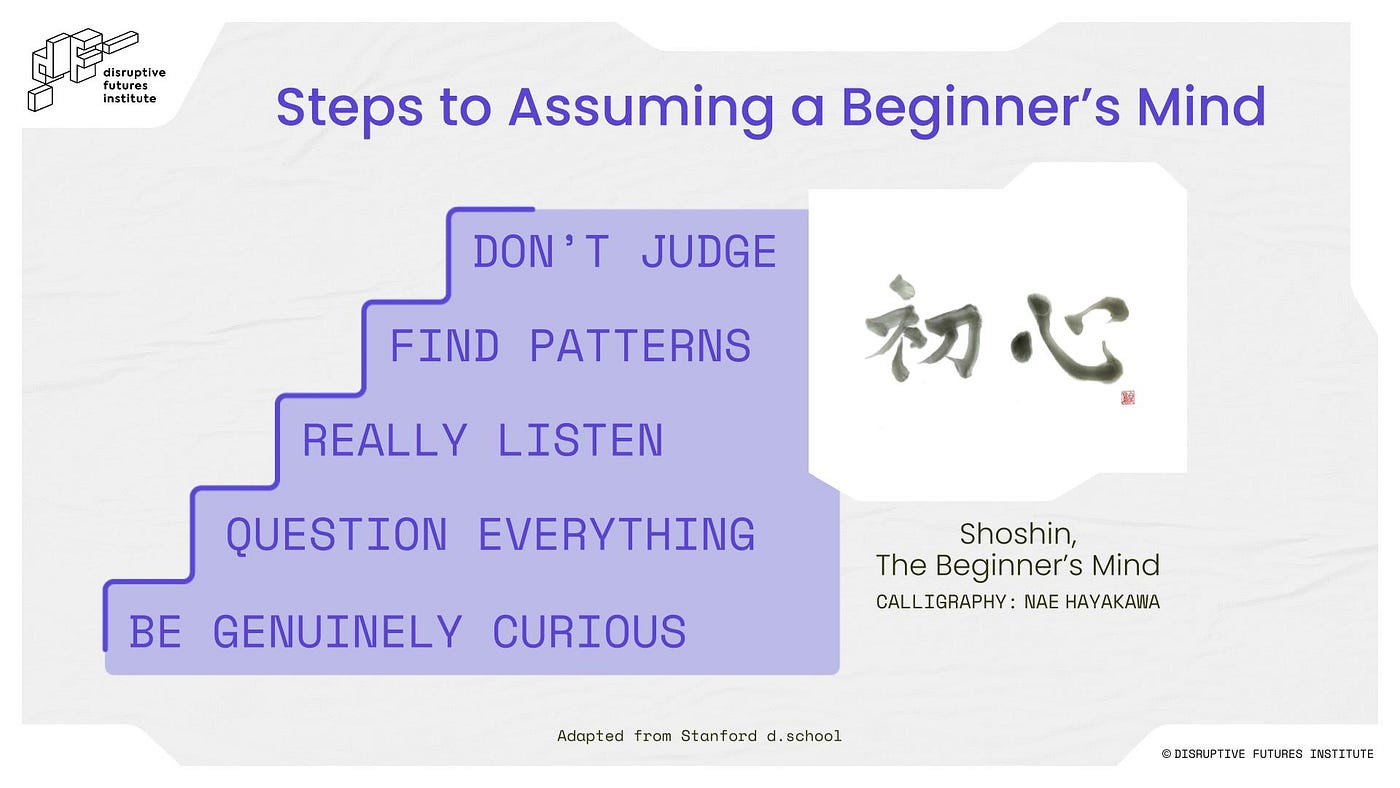
Don’t judge: Observe and engage at the present moment, without the influence of value judgements upon our actions, circumstances, decisions, or “issues.”
Question everything: Even question things you believe you already understand. Learn how the customer perceives the world, akin to how a child would ask “why?” after every question.
Be genuinely curious: Approach every situation with a posture of wonder and curiosity.
Find patterns: Seek threads and themes that emerge across interactions with users.
Really listen: Lose your agenda and simply let the scene soak into your psyche. Absorb what’s said to you, how it is said, without thinking about what you’re going to say.
These key concepts relate strongly to shoshin:
Chisoku (知足): Meaning “a contented mind with minimal needs.” A person who achieves chisoku is happy even if they must sleep on the street, while those who lack chisoku would complain even if they lived in a palace. Worldwide chisoku would help us all achieve greater sustainability, avoiding practices that destroy nature and our environment.
Muga (無我): Meaning “no ego,” suggests the path to satisfaction includes decreasing your individual desires.
Mushin (無心): Meaning “no mind” or “flow,” suggests the benefits that can arise from forming a pure mind without agenda or attachment, achieved by doing what you really love or through zazen (sitting meditation).
Ikigai (生き甲斐): A Valuable Life
“When we discover that the truth is already in us, we are all at once our original selves.” - Dōgen, the founder of Zen Buddhism
From iki (“to live”) and gai (“to value”), ikigai means “purpose in life” or “a life worth living.”
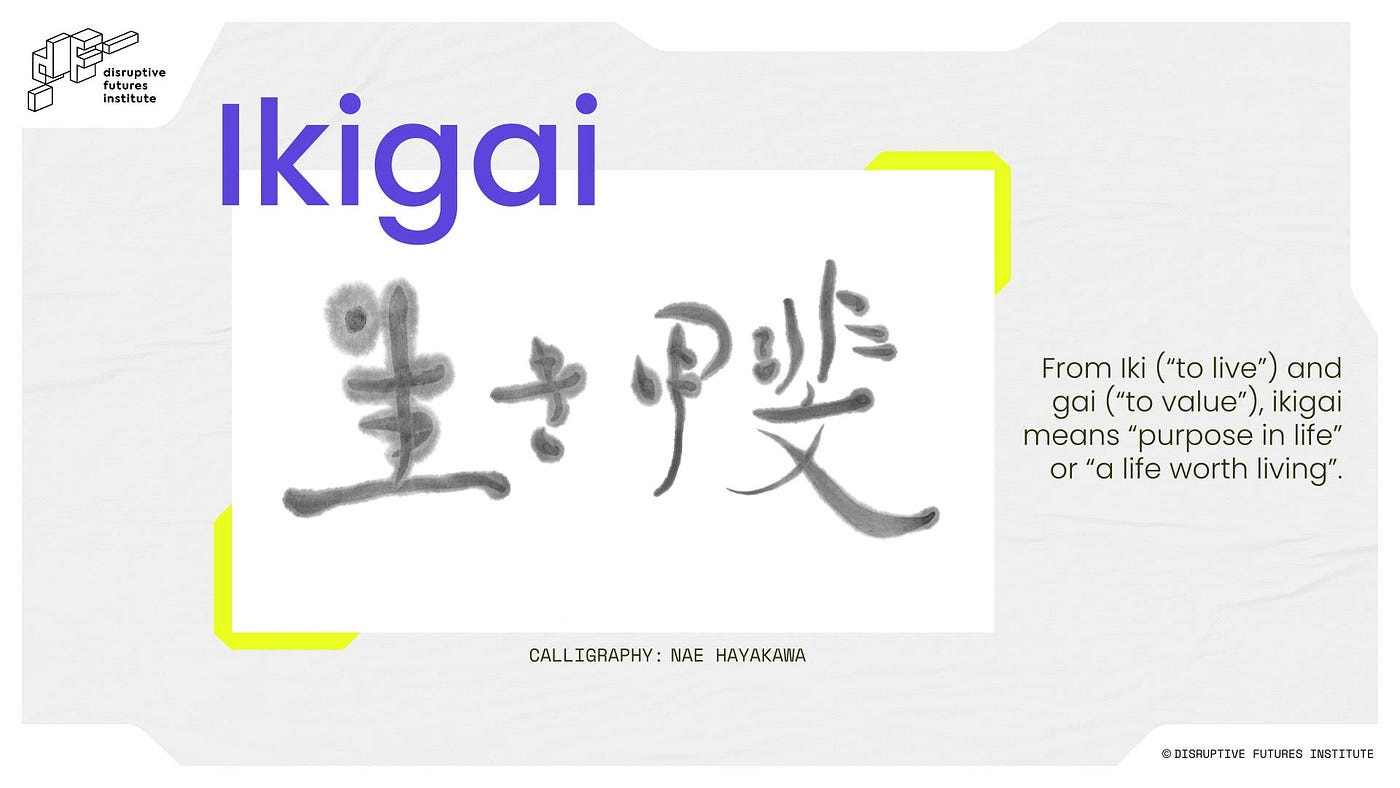
Ikigai means “purpose in life” or “a life worth living.” There is no greater inspiration to a life than finding and following its valuable path. In the West, ikigai is often used as a career-finding diagram. In Japan, ikigai is a way of life, more related to passion than profit. It’s not about career or activities, but the happiness that springs up naturally from within you.
In general, ikigai makes life easier to navigate during difficult times and unknown futures. If we can find our ikigai — a clearer fit between what one is good at and what the world needs — we will each experience greater flourishing.
Key Insights: Ikigai Is About Passion and Purpose
“There is nothing more for humans to live life fully than ikigai. Therefore, there is no cruelty greater than to deprive humans of their ikigai, and there is no greater love than to give humans their ikigai.” - Mieko Kamiya, the Mother of Ikigai Philosophy
As a psychotherapist, Mieko Kamiya was the first author in Japan to write about ikigai, publishing Ikigai ni tsuite (「生き甲斐について) in 1966. Kamiya taught that:
Personal: Ikigai is personal and unique for each person.
Consciousness: Ikigai gives people the feeling of aliveness.
Organic: Ikigai comes naturally from our environment; it is not something you look for.
Multiplicity: Several ikigai can be priorities in someone’s life.
Agency and fulfillment: Each of us can achieve the feeling of satisfaction of being alive (ikigai kan seizon jujitsukan; 生き甲斐感 生存充実感), building a unique world of order, peace, and balance into our mind.
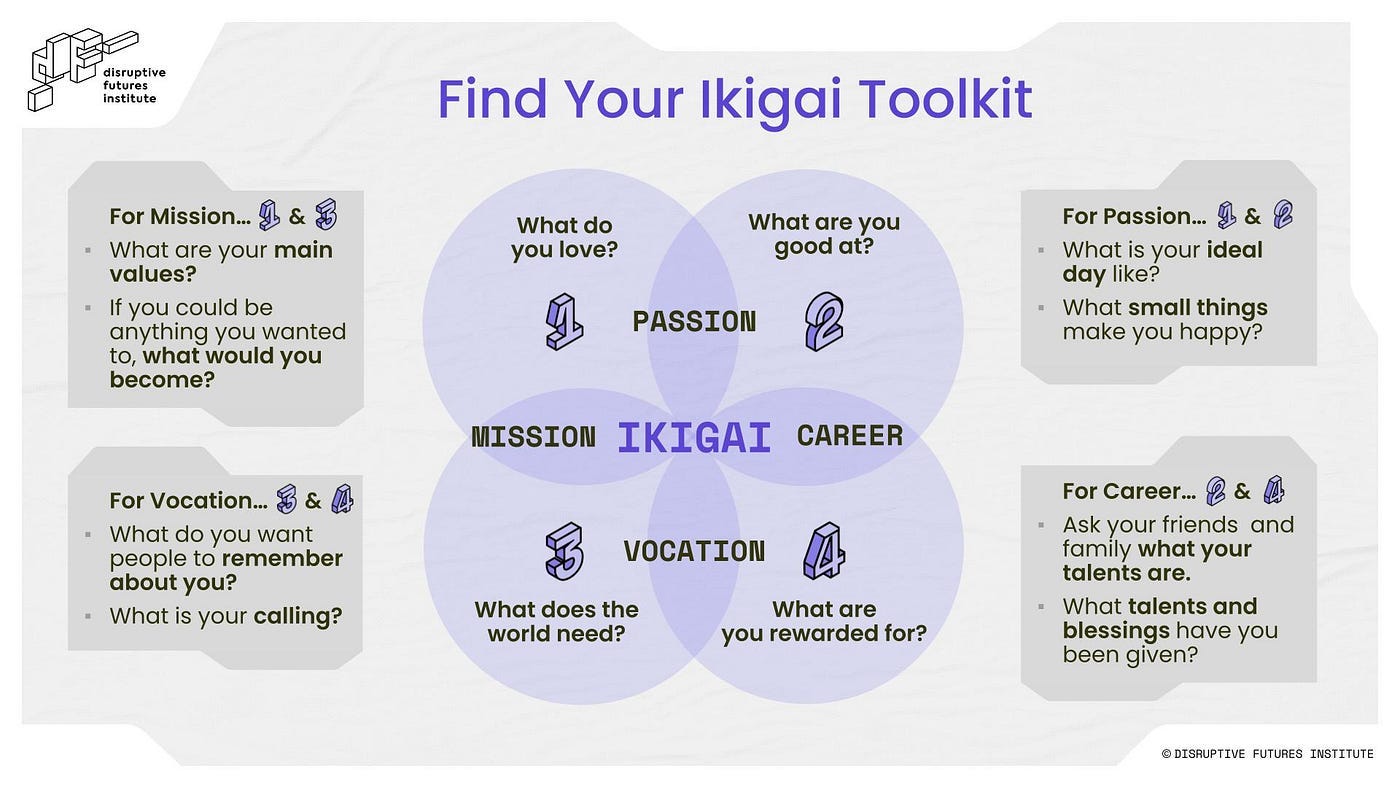
Find Your Ikigai Toolkit — A Possible Undertaking
If we can find our ikigai — a clearer fit between what one is good at and what the world needs — we would each experience greater flourishing. It leads to discussions of what sparks a satisfying life, a concept that changes over time as our bodies and life circumstances shift.
The Game to Find Your Ikigai
There are some questions which can help to find your ikigai, including:
What do you love?
What are you good at?
What do you get rewarded for?
What does the world need right now?
Mujō (無常): Impermanence
“Do not dwell in the past; do not dream of the future; concentrate the mind on the present moment.” - Buddha
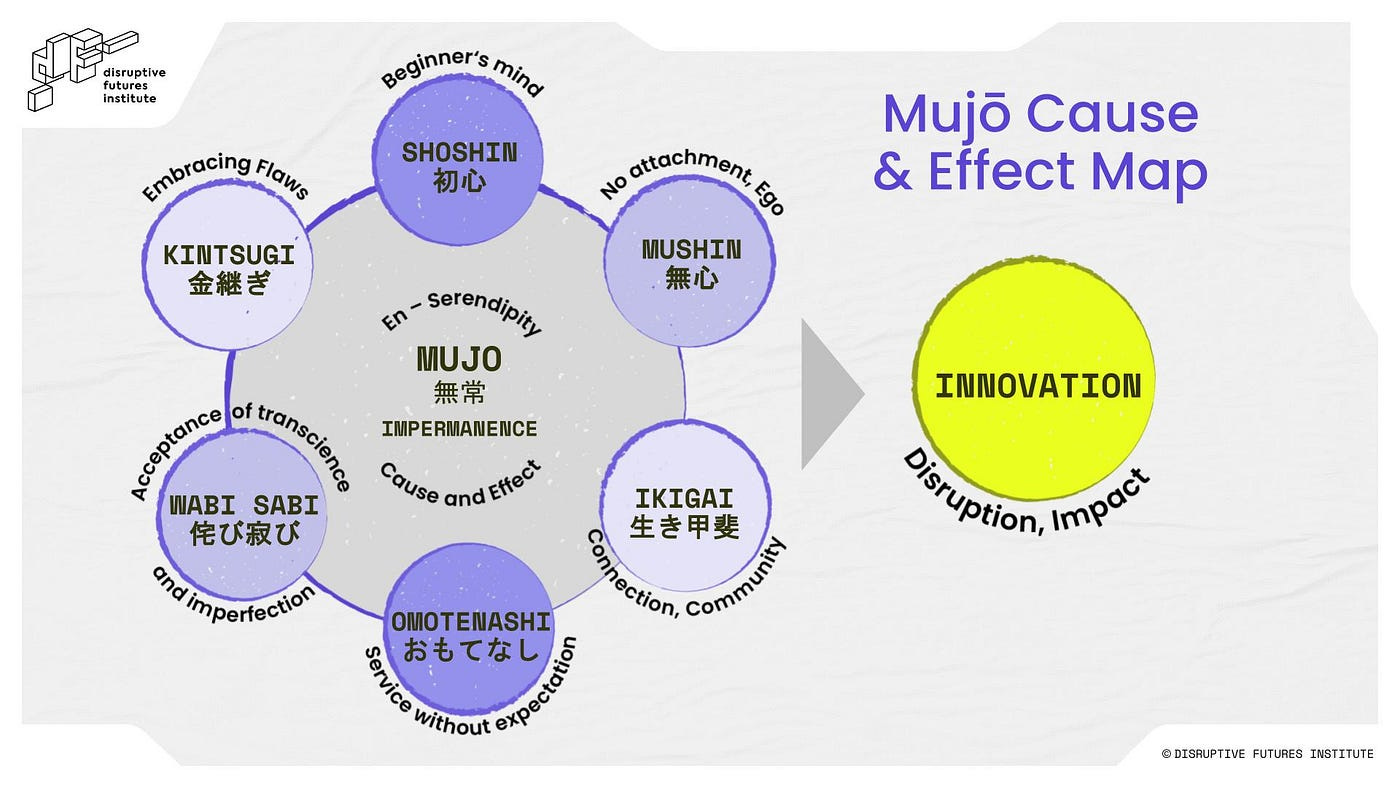
If you’re going to find your ikigai, you also need to understand and incorporate mujō — which teaches us about the profound importance of change and impermanence. Nothing lasts forever, and everything in our lives and the world around us is constantly changing. With respect to our 6 i’s, mujō aids most clearly in improvisation and invention by helping you see afresh.
The world is one constant disruption, where concepts such as stability, predictability, and certainty are just an illusion. Eastern philosophy not only understands the true nature of our world as impermanent, but also appreciates how to leverage on impermanence for innovation and impact.
From mu (無), meaning “nothing” and jo (常) meaning “stable” or “consistent,” the Buddhist concept of mujō (無常) means “impermanence.” Nothing lasts forever. We must therefore recreate our ikigai repeatedly as time marches on.
Everything in our lives and the world around us is constantly changing.
Wabi Sabi: The Beauty of Nature & Impermanence
Wabi sabi centers on the acceptance of transience and imperfection, an aesthetic of appreciating beauty that is imperfect, impermanent, and incomplete.
In Japanese Art, wabi sabi (侘び寂び) is the art of finding beauty in imperfection and natural decay. Counter to many artistic principles found in the West, wabi sabi’s aesthetics include:
Asymmetry
Roughness
Simplicity
Economy
Austerity
Modesty
Intimacy
Appreciation of both natural objects and the forces of nature
Things will always break and decay. There is beauty in that natural process. If your favorite plate breaks, why anguish with sentimental attachment when you can patch it with gold to create a new artistic expression?
The beauty of wabi sabi reminds us of the impermanence of nature as well as the disruptive nature around us.
Kintsugi: Implementing Wabi Sabi
The Japanese art of repairing broken pottery with gold is called kintsugi (金継ぎ), from kin (金), meaning “gold,” and tsugi (継ぎ), meaning “repair” or “inherit.” Built on the idea of embracing flaws and imperfections, kintsugi highlights breaks and scars, forming them into an even stronger, more beautiful piece of art.
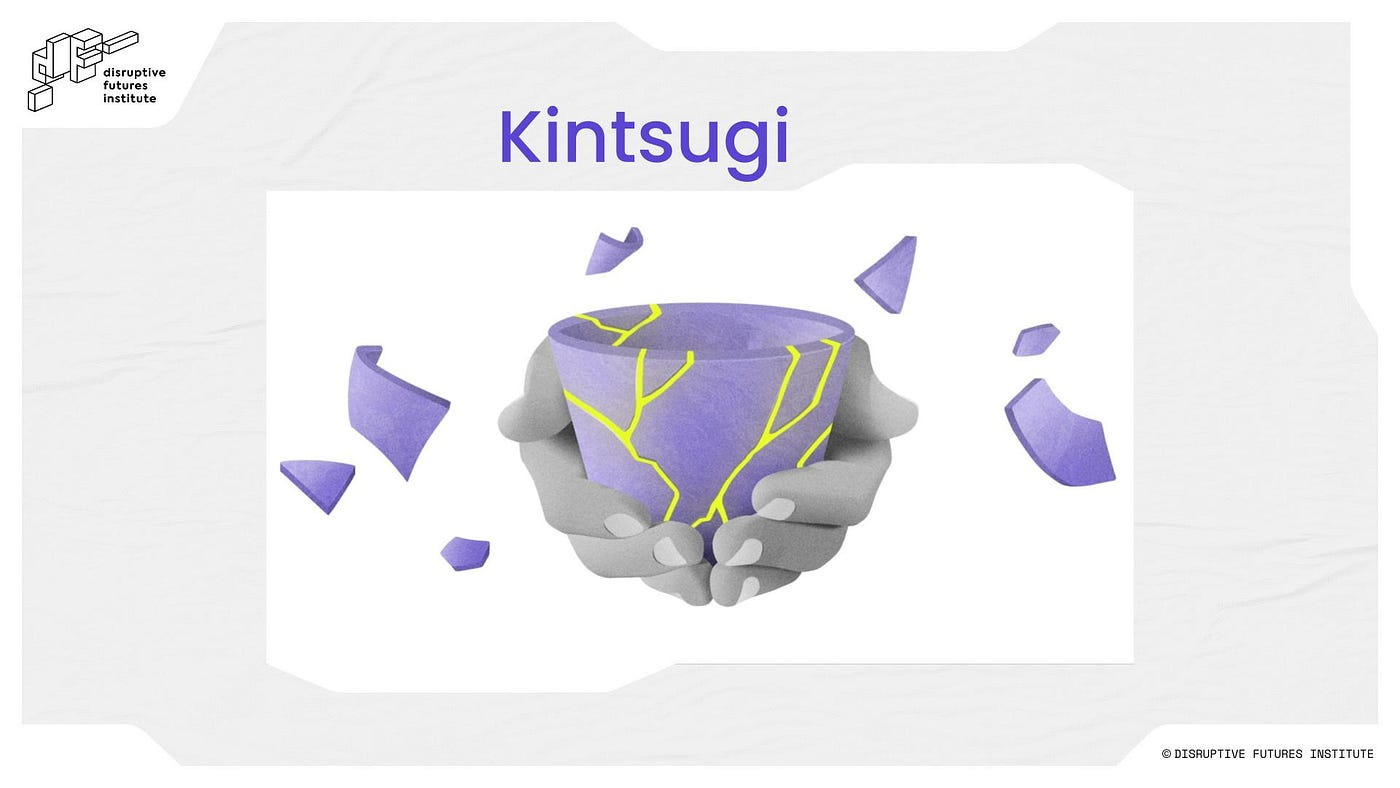
Kintsugi is the essence of innovation: in any situation — even those that distress us — we can improve our experience, making ourselves and our outcomes even stronger and more resilient. Where could you improve your experience and outcome by incorporating breaks and cracks?
Reframing Relevance with Zen Buddhism
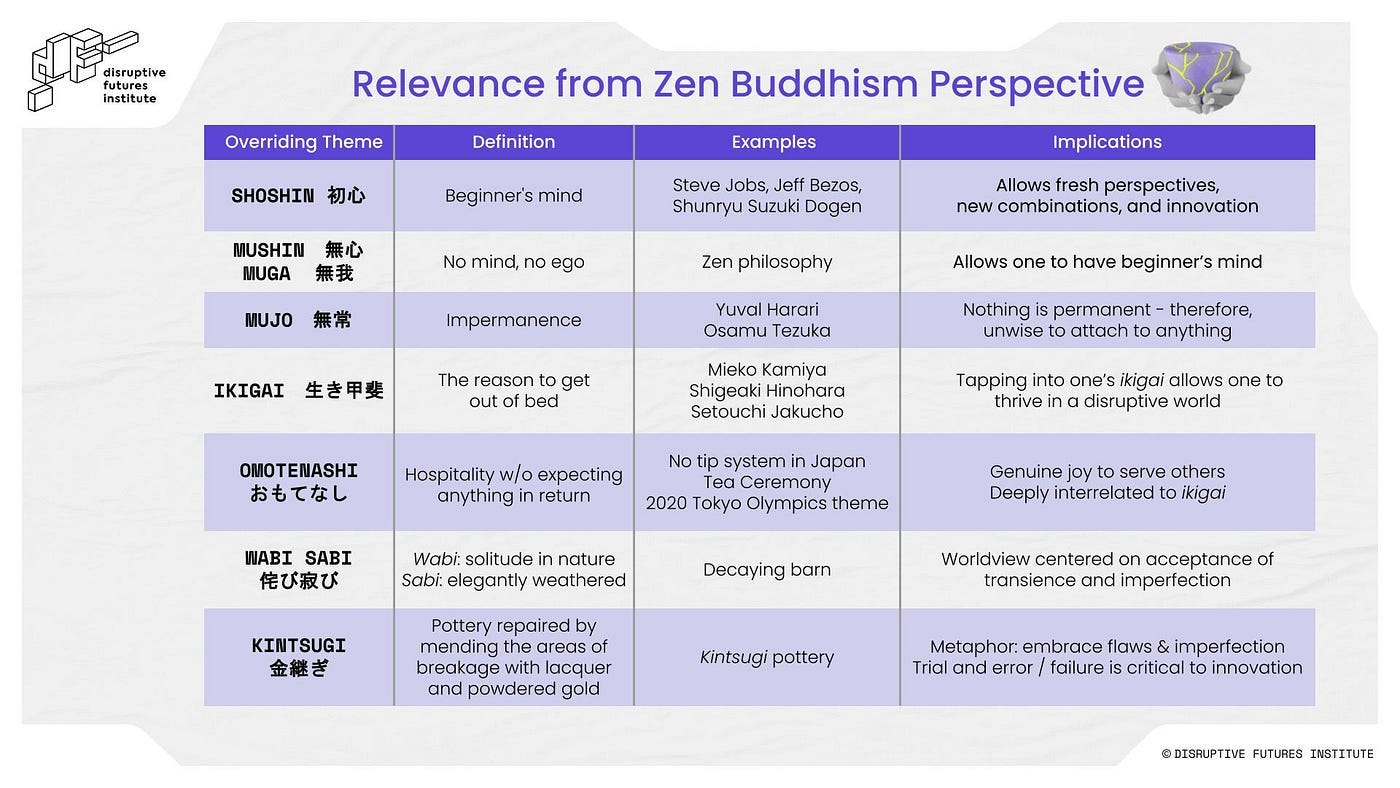
Eastern Philosophy & Relevance Checklist
In what ways can ikigai (purpose of life) be used beyond career-finding?
How does shoshin suggest that each situation be approached? And in what ways can this beginner’s mind be conducive to innovation and invention?
How can the principles of Zen Buddhism inspire fresh perspectives and new combinations?
Should change be considered surprising or unusual? Which Japanese term teaches us about the profound importance of change and impermanence?
What are some of the steps which can be taken to assume a beginner’s mind?
In what way does wabi sabi remind us of the impermanence of nature? How can wabi sabi (or even kintsugi) help us accept and challenge the West’s single-mindedness in relation to perfectionism? How can you apply the principles of wabi sabi in your own life or projects?
Muga means “no ego,” and mushin “no mind” or “flow.” In what ways do muga and mushin relate to the principles of shoshin?
Many of the concepts of Eastern Philosophy & Zen Buddhism can drive innovation and help with uncertainty. How will you use the superpowers of the beginner’s mind, serendipity, transience, impermanence, connection, and acceptance of flaws to be the instigator of disruption?
In what ways can it be beneficial to appreciate the true nature of the world as impermanent, as opposed to the idealized Western perception of stability and predictability?
How can meditation be used to gain clarity despite uncertainty and constant changes? Could you benefit from meditation?
Further Reading from the Disruptive Futures Institute: Citations and References
Suzuki, S. Zen Mind, Beginner’s Mind, Shambhala, 2011.
Dogen. Shōbōgenzō; Treasury of the True Dharma Eye, Shambhala, 2013.
Kamiya, M. Ikigai ni tsuite, 1966.
Mogi, K. The Little Book of Ikigai, Quercus, 2017.
García, H., and Miralles, F. Ikigai: The Japanese Secret to a Long and Happy Life, Penguin, 2017.
Spitz, R. Disrupt With Impact: Achieve Business Success in an Unpredictable World. Kogan Page: London, 2024.
Spitz, R., and Zuin, L. The Definitive Guide to Thriving on Disruption: Vol. I. Reframing and Navigating Disruption. Disruptive Futures Institute: San Francisco, 2022.
Spitz, R., and Zuin, L. The Definitive Guide to Thriving on Disruption: Vol. II. Essential Frameworks for Disruption and Uncertainty. Disruptive Futures Institute: San Francisco, 2022.
Spitz, R., and Zuin, L. The Definitive Guide to Thriving on Disruption: Vol. III. Beta Your Life: Existence in a Disruptive World. Disruptive Futures Institute: San Francisco, 2023.
Spitz, R., and Zuin, L. The Definitive Guide to Thriving on Disruption: Vol. IV. Disruption as a Springboard to Value Creation. Disruptive Futures Institute: San Francisco, 2023.
Spitz, R., and Nykänen, R. “An Existential Framework for the Future of Decision-Making in Leadership”. In T. Mengel (Ed.), Leadership for the Future: Lessons from the Past, Current Approaches, and Future Insights. Cambridge Scholars Publishing: Newcastle upon Tyne, 2021.
Spitz, R. “Techistentialism: Could Superstupidity Be as Dangerous as Superintelligence?”. Compass Magazine, December 2023: AI and Futures. Association of Professional Futurists (APF), December, 2023.
Spitz, R. “The Disruptive Futures Institute’s Frameworks, Tools, and Language [1/4]”. Disruptive Futures Institute Medium, August 8, 2025.
Spitz, R. “The Disruptive Futures Institute’s Frameworks & Methodologies [2/4]”. Disruptive Futures Institute Medium, August 8, 2025.
Spitz, R. “The Toolkits of the Disruptive Futures Institute [3/4]”. Disruptive Futures Institute Medium, August 8, 2025.
Spitz, R. “Language & Core Concepts of the Disruptive Futures Institute [4/4]”. Disruptive Futures Institute Medium, August 9, 2025.
Learn the Language of Disruption with the Disruptive Futures Institute’s Publications
The language of disruption is rooted in action. The concepts and terms explored throughout this list represent the foundational core of the Disruptive Futures Institute’s lexicon. But it’s just the beginning.
Throughout The Definitive Guide to Thriving on Disruption and Disrupt With Impact: Achieve Business Success in an Unpredictable World, we dive into these concepts in great depth, connecting the dots between them and numerous real-world case studies and practical applications. If you’re ready to master the language of disruption, read more about our publications:
The Definitive Guide to Thriving on Disruption: A comprehensive four-volume series packed with proprietary frameworks, tools, and strategies.
Disrupt With Impact: Achieve Business Success in an Unpredictable World: Roger Spitz’s latest bestseller, your compass for exploring the uncharted waters of the future. Disrupt With Impact is the winner of the 2024 Chanticleer International Best Book Awards, Harvey Chute Category Winner (Non-Fiction Business & Enterprise), winner of the 2024 Foreword Indies Book of the Year Award — Bronze, Business & Economics, and was named finalist in the 2025 International Book Awards (IBA) for both General Business and Management & Leadership.
Through pioneering frameworks developed in Disrupt With Impact, Roger Spitz’s work is redefining how organizations and leaders navigate disruption and unpredictability. His innovative models, such as the AAA Framework (Antifragile, Anticipatory, Agility), the UN-VICE paradigm, and Techistentialism, provide actionable strategies for thriving amid systemic, nonlinear change and the growing influence of AI. From futures studies and systems thinking to sustainable development and foresight strategy, Roger Spitz’s books serve as a trusted compass for staying relevant and resilient amid systemic change.
Both The Definitive Guide to Thriving on Disruption and Disrupt With Impact: Achieve Business Success in an Unpredictable World are now available to order, on Amazon or wherever books are sold.
The Disruptive Futures Institute’s publications are now available everywhere books are sold.
Wow, the part about embracing impermanence as a superpower really stood out to me; it's so insightful how this echoes the constant need for dynamic adaptibility we see in cutting-edge AI developement, moving beyond static predictions.