

“These are not just theoretical constructs but practical strategies that leaders can employ to create sustainable value in times of uncertainty.” — Dimitris Dimitriadis, Member Researcher at Special Secretariat for Strategic Foresight, Presidency of the Greek Government
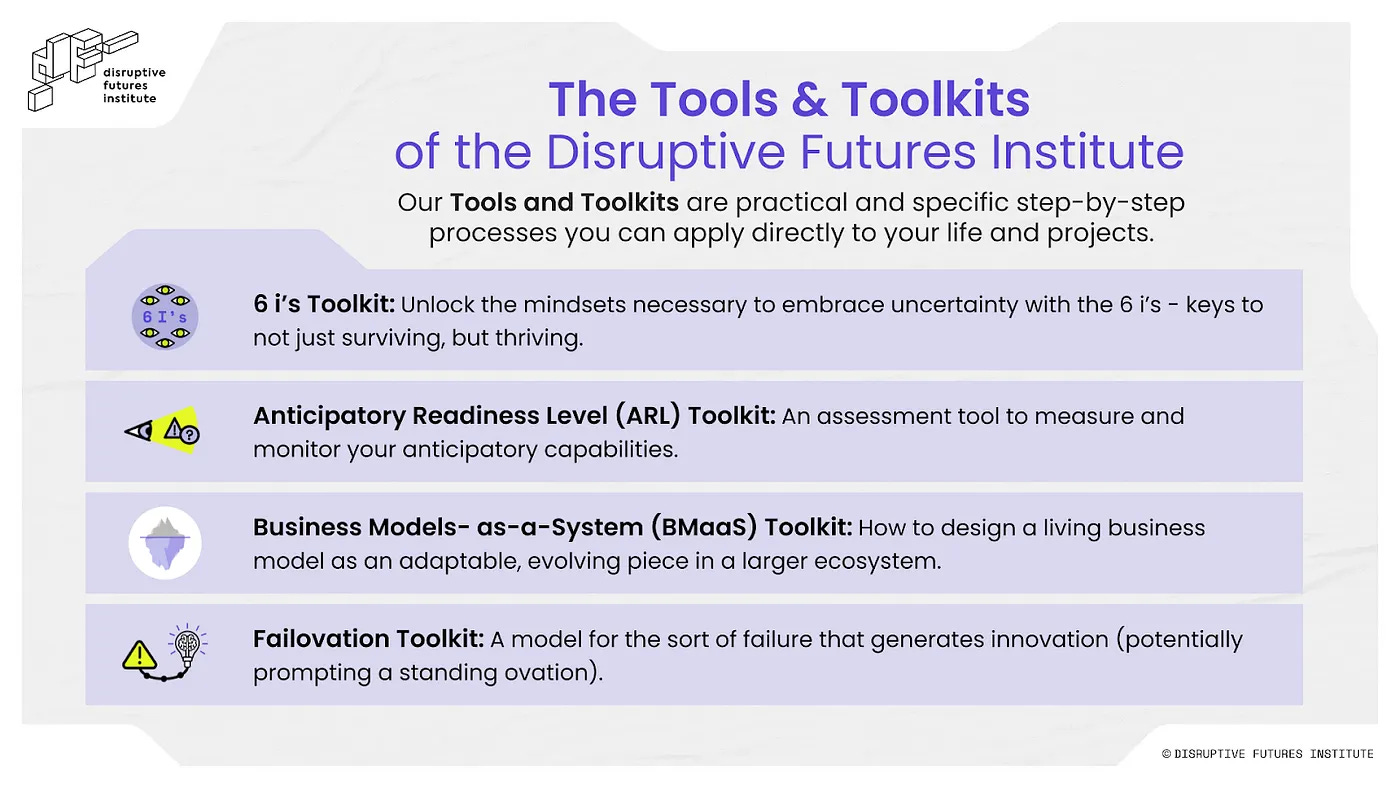
The Disruptive Futures Institute’s Tools are practical step-by-step processes you can apply directly to your life and projects.
By leveraging these practical toolkits — which support our broader frameworks — you’ll be able to make sense of our complex, nonlinear, unpredictable world. Using these tools, changemakers will be better equipped with tactical knowledge and skills to immediately build resilience and drive change by experimenting with more agency and imagination.
This article provides a high-level overview of the Disruptive Futures Institute’s toolkits, which support our foundational frameworks. To explore the toolkits and frameworks in greater depth, refer to the books, publications, articles, education programs, and keynote talks by Roger Spitz and the Disruptive Futures Institute. These resources outline our proprietary methodologies, including through step-by-step guidelines, practical applications, real-world examples, and case studies. We hope that this overview provides a useful introduction to themes and approaches of the Disruptive Futures Institute.
Introducing the Disruptive Futures Institute’s Toolkits
Today, the lines between the present and future are becoming blurred. The choices we make about how we will engage with the future intimately affect the present. These toolkits are designed to help you make the most of today, for the benefit of both present and future realities as they intersect.
The 6 i’s Toolkit: Unlock the mindsets necessary to embrace uncertainty with the 6 i’s — keys to not just surviving, but thriving. The 6 i’s are Intuition, Inspiration, Imagination, Improvisation, Invention, and Impossible.
Anticipatory Readiness Level (ARL) Toolkit: An assessment tool to measure and monitor your anticipatory capabilities.
Business Models-as-a-System (BMaaS) Toolkit: How to design a living business model as an adaptable, evolving piece in a larger ecosystem.
Failovation Toolkit: A framing for the sort of failure that generates innovation (potentially prompting a standing ovation).
It’s Time to Update our Understanding of Disruption
This article is a part of a larger series that shares updated knowledge and understanding of the Disruptive Futures Institute’s work on change and uncertainty through our frameworks, tools, and concepts:
The first article, titled “The Frameworks, Tools, and Language of the Disruptive Futures Institute”, provides an “executive summary” overview of the purpose and impact of the Disruptive Futures Institute’s work and contributions.
In article 2, titled “The Disruptive Futures Institute’s Frameworks & Methodologies”, we outline our proprietary structures and techniques. These foundational FRAMEWORKS help you understand, anticipate, and navigate change — as well as drive and thrive on disruption.
In this article 3, titled “The Toolkits of the Disruptive Futures Institute”, we illuminate specific step-by-step toolkits you can apply directly to your life and projects. These TOOLS are applicable standalone, but often support our overarching frameworks.
In article 4, titled “Language & Core Concepts of the Disruptive Futures Institute”, we define the words we use to describe the current state of our complex and nonlinear world. We help you master the LANGUAGE of change, uncertainty, and unpredictability.
1. 6 i’s TOOLKIT
What are the 6 i’s?
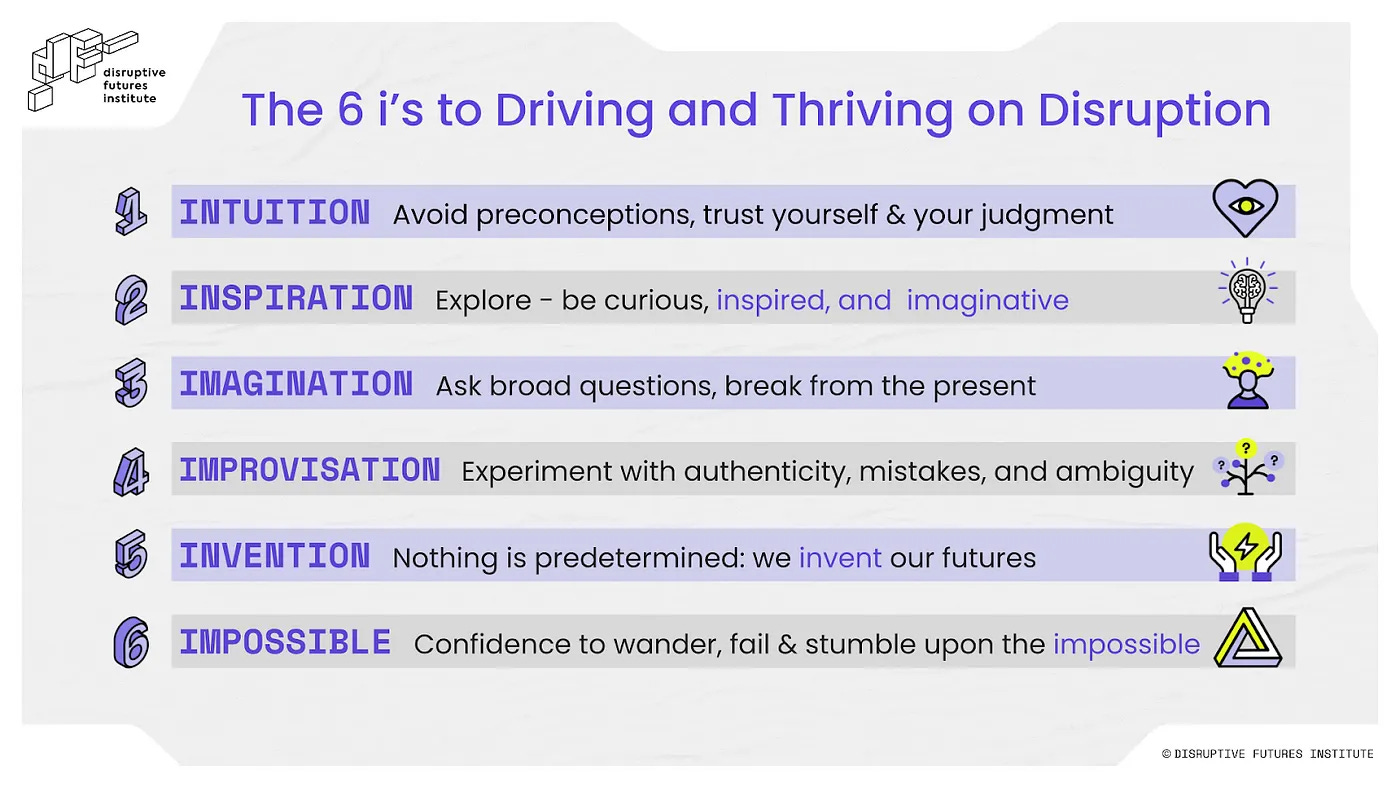
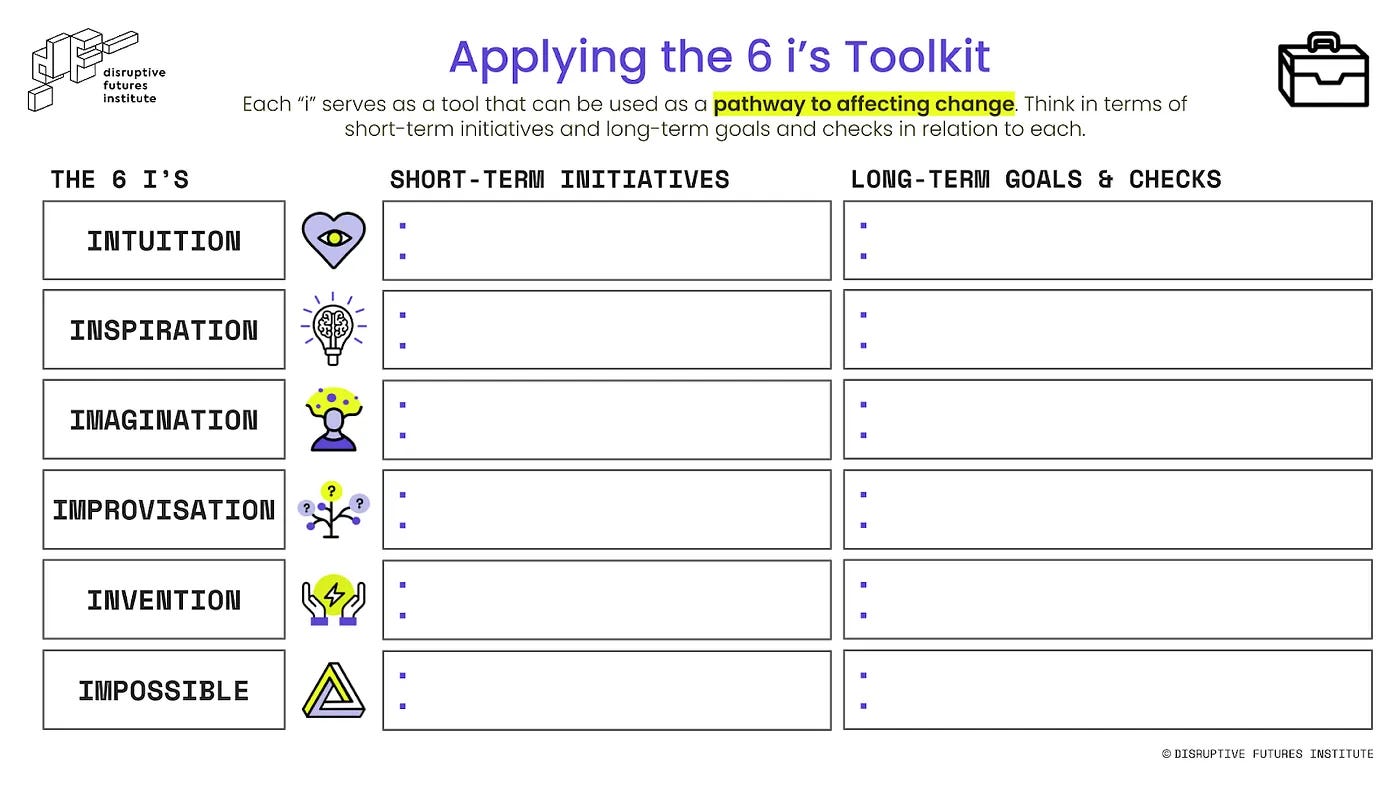
Our 6 i’s to thriving on disruption — Intuition, Inspiration, Imagination, Improvisation, Invention, and Impossible — comprise a toolkit that provides perspectives to investigate and create your preferred futures, and drive disruption to your advantage.
The 6 i’s Toolkit, Explained
The language of disruption is rooted in action. Unlock the mindsets necessary to embrace uncertainty with the 6 i’s — keys to not just surviving, but thriving:
Intuition: Explore ambiguous environments without straightforward answers by tapping into curiosity, avoiding preconceptions.
Inspiration and Imagination: Encompassing broader futures, be inspired by asking profound questions and breaking from the present.
Improvisation: Experiment through improvisation, mistakes, and ambiguity, seeking authenticity.
Invention: Nothing is predetermined. We have an open canvas to create our futures.
Impossible: With the courage to wander and fail, you can stumble upon — and achieve — the impossible.
These are our 6 i’s to thriving on disruption: Intuition, Inspiration, Imagination, Improvisation, Invention, Impossible.
The 6 i’s should not be considered as separate or stand-alone. They mutually reinforce each other as they interact to bring you novel experiences and exposure to new ideas. We can learn to exercise our “impossibility muscles” to form new mental models, and develop capabilities to achieve the impossible. Most importantly, harnessing the 6 i’s will allow serendipity through the emergence of new ideas, where logic, analysis, and strategy may fall short.
Why We Developed the 6 i’s Toolkit
As the pace of change accelerates and uncertainty prevails, the tools and techniques used by foresight strategists and futurists are gaining global popularity among leaders and changemakers of all types who are interested in preparing themselves and their organizations for the future.
The surprise you experience from disruption is inversely tied to your preparedness and willingness to question. An anticipatory mindset diminishes astonishment when change occurs. By recognizing the duality of disruption, thinking critically, and questioning assumptions, we reduce shocks and uncover opportunities.
How do we rise above resilience to actually thrive on disruption? In the quest to make an impact, how can we have a passionate, effective, and flourishing experience?
The 6 i’s in Quotes, Reviews & Citations
“One framework Spitz introduces is the “6 i’s” toolkit — Intuition, Inspiration, Imagination, Improvisation, Invention, and the Impossible — as essential for thriving and creating your preferred futures in an uncertain world.” — Chris Mayer, Director of Philosophy, United States Military Academy at West Point, Futures Empowered
“The depth of Spitz’s thinking shines through his discussion of tools like horizon scanning, anticipatory governance, and the 6 i’s framework (intuition, inspiration, imagination, improvisation, invention, and impossible).” — Dimitris Dimitriadis, Member Researcher at Special Secretariat for Strategic Foresight, Presidency of the Greek Government
“The second chapter focuses on the changes in mindset needed to confront disruption, and Spitz introduces his “6 is” as one mnemonic. The chapter includes many other examples, including inspiring stories from other leaders (including Arthur Clarke’s three laws, which if you don’t know them are worth looking up).” — Charles Brass, Chair, The Futures Foundation, Future News, on Disrupt With Impact
“As disruption evolves from a series of episodic events to a constant, we must learn to thrive by mastering its language.” — Roger Spitz with Lidia Zuin, quote from The Definitive Guide to Thriving on Disruption: Vol. II. Essential Frameworks for Disruption and Uncertainty
“It is the players who challenge assumptions and ask new questions that beat incumbents in innovation.” — Roger Spitz and Lidia Zuin, “How Science Fiction Can Help Chart Your Company’s Path Forward”, Inc.
Learn More About the 6 i’s
Disrupt With Impact, Chapter 2: Embracing new mindsets for thriving on uncertainty and disruption, shares how we can use the 6 i’s to cultivate new mindsets and capabilities crucial for thriving amidst ambient disruption.
On the IBM Business of Government: Special Leadership Edition with host Michael Keegan, Roger Spitz explains how we can use the 6 i’s to stay relevant.
In The Definitive Guide to Thriving on Disruption, Volume II: Essential Frameworks for Disruption and Uncertainty, Roger Spitz with Lidia Zuin explore the 6 i’s in great detail, across a number of chapters with applied case studies and insights from Eastern Philosophy & Zen Buddhism to Science Fiction.
2. ANTICIPATORY READINESS LEVEL (ARL) TOOLKIT
What is the Anticipatory Readiness Level (ARL)?
The Anticipatory Readiness Level (ARL) is a tool to measure and monitor your anticipatory capabilities, from Being human (ARL 1) to Agency and implementation (ARL 6). The assessment tool can be used as a means to quantify or measure the level of proficiency in relation to developing an anticipatory mindset and capabilities.
Why We Developed the Anticipatory Readiness Level (ARL)
NASA’s Technology Readiness Level (TRL) was originally created in the 1960s to evaluate space technologies. Today, it is used to quantify the maturity of a technology’s development from 1 to 9. The higher a technology ranks, the more technically developed and qualified it is.
Inspired by NASA’s TRL framework, we developed the Anticipatory Readiness Level (ARL) as a tool to measure and monitor anticipatory capabilities. ARL is based on a scale from 1 to 6. The higher the rank, the more developed the anticipatory capabilities. Using the ARL framework can help you identify gaps to prompt continued learning and capacity building for foresight.
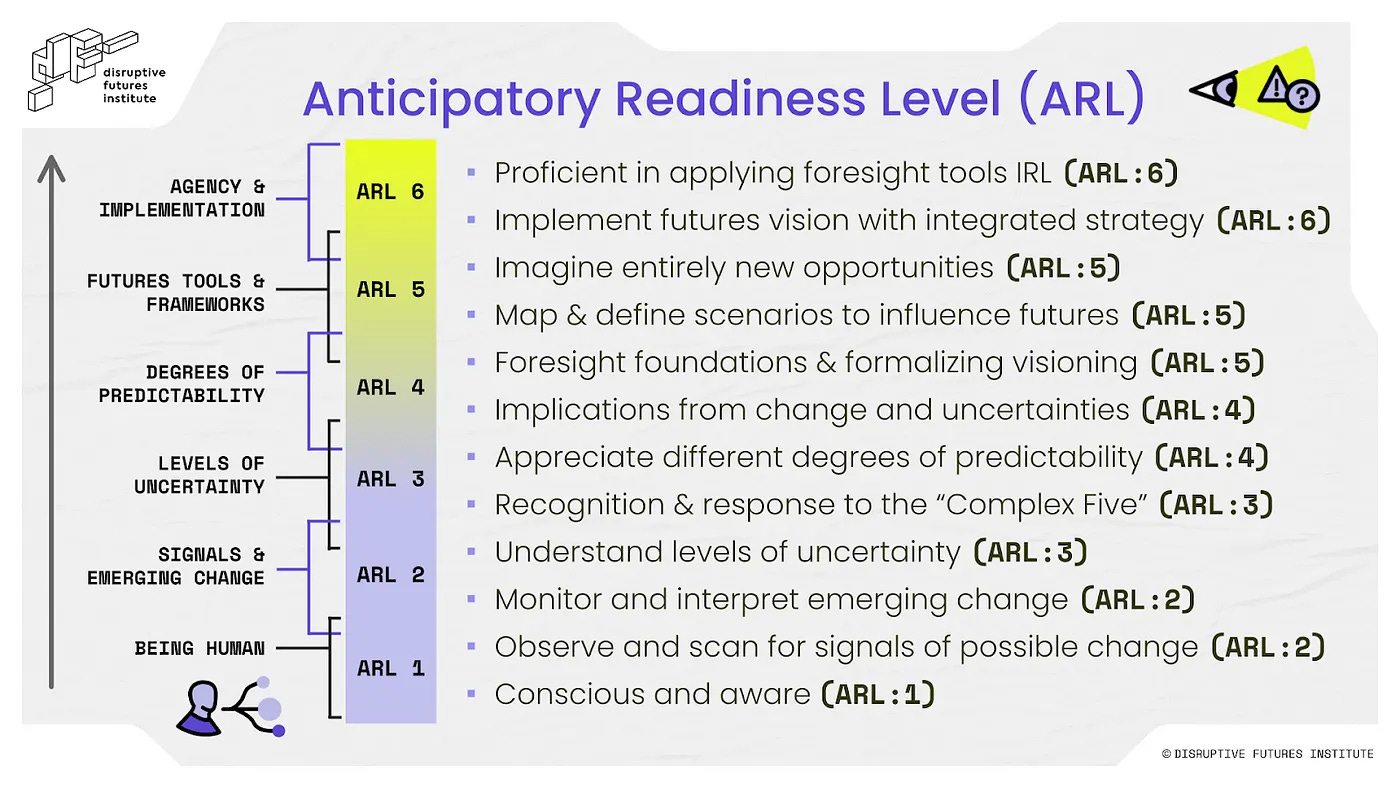
Starting from the highest level of the scale:
Agency and implementation (ARL 6): We can proficiently apply anticipatory tools in real life (IRL) and have experience implementing integrated foresight strategies.
Futures tools and frameworks (ARL 5): We are accustomed to imagining new opportunities and mapping broad scenarios that allow us to influence our preferable futures. We can apply frameworks to formalize visioning and develop usable scenarios.
Degrees of predictability (ARL 4): We can assess different degrees of predictability to help evaluate next-order impacts from change.
Levels of uncertainty (ARL 3): We can recognize the “Complex Five,” challenge what we know, and have a sense of how to respond according to the level of uncertainty.
Signals and emerging change (ARL 2): We are constantly alert to anticipate potential threats as a survival mechanism. This level of anticipatory readiness goes beyond innate reflexes as we systematically scan for and interpret signals of possible change.
Being human (ARL 1): Anticipation is evident in nature. Simply being human means that we are conscious and aware of what is required to survive tomorrow.
“Being anticipatory is opening the doors of the future.” — Roger Spitz, quote from The Definitive Guide to Thriving on Disruption: Vol. II. Essential Frameworks for Disruption and Uncertainty
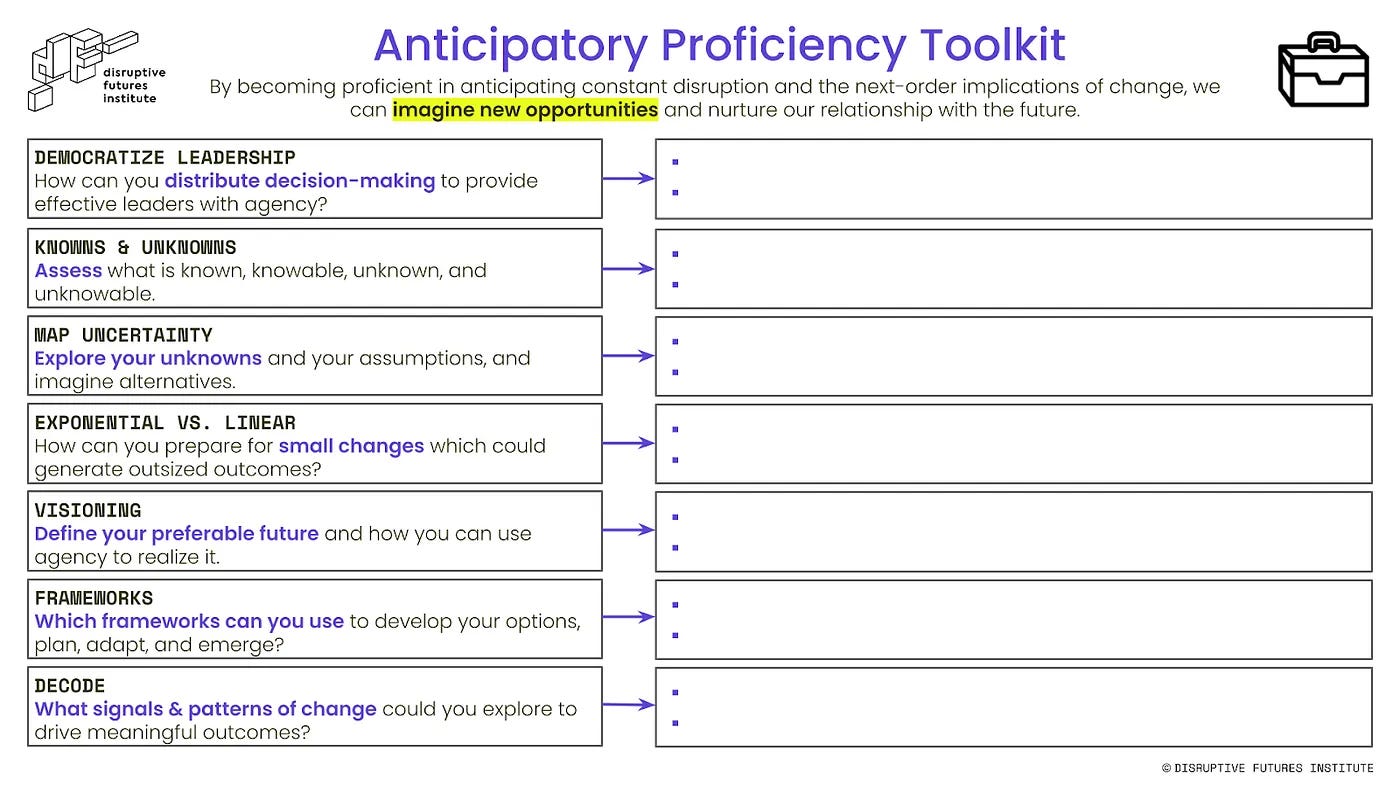
Learn More About Anticipatory Readiness Level
In The Definitive Guide to Thriving on Disruption, Volume II, Chapter 5: “Anticipatory: The Capacity to Prepare for Constant Disruption”, authors Roger Spitz with Lidia Zuin introduce the ARL.
In Disrupt With Impact, Roger Spitz explores the ARL in the context of tools you can use to navigate and anticipate disruption.
3. BUSINESS MODELS-AS-A-SYSTEM (BMaaS) TOOLKIT
“Ecosystems have the power to positively disrupt economic systems.” — Roger Spitz with Lidia Zuin, quote from The Definitive Guide to Thriving on Disruption: Vol. IV. Disruption as a Springboard to Value Creation
What are Business Models-as-a-System?
System-level innovation acknowledges how everything is interconnected. In perpetually evolving environments, there is an inherent need to act and respond with novel options.
Hardwired models only change periodically — if at all. To be relevant in today’s UN-VICE world (UNknown, Volatile, Intersecting, Complex, Exponential), business models must adapt to paradigm shifts with agility. Dynamic business models support experimentation, catalyze innovation, and create shared value for the entire ecosystem, providing deeper complementarities between participants.
We define these ecosystems as Business Models-as-a-System (BMaaS), which emerge thanks to three key elements: Eco, Co, and Ecosystems.
“Eco” is Eco-friendly: New opportunities, jobs, and industries for those creative enough to shift to more sustainable ecosystems across agriculture, energy, transportation, real estate, retail, and more.
“Co” refers to Collaboration: Co-created, Co-evolving, Connected, and Consumers.
“Ecosystems” live and breathe dynamic changes: They are systemic, in flux, interdependent, and generate feedback loops to emerge with something new.
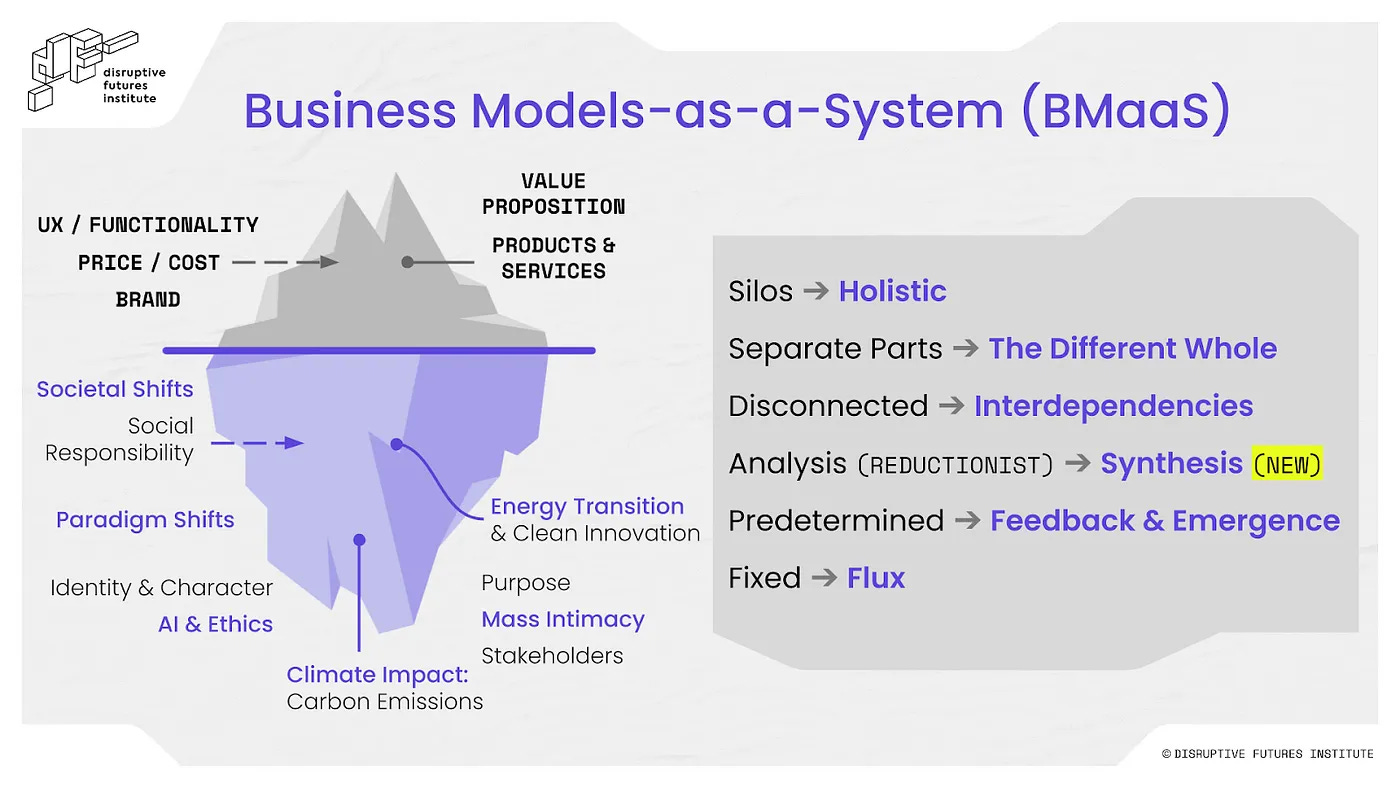
Business models as systems are needed to respond to the deeply complex challenges of today’s world. Traditional business models don’t tend to change — or only do so periodically. BMaaS are constantly adapting to surrounding ecosystem shifts. Collaborative ecosystems support novel explorations and synthesize innovation. BMaaS are interconnected and constantly evolving — it’s alive, it’s Eco, it’s Co, it’s an ecosystem, and it’s a system.
Similar to living organisms, these living BMaaS change creatively within their ecosystems as they unfold.
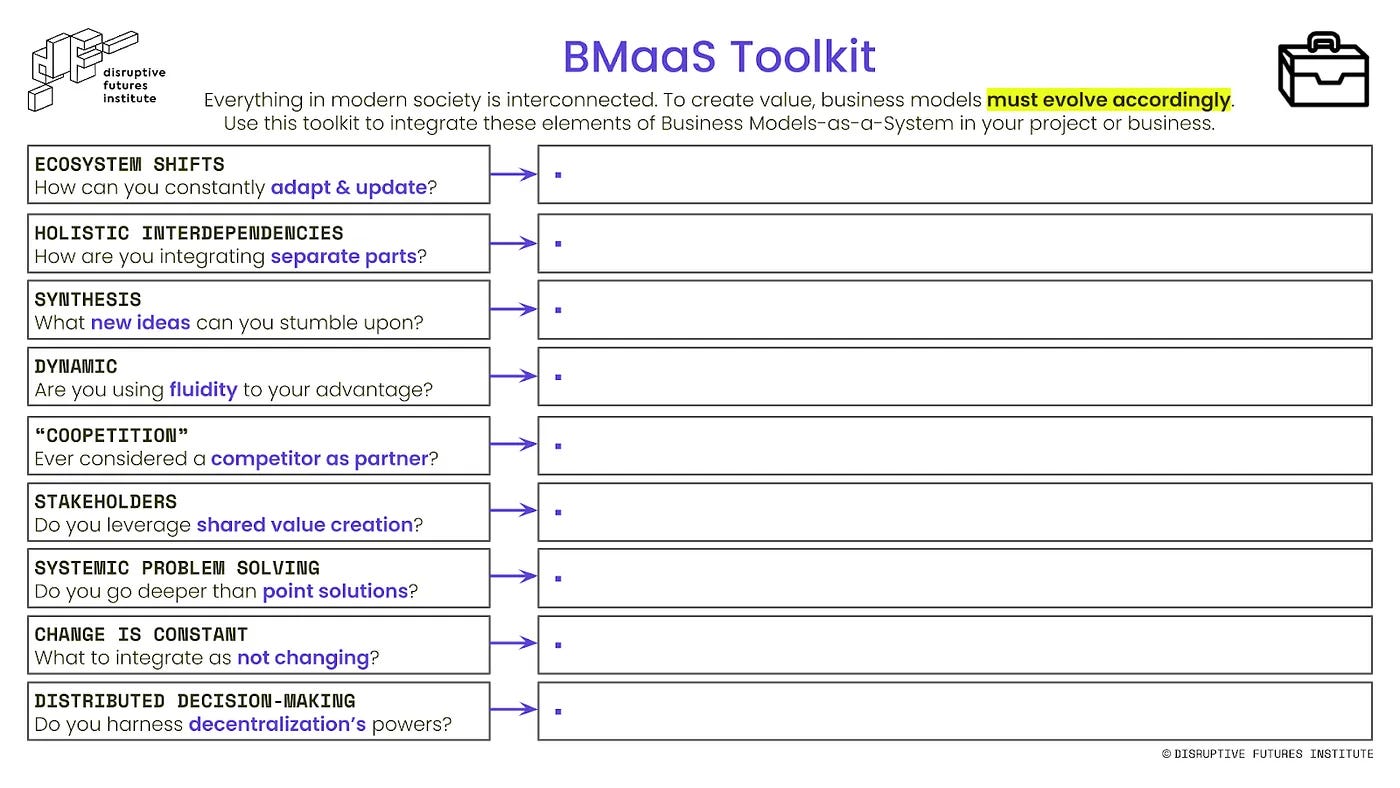
Learn More About Business Models-as-a-System (BMaaS)
Roger Spitz describes how BMaaS can fit into the broader ClimateTech ecosystem in illuminem article, “ClimateTech: system innovation (versus point solutions)”
The Definitive Guide to Thriving on Disruption, Volume IV: Disruption as a Springboard for Value Creation, devotes a chapter to the exploration of BMaaS: “Chapter 3. Ecosystem Innovation: Platform Evolution 2.0 & Business Models-as-a-System (BMaaS)”
Roger Spitz unpacks how BMaaS can help business leaders innovate and address complex challenges in Disrupt With Impact: Achieve Business Success in an Unpredictable World.
4. FAILOVATION TOOLKIT
What is Failovation?
Failure on an organizational scale can feel even worse than as an individual. Sometimes, organization-level failures can be catastrophic. Even if failures occur in relatively isolated teams within an organization, their effects can still resonate across departmental boundaries. However, failure isn’t something to be afraid of. In fact, failures can be some of the greatest teachers, and can even be the breeding grounds for innovations and value creation.
“By developing an internal model for failure, organizations can capitalize on failures rather than be disrupted by them.” — Roger Spitz with Lidia Zuin, quote from The Definitive Guide to Thriving on Disruption: Vol. IV. Disruption as a Springboard to Value Creation
As a business, organization, or individual, you want foundations that experience more upside from shocks that might arise, even if those shocks are from errors or failures. Antifragile foundations flourish on mistakes. The testing mode enables experimentation, discovery, and learning. Similar to Darwin’s natural selection, trial and error triages and retains the surviving ideas.
We call “failovation” the sort of failure that generates innovation (potentially prompting a standing ovation).
How to Leverage Failovation
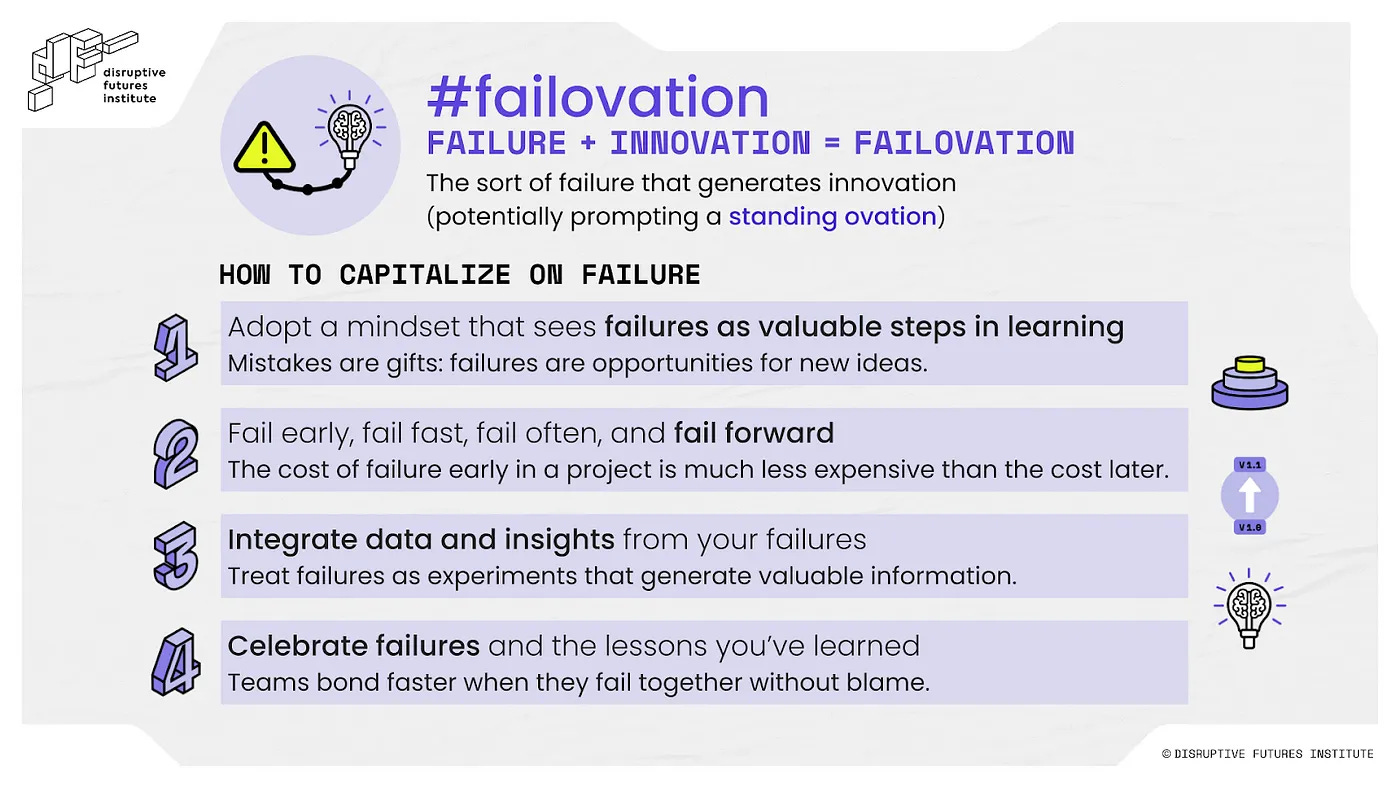
Following the #failovation model and developing a clear model for failure can help even the most stinging failures become shining innovations:
Perspective: Adopt a mindset that sees failures as valuable steps in learning.
Cost and reversibility: Fail early, fail fast, fail often, and fail forward.
Feedback loops: Integrate data and insights from your failures.
Culture: Celebrate failures and the lessons you’ve learned.
“In a complex world of unknown unknowns, there are no right answers, so do failures even exist? Take failure off the table, and reframe the learning experience and process of discovery.” — Roger Spitz with Lidia Zuin, quote from The Definitive Guide to Thriving on Disruption: Vol. III. Beta Your Life: Existence in a Disruptive World
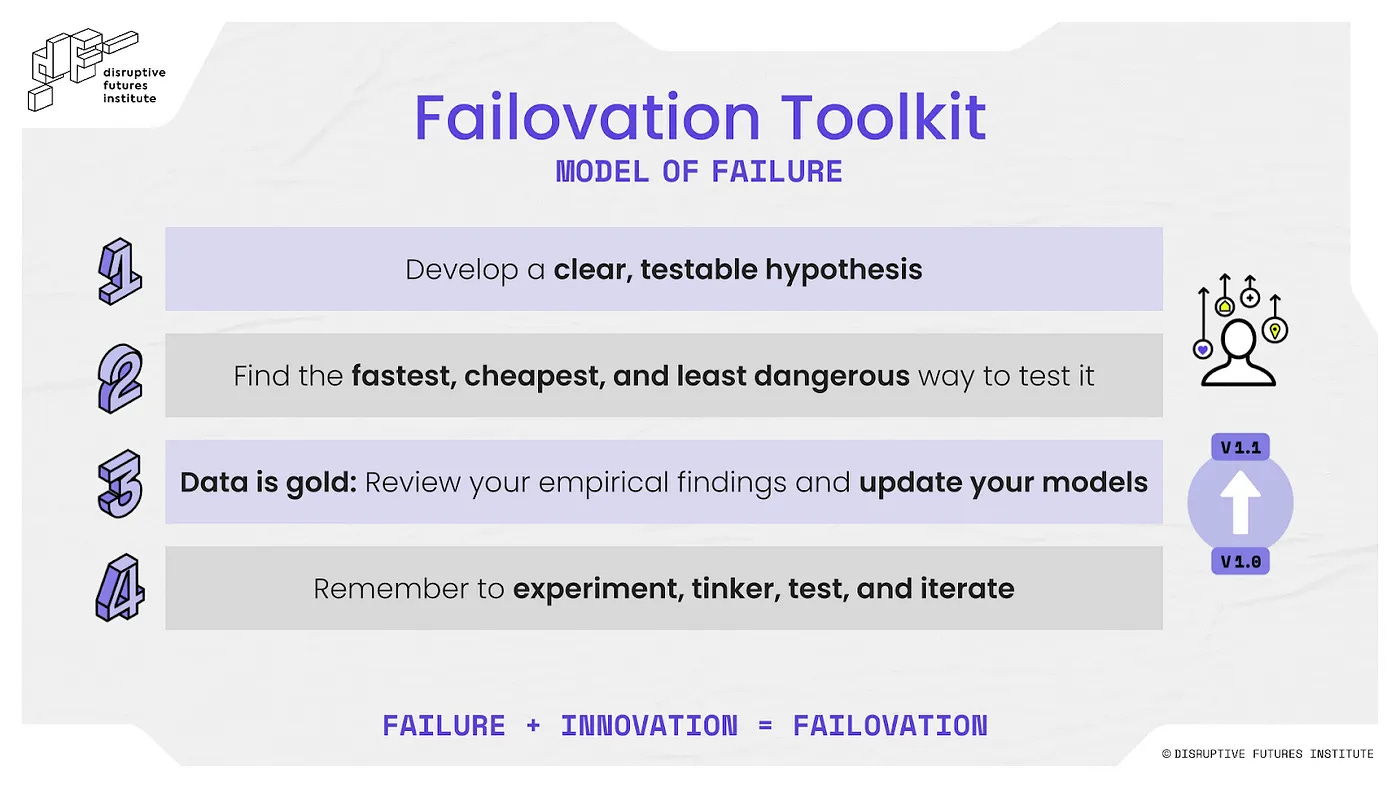
Definition of Failovation
The sort of failure that generates innovation (potentially prompting a standing ovation). Failure → Innovation = Failovation.
Learn More About Failovation
Learn the foundations and practical applications of the Failovation Toolkit in The Definitive Guide to Thriving on Disruption, Volume IV, Chapter 9: “Disruptive Technology & Innovation Workbook: Invent the Future”.
Roger Spitz explores Failovation in the context of the 6 i’s Toolkit — and achieving the impossible — in Disrupt With Impact: Achieve Business Success in an Unpredictable World.
On this episode of The New Abnormal podcast, produced in partnership with the Copenhagen Institute for Futures Studies (CIFS), host Sean Pillot de Chenecey and Roger Spitz discuss how to unlock the power of failure and innovation.
On the Reframe & Reset Your Career Podcast, host Harsha Boralessa and Roger Spitz speak about why it is so critical to rethink our relationship with failure.
Selected References for the Disruptive Futures Institute’s Toolkits
This article has provided a high-level overview of the Disruptive Futures Institute’s toolkits, which support our foundational frameworks. Below are the key references for each of these toolkits.
Selected Toolkit References for the 6 i’s Toolkit
Spitz, R. Disrupt With Impact: Achieve Business Success in an Unpredictable World. Kogan Page: London, 2024.
Spitz, R., and Zuin, L. The Definitive Guide to Thriving on Disruption: Vol. II. Essential Frameworks for Disruption and Uncertainty. Disruptive Futures Institute: San Francisco, 2022.
Selected Toolkit References for the Anticipatory Readiness Level (ARL) Toolkit
Spitz, R., and Zuin, L. The Definitive Guide to Thriving on Disruption: Vol. II. Essential Frameworks for Disruption and Uncertainty. Disruptive Futures Institute: San Francisco, 2022.
Spitz, R. Disrupt With Impact: Achieve Business Success in an Unpredictable World. Kogan Page: London, 2024.
Selected Toolkit References for the Business Models-as-a-System (BMaaS) Toolkit
Spitz, R. “ClimateTech: system innovation (versus point solutions)”. illuminem, January 23, 2024.
Spitz, R. Disrupt With Impact: Achieve Business Success in an Unpredictable World. Kogan Page: London, 2024.
Spitz, R., and Zuin, L. The Definitive Guide to Thriving on Disruption: Vol. IV. Disruption as a Springboard to Value Creation. Disruptive Futures Institute: San Francisco, 2023.
Selected Toolkit References for the Failovation Toolkit
Spitz, R., and Zuin, L. The Definitive Guide to Thriving on Disruption: Vol. IV. Disruption as a Springboard to Value Creation. Disruptive Futures Institute: San Francisco, 2023.
Spitz, R. Disrupt With Impact: Achieve Business Success in an Unpredictable World. Kogan Page: London, 2024.
Access the Disruptive Futures Institute’s Full Suite of Toolkits & Frameworks
“A rich and practical set of resources for anyone to capitalize on disruption.” — Cathy Hackl, CEO Future Dynamics, Senior Advisor BCG
The 6 i’s Toolkit, the ARL, BMaaS, and Failovation represent just a sample of the Disruptive Futures Institute’s full suite of toolkits. Explored in tantalizing detail, with fillable slides you can make your own, we present dozens of practical toolkits and frameworks throughout The Definitive Guide to Thriving on Disruption and within Disrupt With Impact: Achieve Business Success in an Unpredictable World.
Volume II of The Definitive Guide to Thriving on Disruption is titled “Essential Frameworks for Disruption and Uncertainty”. Throughout this comprehensive guidebook, Roger Spitz with Lidia Zuin present and apply a host of enhanced foresight frameworks and toolkits. Chapter 5, “Anticipatory: The Capacity to Prepare for Constant Disruption”, and Chapter 11, “Futures Frameworks & Foresight Fundamentals Workbook”, contain a particularly dense frequency of practical tools and frameworks, used by professional futurists to help us imagine and create the futures we desire.
Disrupt With Impact: Achieve Business Success in an Unpredictable World presents, for the first time ever, our Disruptive Thinking Canvas. This Canvas is a personalized roadmap designed to help you thrive in today’s shifting environments. Throughout Roger Spitz’s presentation and discussion of the Disruptive Thinking Canvas, you will find a streamlined six-step process, with practical toolkits in each step designed to help you leverage disruption and drive systemic change.
Drawing on transdisciplinary insights — from futures studies and systems thinking to sustainable development and foresight strategy — these books serve as a trusted compass for staying relevant and resilient amid systemic change.
Both The Definitive Guide to Thriving on Disruption and Disrupt With Impact: Achieve Business Success in an Unpredictable World are now available to order, on Amazon or wherever books are sold.
Disruptive Futures Institute Social Media Links & Resources
Websites & Resources
Homepage: Disruptive Futures Institute Homepage
LinkedIn Page: Disruptive Futures Institute LinkedIn
Youtube Channel: Disruptive Futures Institute Youtube Channel
Latest book (reviews, media, synopsis…): Disrupt With Impact Webpage
Instagram
Twitter / X
Read the next article of this four-part series:
Learn the Disruptive Futures Institute’s Language of Systemic Disruption in this 4-Part Series Exploring Its Methodologies, Toolkits, and Core Concepts
All four articles can be found here:
Article 1 — Introduction: “The Frameworks, Tools, and Language of the Disruptive Futures Institute” [1/4]
Article 2 — Frameworks: “The Disruptive Futures Institute’s FRAMEWORKS & Methodologies” [2/4]
Article 3 — Toolkits: “The TOOLKITS of the Disruptive Futures Institute” [3/4]
Article 4 — Language: “LANGUAGE & Core Concepts of the Disruptive Futures Institute” [4/4]
Press Release:
Disruptive Futures Institute Reveals the Secrets Behind Global Impact in New Article Series
Metadata & Citations
Article 1:
The Disruptive Futures Institute’s Frameworks, Tools, and Language [1/4]
DOI: 10.13140/RG.2.2.16265.30562
Citation:
Spitz, R. “The Disruptive Futures Institute’s Frameworks, Tools, and Language [1/4]”. Disruptive Futures Institute Medium, August 8, 2025.
Synopsis:
In this four-article series, we outline Disruptive Futures Institute’s frameworks, toolkits, and concepts, now consolidated in one place for your convenience. This first article provides an overview of the purpose and impact of the Disruptive Futures Institute’s work.
URL:
Article 2:
The Disruptive Futures Institute’s Frameworks & Methodologies [2/4]
DOI: 10.13140/RG.2.2.29687.07845
Citation:
Spitz, R. “The Disruptive Futures Institute’s Frameworks & Methodologies [2/4]”. Disruptive Futures Institute Medium, August 8, 2025.
Synopsis:
The Disruptive Futures Institute’s Frameworks and Methodologies are structured approaches designed to help you understand, anticipate, and navigate change. This article provides a high-level overview of the core frameworks that are foundational to the Disruptive Futures Institute.
URL:
Article 3:
The Toolkits of the Disruptive Futures Institute [3/4]
DOI: 10.13140/RG.2.2.22976.19208
Citation:
Spitz, R. “The Toolkits of the Disruptive Futures Institute [3/4]”. Disruptive Futures Institute Medium, August 8, 2025.
Synopsis:
The Disruptive Futures Institute’s Tools are practical step-by-step processes you can apply directly to your life and projects. This article provides a high-level overview of the Disruptive Futures Institute’s toolkits, which support our foundational frameworks.
URL:
Article 4:
Language & Core Concepts of the Disruptive Futures Institute [4/4]
DOI: 10.13140/RG.2.2.36397.96481
Citation:
Spitz, R. “Language & Core Concepts of the Disruptive Futures Institute [4/4]”. Disruptive Futures Institute Medium, August 9, 2025.
Synopsis:
At the Disruptive Futures Institute, our Language and Core Concepts are the words we use to describe and operate in the current state of our complex and nonlinear world. This article provides a high-level overview of the Disruptive Futures Institute’s foundational language and core concepts.
URL: