The Disruptive Futures Institute’s Frameworks, Tools, and Language [1/4]
Learn the Disruptive Futures Institute’s Language of Systemic Disruption in this 4-Part Series Exploring Its Methodologies, Toolkits, and Core Concepts [1/4]

Since 2020, the Disruptive Futures Institute has developed a wide collection of proprietary methodologies, frameworks, toolkits, and core concepts that have been adopted by organizations worldwide. These methodologies have featured in leading publications such as the Journal of Futures Studies, MIT Technology Review, the Global Peter Drucker Forum, Fast Company, Risk.Net, Institute of Directors India, the World Economic Forum, and more, collectively advancing the field of futures studies.
Founded by professional foresight practitioner Roger Spitz, the Disruptive Futures Institute is an award-winning global Think Tank offering executive education, practitioner research, and thought leadership on driving transformative change in our increasingly complex, unpredictable, and nonlinear world. We integrate cutting-edge practitioner research, proprietary frameworks, exclusive tools, and real-world case studies from Techistential, the preeminent foresight practice, to empower organizations and individuals.
The Disruptive Futures Institute helps you master the language of systemic disruption, using our proprietary methodologies and frameworks. As the world’s capital for understanding change and unpredictability, the Disruptive Futures Institute educates through Executive Education, Courses & Masterclasses, Keynote Talks, Custom Workshops & Conferences, Board, Leadership & Investor Retreats, and Books, Research & Publications.
Today, strategic foresight must evolve into a more holistic and resilient practice — one grounded in futures intelligence and supported by frameworks designed to shift mindsets and enable the creation of thriving, adaptive futures. This requires moving beyond predictive models that ask “What will happen?” to engage with more dynamic and probing questions: “What could happen?”, “What if?”, and especially “What forces might interact, amplify, or cascade unexpectedly?”
For too long, we spoke of tomorrow as something distant — yet tomorrow has arrived. The future is no longer an abstract horizon; it is unfolding now. What we once feared, what we once dreamed — it is here. We must now ask “What if this were to happen suddenly, right now?”
Through the Disruptive Futures Institute, Roger Spitz is helping evolve the language and scope of the futures field, offering a comprehensive set of frameworks, methodologies, tools, language, and core concepts to help individuals and organizations shape resilient, transformative futures. Through this work, we can shift mindsets, master the language of disruption and uncertainty, and build the capacity to navigate complexity, unpredictability, and change with confidence.
One consistent favorite among our learners and participants is the Disruptive Futures Institute’s frameworks, toolkits, and concepts. These transdisciplinary methodologies form the core of the Disruptive Futures Institute’s work, and are the foundation of our Executive Education & Corporate Training Programs. These are unique, grounded in real-world examples. They were crafted to help individuals stay relevant and even thrive in today’s complex, nonlinear, and unpredictable world.
In this four-part article series, we outline these updated concepts — now consolidated in one place for your convenience.
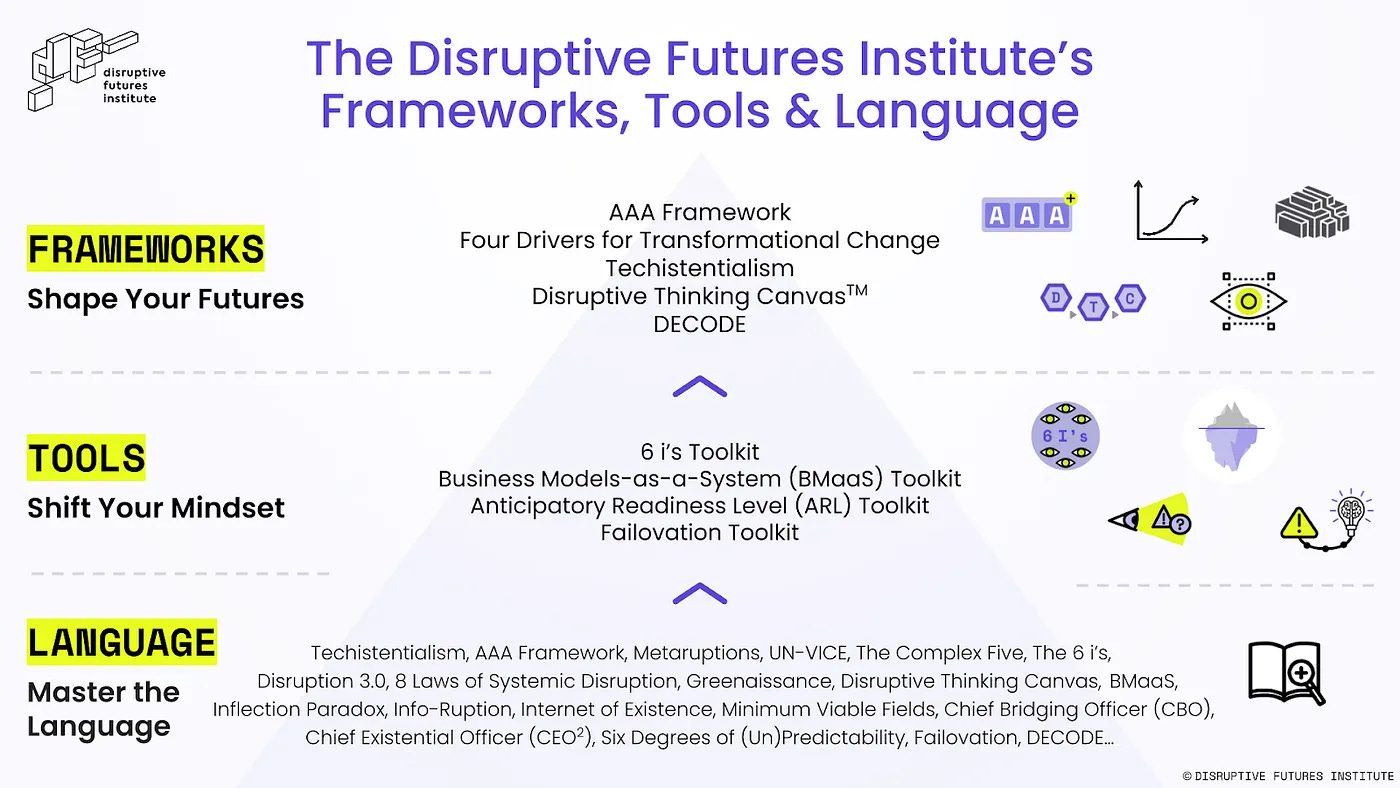
Systemic Change and Unpredictability Highlight the Need to Update Legacy Frameworks, Tools & Language
In an age where disruption is no longer merely a single or recurring event but a steady state, the Disruptive Futures Institute focuses on futures intelligence, capacity building, and transformational outcomes, not the status quo. For years, organizations, entrepreneurs, academic institutions, and think tanks worldwide have sought us out to solicit our views on remaining relevant in our unpredictable world.
Unfortunately, the more we investigated the essence of our world, the more we realized that humanity’s systems are not just fragile, but outright ineffective. Everything in our world is constantly evolving — except our organizations, strategies, and governance structures. Too often, we act on flawed assumptions, relying on a world that is assumed to be predictable, linear, stable, and controllable. But the cost and missed opportunities from these misconceptions are on the rise.
It’s Time to Update Our Understanding of Disruption
To help our clients and learners remedy this lack of resiliency, we developed our frameworks, toolkits, methodologies, and a unique lexicon of systemic disruption through our primary publications. These concepts multiply the lenses, widen the aperture, and deepen the exploration to shift mindsets and change the narrative structure around uncertainty.
How does the Disruptive Futures Institute help shape a future already colliding with the present?
It begins with the humility to recognize the end of trends, the permanence of change, and the convergence of multiple futures. In an era where linear time collapses, stable baselines dissolve, and disruptions intertwine, we need enhanced foresight — capable not of applying yesterday’s formulaic scenarios, but of navigating tomorrow’s dynamic complexity.
As the space between present and future collapses, foresight — once a tool for distancing ourselves from tomorrow — must evolve. The tidy taxonomy of Possible, Plausible, Probable, and Preferable futures is blurring, as the impossible manifests with increasing frequency.
Foresight must move beyond anticipation. It is about creating, emerging, deciding, and responding — dynamically and relationally — within living systems. Perhaps the future of foresight lies in cultivating actionable urgency for systemic disruption: the capacity to experience the present with agency and informed optimism. Yet agency, like an unexercised option, holds no value without action.
As our understanding deepens, our focus must shift toward engendering agency — developing superpowers for sense-making, decision-making, and intuiting the consequences of our choices. All in service of building aspirational futures grounded in real-world complexity and constraints.
In this article series, we will share an updated knowledge and understanding of the Disruptive Futures Institute’s work on systemic disruption — to enhance resilience and future-preparedness, because our futures depend on it.
This first article will provide an “executive summary”, an overview of the purpose and impact of the Disruptive Futures Institute’s work.
In article 2, titled “The Disruptive Futures Institute’s Frameworks & Methodologies”, we outline our proprietary structures and techniques. These foundational FRAMEWORKS help you understand, anticipate, and navigate change — as well as drive and thrive on disruption.
In article 3, titled “The Toolkits of the Disruptive Futures Institute”, we illuminate specific step-by-step toolkits you can apply directly to your life and projects. These TOOLS are applicable standalone, but often support our overarching frameworks.
In article 4, titled “Language & Core Concepts of the Disruptive Futures Institute”, we define the words we use to describe the current state of our complex and nonlinear world. We help you master the LANGUAGE of change, uncertainty, and unpredictability.
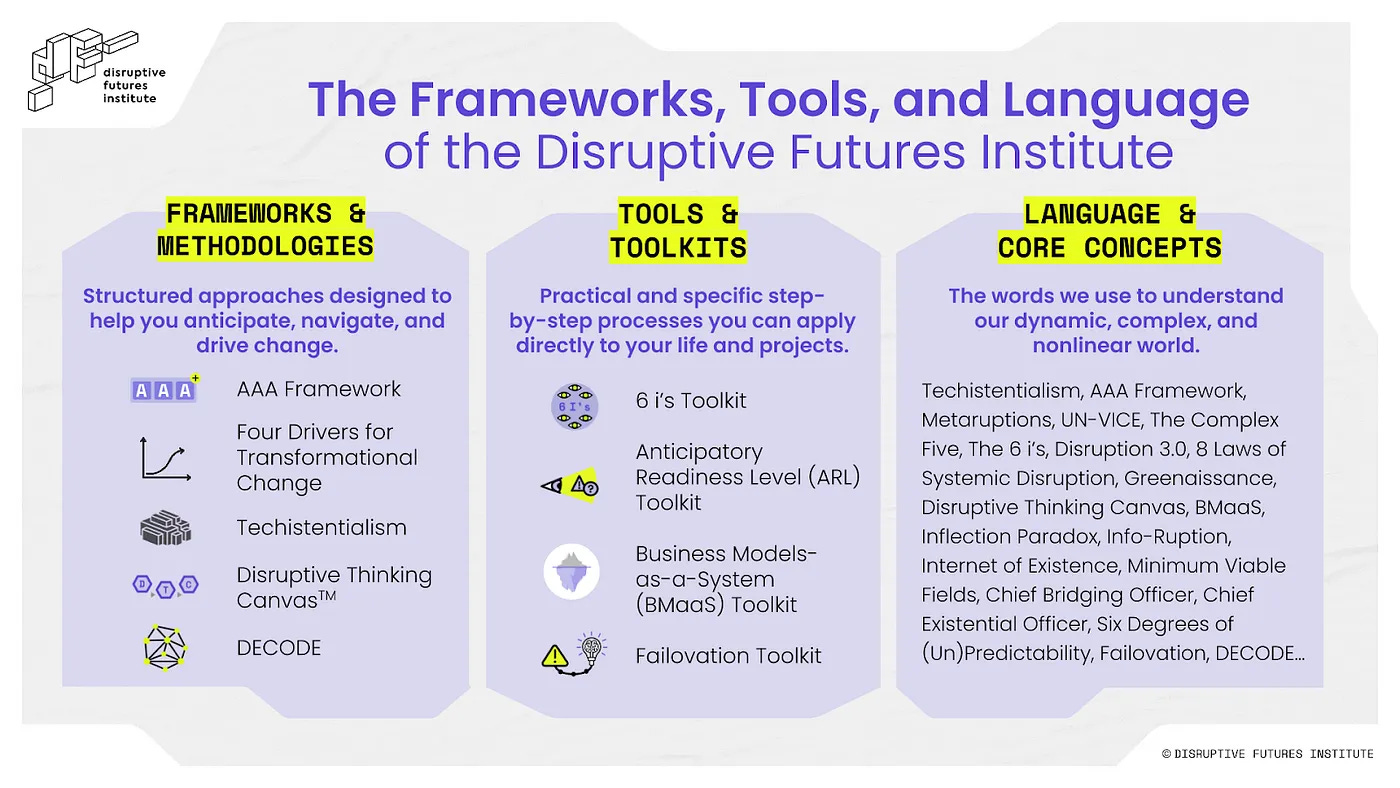
Next, let’s dive into an overview of our frameworks, toolkits, and core concepts, as we present them in this article series.
“Roger Spitz masterfully equips decision-makers for the steep slopes, crevasses and hazards of the world’s fast-changing environments. There are no better frameworks to help build resilience for the shocks while seizing the windows of opportunities as you creatively shape your future.” — Benedikt Böhm, Executive Board Oberalp, CEO Dynafit & Extreme Ski Mountaineer
Article 2. The Disruptive Futures Institute’s Frameworks and Methodologies
The Disruptive Futures Institute’s Frameworks and Methodologies are structured approaches designed to help you understand, anticipate, and navigate change — as well as drive and thrive on disruption.
As a team of professional, academically trained futurists, we strive to make foresight strategy and futures studies clear, approachable, engaging, conversational, relatable, and relevant to everyday decision-making. These methodologies form a core component of that purpose.
From the AAA Framework to the Disruptive Thinking Canvas, our frameworks and methodologies are your key to unlocking the opportunities of systemic disruption.
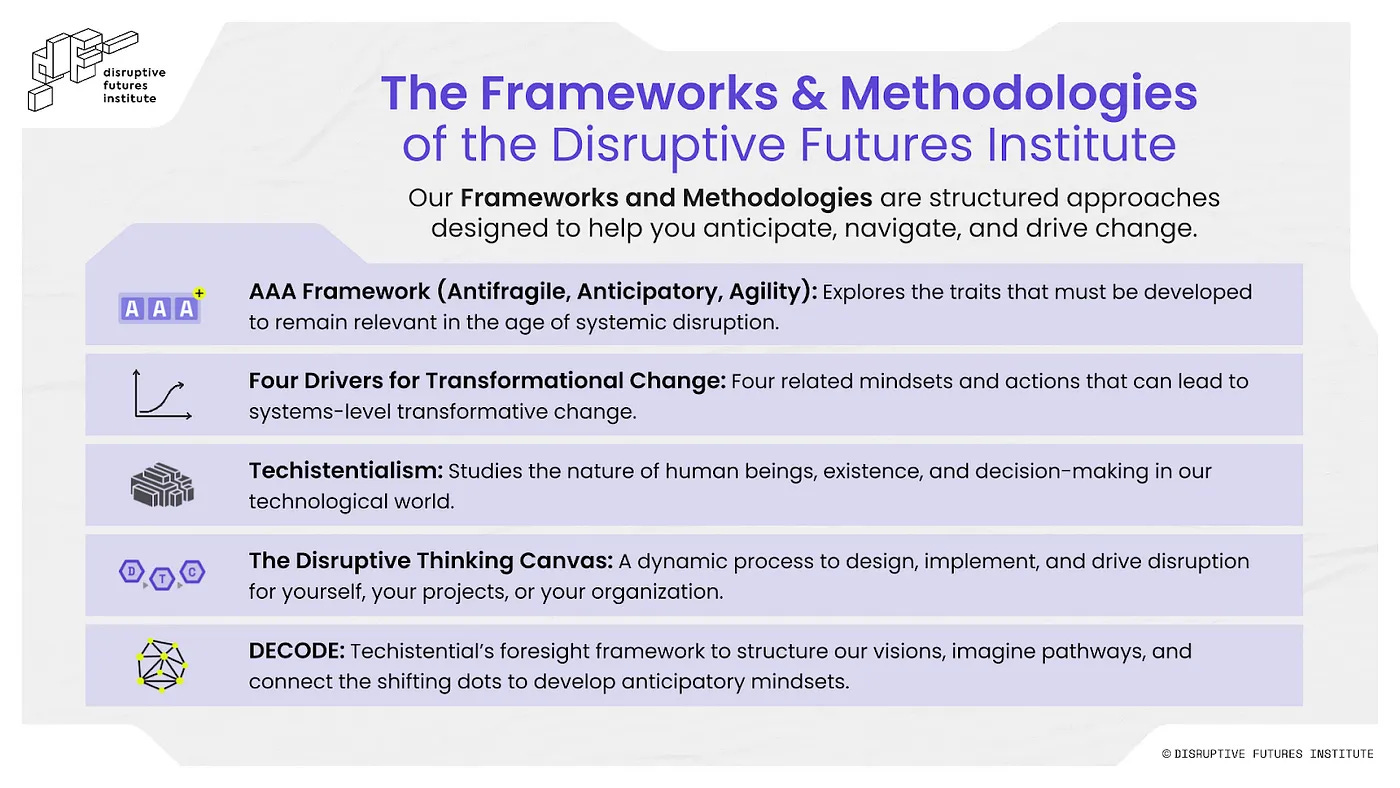
AAA Framework: Explores the traits that must be developed to remain relevant in the age of systemic disruption.
Four Drivers for Transformational Change: Four related mindsets and actions that can lead to systems-level transformative change.
Techistentialism: Studies the nature of human beings, existence, and decision-making in our technological world.
Disruptive Thinking Canvas: A dynamic process to design, implement, and drive disruption for yourself, your projects, or your organization.
DECODE: Techistential’s foresight framework to structure our visions, imagine pathways, and connect the shifting dots to develop anticipatory mindsets.
In article 2, we also briefly describe a selection of case studies that have been developed on and using our frameworks for applied research.
Click here to read article 2, “The Disruptive Futures Institute’s Frameworks and Methodologies”.
“Using the Disruptive Futures Institute’s resources and frameworks, our participants can immediately develop antifragile strategies to imagine aspirational futures and create sustainable value for them and their organizations while building resilience.” — Junior Borneli, CEO & Founder of StartSe
Article 3. The Toolkits of the Disruptive Futures Institute
The Disruptive Futures Institute’s Tools are practical and specific step-by-step processes you can apply directly to your life and projects. These toolkits focus on specific actions you can take, designed to help you engage with and overcome specific challenges.
Using these toolkits, changemakers will be better equipped with tactical knowledge and skills to immediately build resilience and drive disruption by experimenting with more agency and imagination.
Today, the lines between the present and future are becoming blurred. The choices we make about how we will engage with the future intimately affect the present. These toolkits are designed to help you make the most of today, for the benefit of both present and future realities as they intersect.
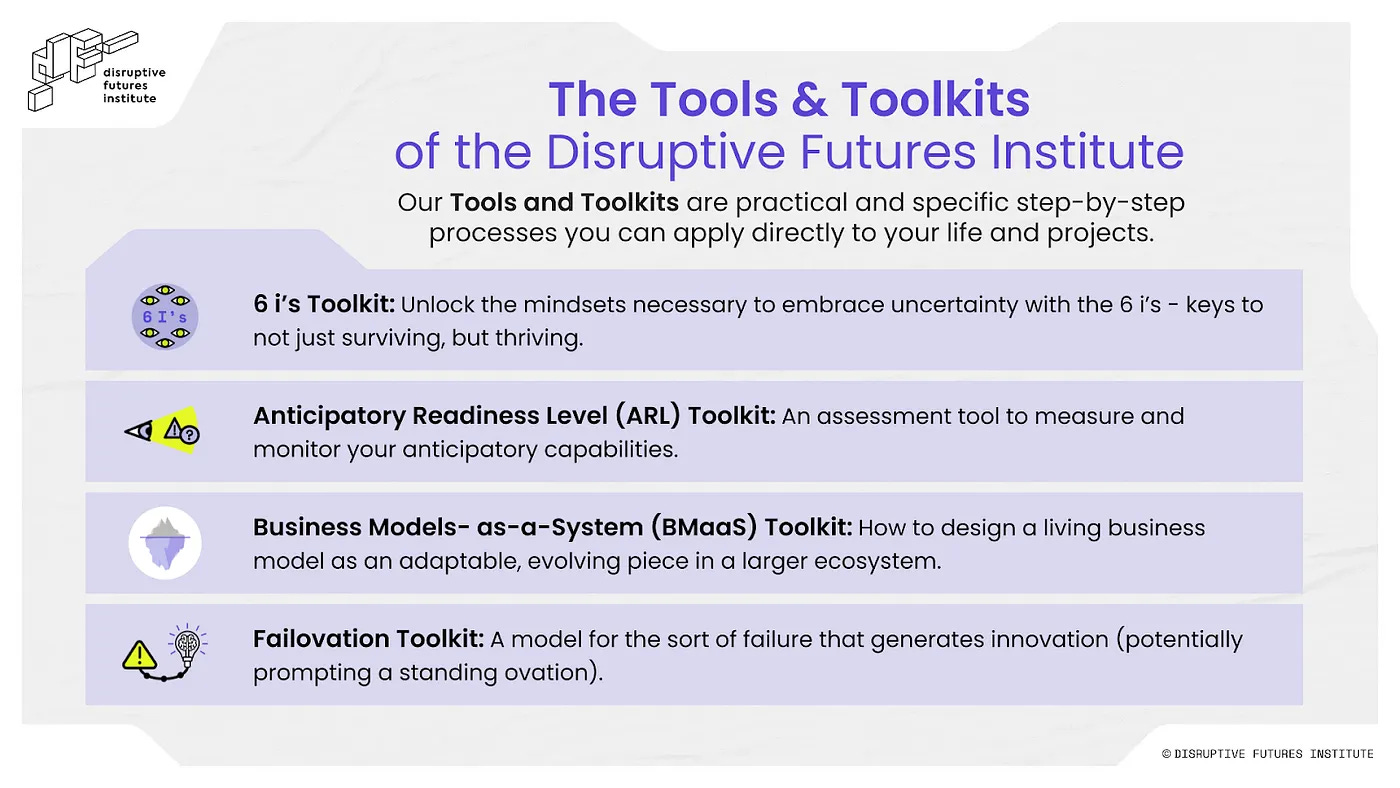
The 6 i’s Toolkit: Unlock the mindsets necessary to embrace uncertainty with the 6 i’s — keys to not just surviving, but thriving. The 6 i’s are Intuition, Inspiration, Imagination, Improvisation, Invention, and Impossible.
Anticipatory Readiness Level (ARL) Toolkit: An assessment tool to measure and monitor your anticipatory capabilities.
Business Models-as-a-System (BMaaS) Toolkit: How to design a living business model as an adaptable, evolving piece in a larger ecosystem.
Failovation Toolkit: A model for the sort of failure that generates innovation (potentially prompting a standing ovation).
Click here to read article 3, “The Toolkits of the Disruptive Futures Institute”.
Article 4. The Disruptive Futures Institute’s Language & Core Concepts
The language of disruption is one of activity and action. Disruptive times deeply affect the shared terminology we use. Speaking the language of change will support capacity building and decision-making for this uncertain world, adopting new mindsets essential for thriving amidst ambient disruption.
At the Disruptive Futures Institute, our Language and Core Concepts are the words we use to describe the current state of our complex and nonlinear world. These range from strategic agility, such as the Chief Bridging Officer (a proposed C-suite position), to cognitive agility, like Techistentialism, the implications on human decision-making in our technological world.
This collection of terms and concepts is designed to help you build fluency with the evolving language of systemic disruption, complexity, and unpredictability. The Disruptive Futures Institute helps you master this language.
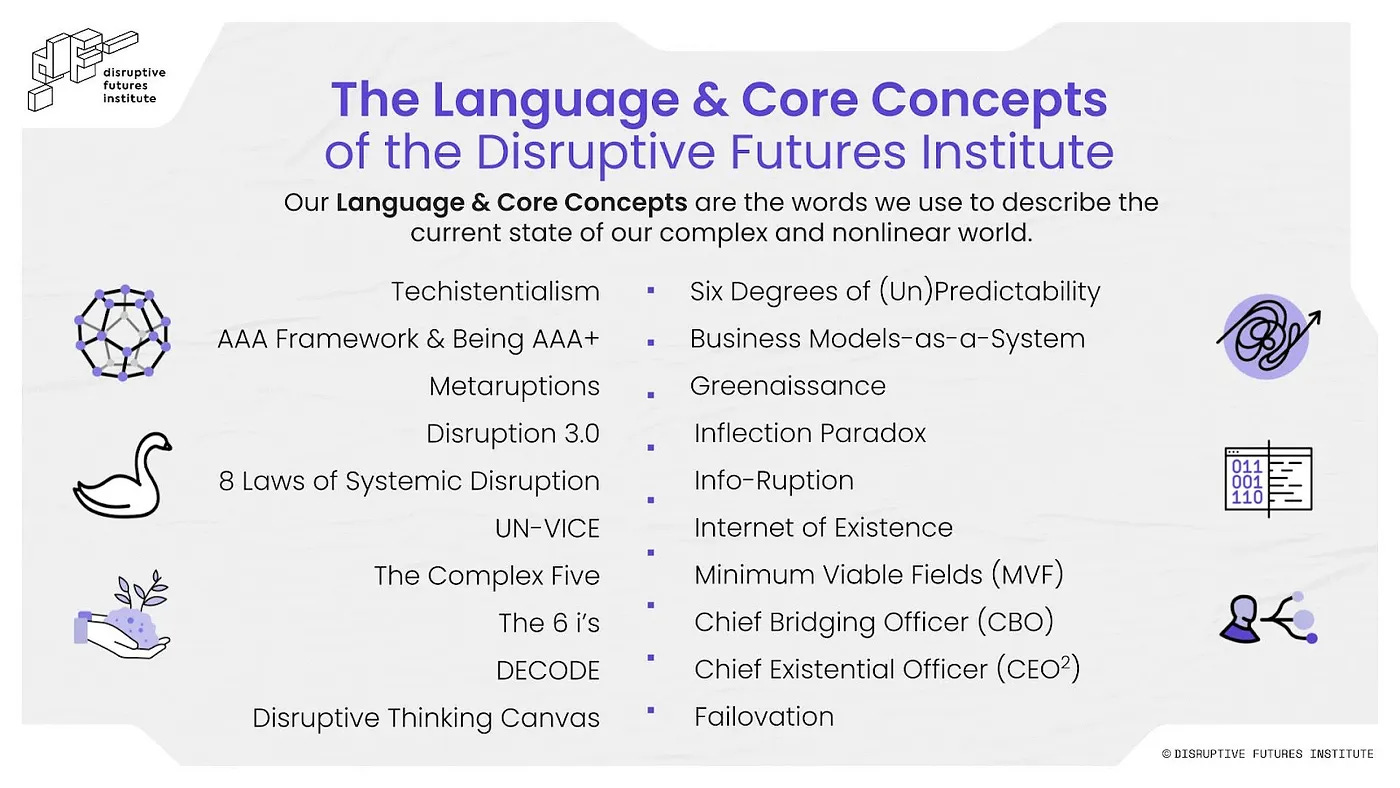
Techistentialism: Studies the nature of human beings, existence, and decision-making in our technological world
The AAA Framework: Explores the traits that must be developed to remain relevant in the age of systemic disruption.
Metaruptions: A multidimensional family of systemic disruptions that cause widespread and self-perpetuating effects that extend beyond their initial disruptions.
UN-VICE (UNknown, Volatile, Intersecting, Complex, and Exponential): An updated way of capturing the state and velocity of the world, to replace VUCA.
The Complex Five: Five animals that represent a matrix of highly impactful events according to their degrees of uncertainty.
The 6 i’s: Unlock the mindsets necessary to embrace uncertainty — keys to not just surviving, but thriving.
Disruption 3.0: Omnipresent and systemic disruption, a constant that establishes entirely new paradigms, which themselves will evolve.
The 8 Laws of Systemic Disruption: Reframing and defining disruption in a world that is no longer linear, where patterns become increasingly hard to interpret.
Greenaissance: An era of renewal with momentous innovation and investment opportunities, with the common objective of sustainable energy transition.
The Disruptive Thinking Canvas: A dynamic process to design, implement, and drive disruption for yourself, your projects, or your organization.
Business Models-as-a-System (BMaaS): How to design a living business model as an adaptable, evolving piece in a larger ecosystem.
The Inflection Paradox: The conflicting drivers and cognitive biases that contribute to a failure to spot inflection points.
Info-ruption: A pervasive and radical change in worldwide data dynamics, with cascading effects on how information will be interpreted, used, and misused.
Internet of Existence (IoE): The integration of internet-connected technology into previously disconnected areas, bringing biology, geology, and physics online.
Minimum Viable Fields (MVF): Technology, energy, and media drive all companies, which replace the conventions of “sectors”.
Chief Bridging Officer (CBO): Proposed C-suite position responsible for reconciling the long-term goals of an organization with impactful and relevant everyday actions.
Chief Existential Officer (CEO²): Proposed C-suite position responsible for acting upon the increasing number of low-probability but very high-consequence existential risks.
Six Degrees of (Un)Predictability: A set of filters you can use to critically evaluate assumptions and stakeholder incentives.
Failovation: A model for the sort of failure that generates innovation (potentially prompting a standing ovation).
DECODE: Techistential’s foresight framework to structure our visions, imagine pathways, and connect the shifting dots to develop anticipatory mindsets.
Click here to read article 4, “The Disruptive Futures Institute’s Language & Core Concepts”.
From Foresight to Transformative Change
“One of the reasons I decided to focus my work on futures and foresight is to deal with the unpredictability of the world. With foresight, we are not looking for a predetermined answer or specific outcome. Foresight is the capacity to explore the possible futures systemically.” — Roger Spitz, in “From disruption to transformation”, School of International Futures
With two decades in investment banking, Roger Spitz advised on over 50 transactions worth $25 billion. As Global Head of Technology M&A at one of the world’s largest banks, he guided CEOs, founders, and boards to evaluate strategy and competitiveness. Through these boardroom insights, Roger Spitz observed the constraints of traditional decision-making practices — those overly focused on short-term gains and an assumption of a stable, predictable, and linear business environment.
Recognizing these limitations, Roger Spitz shifted his professional focus from finance to foresight. At the heart of this transition is the power of foresight to redefine challenges. While strategic advice often emphasizes efficiency, foresight encourages a broader, more reflective approach. It asks, “Which systems must evolve to build resilience? How can the choices we make today shape more robust and promising futures? And how do we move from efficiency to effectiveness?”
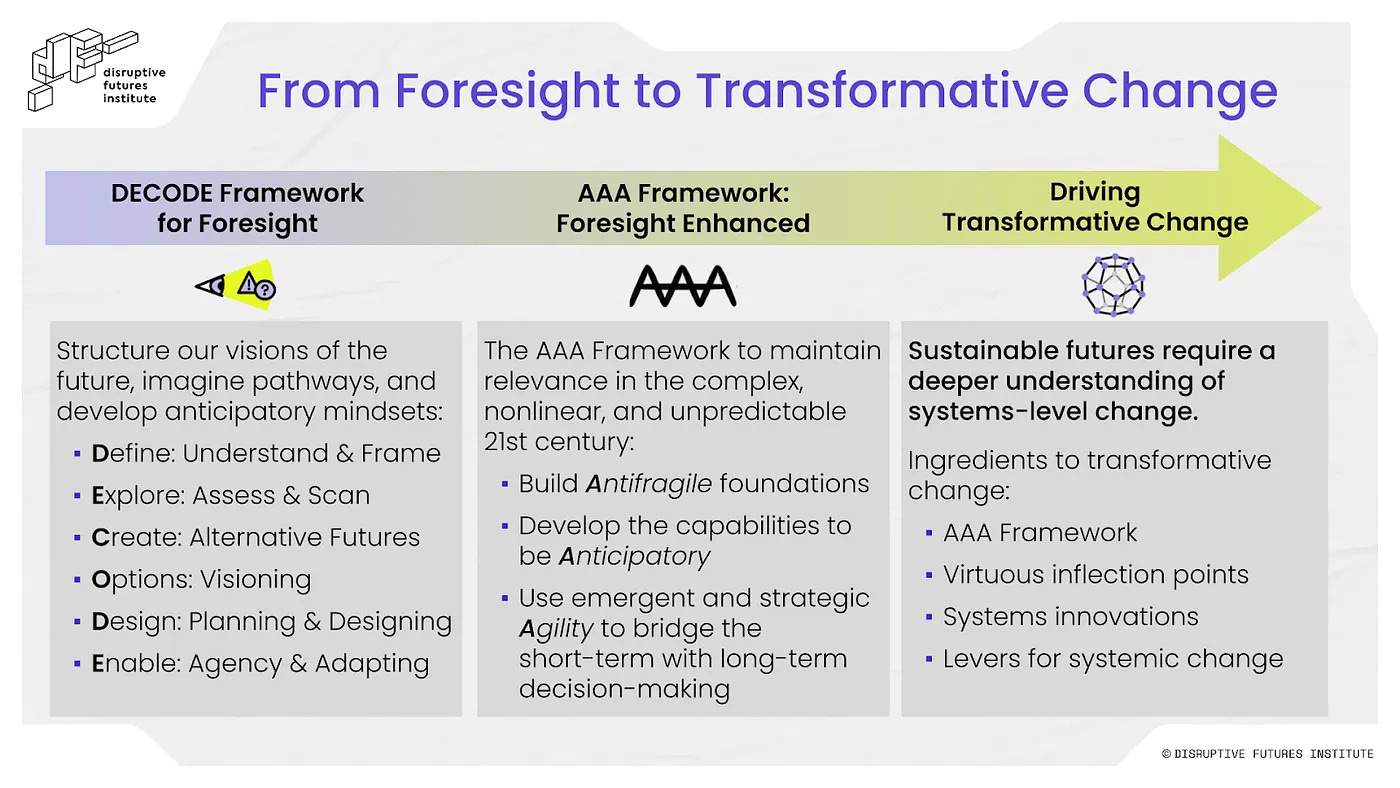
At his foresight practice Techistential, Roger Spitz developed the DECODE Framework, which is presented in Article 2 of this series. DECODE is a series of six phases that help practitioners structure their visions of the future, imagine pathways towards them, and develop anticipatory mindsets to transform visions into reality:
Define: Understand & Frame
Explore: Assess & Scan
Create: Alternative Futures
Options: Visioning
Design: Planning & Designing
Enable: Agency & Adapting
However, just exercising foresight is not enough in our complex world. Roger Spitz’s AAA Framework goes beyond foresight, to help individuals and organizations maintain relevance in the complex, nonlinear, and unpredictable 21st century:
Antifragile: Build foundations to be resilient and able to take advantage of any eventuality.
Anticipatory: Improve the capacity for anticipatory mindsets to navigate uncertainty, and go beyond short-termism, linear assumptions, and singular outcomes.
Agility: Develop the agility to respond to whatever futures emerge, while reconciling our preferred vision of the futures with today’s unpredictable reality.
By bridging the power of foresight (DECODE) with the three primary components of the AAA Framework (Antifragile, Anticipatory, and Agility), organizations and individuals can thrive amidst systemic disruption.
In the decade ahead, we will face choices related to climate, society, and emerging technologies that have unprecedented ramifications. We have the agency to make those choices, but agency alone will not suffice. Business and political cycles are too short to be impacted by these challenges, so there are no incentives to address them. Inaction may lead to the decimation of entire industries, economies, and humanity itself. Our society can transform itself, but this requires discarding the inertia of the status quo.
To overcome the powerful resistance to change, we propose recognizing strategic foresight as an integrated piece within a wider set of drivers of transformation. We call these the Four Drivers for Transformational Change:
Apply strategic foresight with the AAA Framework: Anticipatory thinking and adaptive decision-making for resilient and sustainable futures.
Create virtuous inflection points: Understanding beneficial tipping points to offer pathways for desired changes.
Catalyze systems innovation instead of focusing on point solutions: Innovations must scale cost-effectively to become commercially viable and interact seamlessly in our world.
Harness the levers for effective systemic change: Identify and harness effective levers to enable change across emerging complex systems.
Using these tools and frameworks, which are grounded in the Disruptive Futures Institute’s core publications, we can work as individuals and collectively to build thriving, resilient futures.
Philosophy and Zen Buddhism
Our approach blends real-world case studies with transformative educational experiences to address key areas of adaptive foresight, systems innovation, and sustainable change. Updated continuously with our latest insights, the Disruptive Futures Institute has a holistic focus including:
Existential Philosophy & Techistentialism: Ethical & Existential Foresight for shaping the future of Artificial Intelligence and decision-making.
Eastern Philosophy & Zen Buddhism: To leverage invention, impact, and meaning, through Existential & Eastern philosophies.
During our journey, we realized how disruption is simply mujō: constant change all the time. The concept of impermanence is akin to disruption. Nothing is permanent — except impermanence. Practical learnings from these themes, with a particular focus on how to adopt shoshin (a beginner’s mind), are developed throughout our work, publications, and programs at the Disruptive Futures Institute.
“In an effort to understand, survive, and thrive in our disruptive world and uncertain futures, it’s useful to consider the timeless teachings of Eastern philosophy and Zen Buddhism. To improve our comfort with impermanence, transformation, and change, we can learn from a set of tactics developed and refined over millennia. Shoshin is the Japanese concept of beginner’s mind that articulates the value of approaching each situation with an open, accepting, curious mind. Ikigai means “purpose in life” or “a life worth living.” Ikigai makes life easier to navigate during difficult times and unknown futures. Mujō teaches us about the profound importance of change and impermanence. Nothing lasts forever, and everything in our lives and the world around us is constantly changing. With respect to our 6 i’s, mujō aids most clearly in improvisation and invention by helping you see afresh. The world is one constant disruption, where concepts such as stability, predictability, and certainty are just an imaginary Western illusion. Eastern philosophy not only understands the true nature of our world as impermanent, but also appreciates how to leverage on impermanence for innovation and impact.” — Roger Spitz, quote from The Definitive Guide to Thriving on Disruption: Vol. II. Essential Frameworks for Disruption and Uncertainty
The Disruptive Futures Institute’s Publications
“An engaging and very enlightening read. The kind of book you can always refer to in the future.” — Manhattan Book Review on Disrupt With Impact (Rating 4 out of 5)
At the Disruptive Futures Institute, we’ve helped thousands of changemakers and organizations worldwide navigate disruption through keynote talks, workshops, masterclasses, and tailored executive education programs. Now, our unique expertise is available in a series of acclaimed publications designed to empower leaders in unpredictable times.
Given the overwhelming interest in our work, the responses to our many talks and programs, we decided to also publish our methodologies in two primary sets of publications:
First, the four-Volume Guidebook The Definitive Guide to Thriving on Disruption
Second, Disrupt With Impact: Achieve Business Success in an Unpredictable World
The awards and accolades received for our publications at the Disruptive Futures Institute underscore the growing need for new frameworks to navigate the complex challenges and opportunities of our rapidly changing futures.
These bestselling publications are now included in numerous bibliographies for executive and academic programs — and are fundamentally reshaping how leaders make decisions amidst unprecedented uncertainty. As we’ll describe throughout this article series, many case studies based on our frameworks, toolkits, and core concepts have been developed and published in leading journals and outlets.
“These resources help build the capacity for anticipatory thinking and transformative action. They equip people with the tools to create tangible and lasting impact. Shaping the future, after all, is a skill that can be developed.” — “From disruption to transformation”, School of International Futures
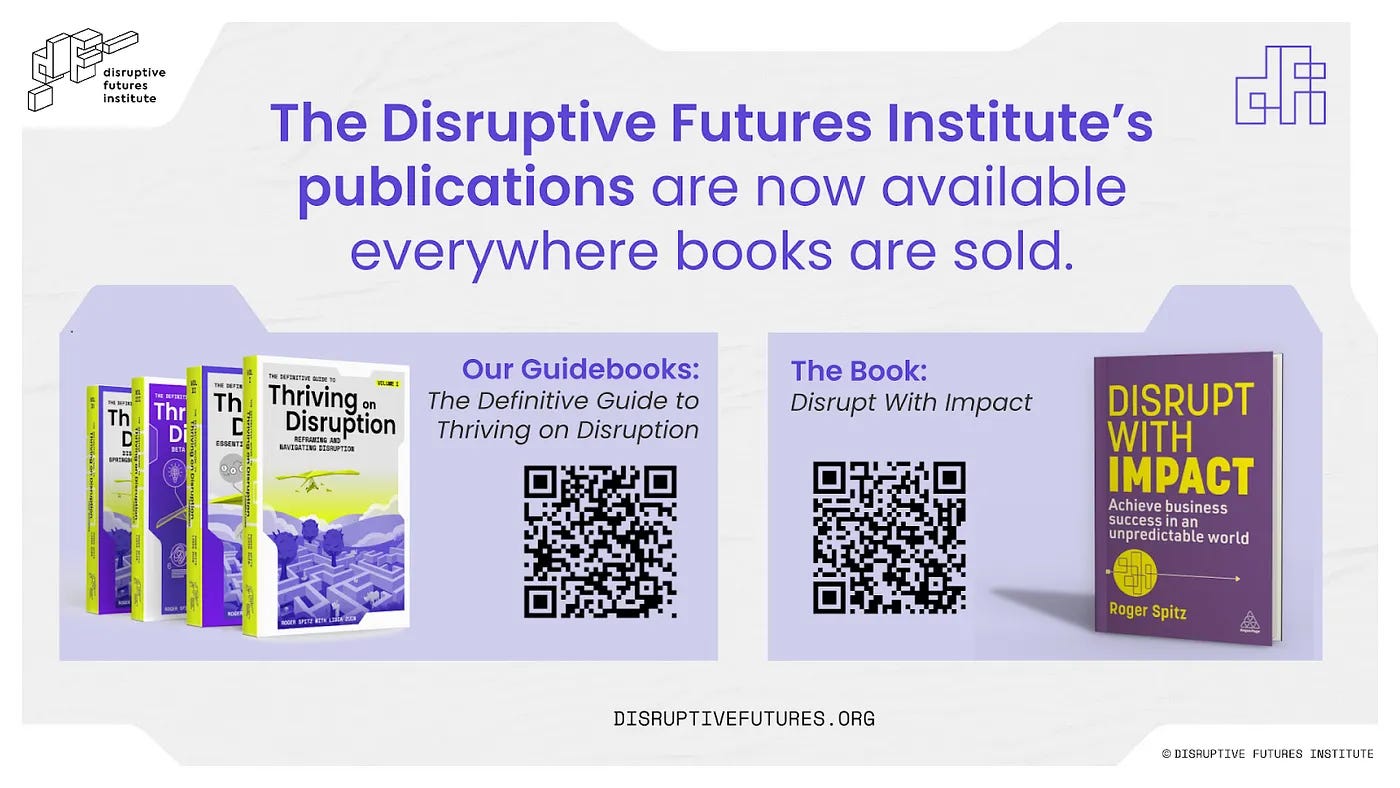
The Definitive Guide to Thriving on Disruption: Our Guidebooks
The Definitive Guide to Thriving on Disruption, by Roger Spitz in collaboration with Lidia Zuin, is a comprehensive four-volume series packed with proprietary frameworks, tools, and strategies. We refer to these volumes together as the “Guidebook”, “Guidebooks”, or “Guide”. The Collection is organized as four Volumes, with 32 Chapters and five Workbooks.
These volumes are structured and educational in nature, akin to textbooks that support our executive education programs and courses. There are no prerequisites for the Guidebook. No previous training, academic, or work experience is required. Our Guide is designed to allow anyone to learn, unlearn, and relearn. We avoid being too technical, even with complex topics. We always define, contextualize, and illustrate with examples.
As a reference guide, the ideas, topics, and chapters within these Guidebooks are designed to be self-contained. You can read these books from front to back; you can also dive right into the chapters that excite or interest you. You should use this work as a reference guide. Start anywhere, browse everywhere, and surf where the waves bring you.
“That’s what the Guidebook trains us to do; it gives leaders the tools they need to help their teams mentally adapt to changes made possible by technology and capital investment.” — Shelli Brunswick, COO of Space Foundation & Forbes Technology Council
Disrupt With Impact: Achieve Business Success in an Unpredictable World
“All in all, it’s a must-read for executives, managers, shareholders, and business owners.” — Readers’ Favorite on Disrupt With Impact (Rating 5 out of 5)
Disrupt With Impact: Achieve Business Success in an Unpredictable World is Roger Spitz’s latest award-winning bestseller, your compass for exploring the uncharted waters of the future. It has been lauded for its unique and compelling frameworks, providing a vital roadmap for navigating systemic disruption. From the UN-VICE Framework (Unknown, Volatile, Intersecting, Complex, Exponential), a superior diagnostic for our global reality, to the AAA Framework (Antifragile, Anticipatory, and Agility), hailed by reviewers as a “new operating system for today’s deeply uncertain world”, Disrupt With Impact operationalizes comprehensive insights into actionable methodologies. It compels a holistic approach to foresight, recognizing today’s challenges as cascading forces altering disruption itself.
Disrupt With Impact is the winner of the 2024 Chanticleer International Best Book Awards, Harvey Chute Category Winner (Non-Fiction Business & Enterprise), winner of the 2024 Foreword Indies Book of the Year Award — Bronze, Business & Economics, winner of the 2025 Readers Favorite Book of the Year Award Winner: Bronze, Business & Finance, and was named finalist in the 2025 International Book Awards (IBA) for both General Business and Management & Leadership.
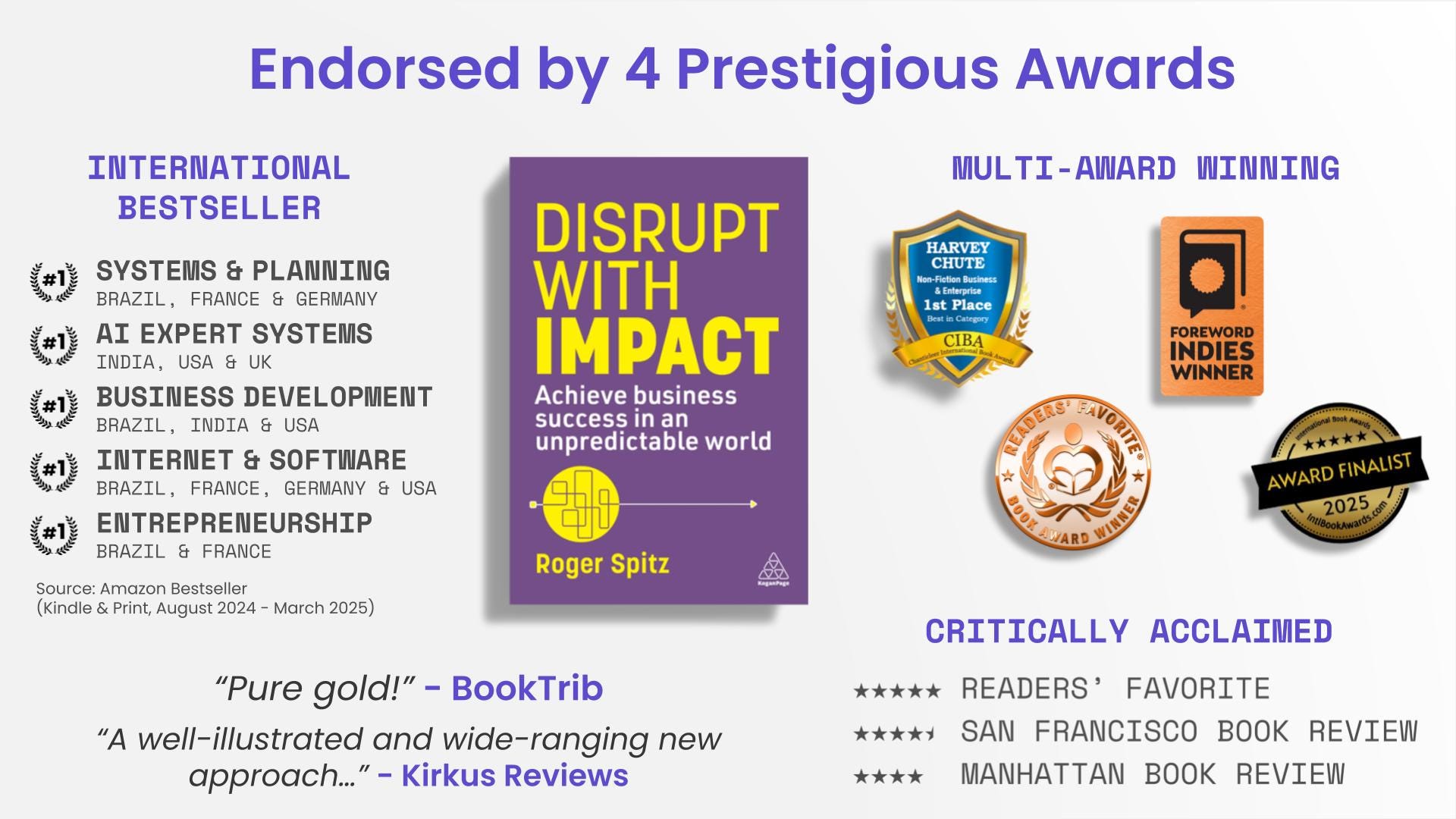
In addition to being a more curated rendition of the Guidebooks, Disrupt With Impact contains additional case studies and insights from real-world foresight advising scenarios.
For instance, Disrupt With Impact contains an updated section on “How to drive systems innovation and transformational change”, which has matured and benefited from Roger Spitz’s work and applied research from our DFI Nature & Climate Academy, and his involvement in the World Economic Forum’s Global Foresight Network.
Likewise, Section 3 of Disrupt With Impact, “The future of artificial intelligence, strategic decision-making and technology”, benefits from some additional perspectives as Roger Spitz has continued to focus on and advise on the implications of “Techistentialism” through our Techistential Center for Human & Artificial Intelligence.
In particular, since writing the Guidebooks, our AAA Framework (Anticipatory, Antifragile, Agility) has been used in new real-world case studies, some published, and this applied research and practitioner examples have helped with clarity and our own precedents since the original publication. The foundations of the original AAA Framework remain relevant, and the various aspects of the constituents of each “A” have not changed from the Guidebooks, but these publications as case studies have helped illuminate how cohesive it is as a framework.
While our frameworks continue to be refined over time — benefiting from additional data, new examples, and case studies from organizations applying our methodologies — they remain foundational. They are designed to be evergreen and resilient in the face of change, supporting systemic transformation, nonlinearity, and unpredictability. We present a selection of these case studies in article 2 of this series, “The Disruptive Futures Institute’s Frameworks & Methodologies”.
Many readers who had read our Guidebooks, both practitioners and academics, from the foresight field and others, found that Disrupt With Impact brought many new perspectives and new topics, in addition to entirely new frameworks, such as our proprietary Disruptive Thinking Canvas, presented for the first time ever in the final section of the book.
“Exceptionally well written, organized and presented… an extraordinary and recommended addition to reading lists.” — Midwest Book Review on Disrupt With Impact
The Thriving on Disruption Movement
It’s no coincidence that we called our four-volume landmark publications The Definitive Guide to Thriving on Disruption. In a world defined by uncertainty and complexity, thriving — not just surviving — requires a new set of tools. That’s why we’ve developed proprietary methodologies, frameworks, toolkits, language, and core concepts to help you not only navigate disruption but harness it. This article series is built on those foundations.
Underpinned by the philosophy that systemic disruption is not just a challenge to be overcome but an opportunity to be leveraged, we define Thriving on Disruption as a Movement to master the language of change with tools to go beyond survival. This Movement is founded on recognizing the opportunities of systemic disruption, to rewire how we think, decide, and lead amid relentless complexity and unpredictability. This entails:
A Mindset Shift: To Become Visionary in an Unpredictable World.
An Intelligence Shift: To Upgrade Human Decision-Making in the Age of AI.
A Leadership Shift: To Inspire Transformational Futures.
Our legacy systems and leadership structures lack resilience in the face of disruptions, unable to make effective decisions under uncertainty. Current assumptions are becoming obsolete. To handle this, we must raise new questions and accept with humility the realm of what we know — and what we don’t.
As the center of the Thriving on Disruption Movement, the Disruptive Futures Institute fosters a dynamic Community of Practice to drive collaboration, knowledge sharing, and collective growth in strategic foresight and futures thinking. We empower professionals and changemakers to shape the future through continuous engagement and experiential learning, as we update the language, tools, and mindsets needed to stay relevant.
Adaptation to rapid change and uncertain times with one’s own tools, models, and mindsets is required for both survival and success, which is why we are presenting this article series to you. It’s time to update our understanding of disruption. To continue learning how to apply the Disruptive Futures Institute’s frameworks and methodologies to your organization, projects, and life, explore our publications and the following three articles in this series:
Article 2: “The Disruptive Futures Institute’s Frameworks & Methodologies”
Article 3: “The Toolkits of the Disruptive Futures Institute”
Article 4: “Language & Core Concepts of the Disruptive Futures Institute”
Disruptive Futures Institute Social Media Links & Resources
Websites & Resources
Homepage: Disruptive Futures Institute Homepage
LinkedIn Page: Disruptive Futures Institute LinkedIn
Youtube Channel: Disruptive Futures Institute Youtube Channel
Latest book (reviews, media, synopsis…): Disrupt With Impact Webpage
Instagram
Twitter / X
Read the next article of this four-part series:
Learn the Disruptive Futures Institute’s Language of Systemic Disruption in this 4-Part Series Exploring Its Methodologies, Toolkits, and Core Concepts
All four articles can be found here:
Article 1 — Introduction: “The Frameworks, Tools, and Language of the Disruptive Futures Institute” [1/4]
Article 2 — Frameworks: “The Disruptive Futures Institute’s FRAMEWORKS & Methodologies” [2/4]
Article 3 — Toolkits: “The TOOLKITS of the Disruptive Futures Institute” [3/4]
Article 4 — Language: “LANGUAGE & Core Concepts of the Disruptive Futures Institute” [4/4]
Press Release:
Disruptive Futures Institute Reveals the Secrets Behind Global Impact in New Article Series
Metadata & Citations
Article 1:
The Disruptive Futures Institute’s Frameworks, Tools, and Language [1/4]
DOI: 10.13140/RG.2.2.16265.30562
Citation:
Spitz, R. “The Disruptive Futures Institute’s Frameworks, Tools, and Language [1/4]”. Disruptive Futures Institute Medium, August 8, 2025.
Synopsis:
In this four-article series, we outline Disruptive Futures Institute’s frameworks, toolkits, and concepts, now consolidated in one place for your convenience. This first article provides an overview of the purpose and impact of the Disruptive Futures Institute’s work.
URL:
Article 2:
The Disruptive Futures Institute’s Frameworks & Methodologies [2/4]
DOI: 10.13140/RG.2.2.29687.07845
Citation:
Spitz, R. “The Disruptive Futures Institute’s Frameworks & Methodologies [2/4]”. Disruptive Futures Institute Medium, August 8, 2025.
Synopsis:
The Disruptive Futures Institute’s Frameworks and Methodologies are structured approaches designed to help you understand, anticipate, and navigate change. This article provides a high-level overview of the core frameworks that are foundational to the Disruptive Futures Institute.
URL:
Article 3:
The Toolkits of the Disruptive Futures Institute [3/4]
DOI: 10.13140/RG.2.2.22976.19208
Citation:
Spitz, R. “The Toolkits of the Disruptive Futures Institute [3/4]”. Disruptive Futures Institute Medium, August 8, 2025.
Synopsis:
The Disruptive Futures Institute’s Tools are practical step-by-step processes you can apply directly to your life and projects. This article provides a high-level overview of the Disruptive Futures Institute’s toolkits, which support our foundational frameworks.
URL:
Article 4:
Language & Core Concepts of the Disruptive Futures Institute [4/4]
DOI: 10.13140/RG.2.2.36397.96481
Citation:
Spitz, R. “Language & Core Concepts of the Disruptive Futures Institute [4/4]”. Disruptive Futures Institute Medium, August 9, 2025.
Synopsis:
At the Disruptive Futures Institute, our Language and Core Concepts are the words we use to describe and operate in the current state of our complex and nonlinear world. This article provides a high-level overview of the Disruptive Futures Institute’s foundational language and core concepts.
URL:
Discussion about this post