Language & Core Concepts of the Disruptive Futures Institute [4/4]
Learn the Disruptive Futures Institute’s Language of Systemic Disruption in this 4-Part Series Exploring Its Methodologies, Toolkits, and Core Concepts [4/4]

The language of disruption is one of activity, agency, and action. Disruptive times deeply affect the shared terminology we use. Speaking the language of change will support capacity building and decision-making for this uncertain world, adopting new mindsets essential for thriving amidst ambient disruption.
Learn the Most Important Language of the 21st Century
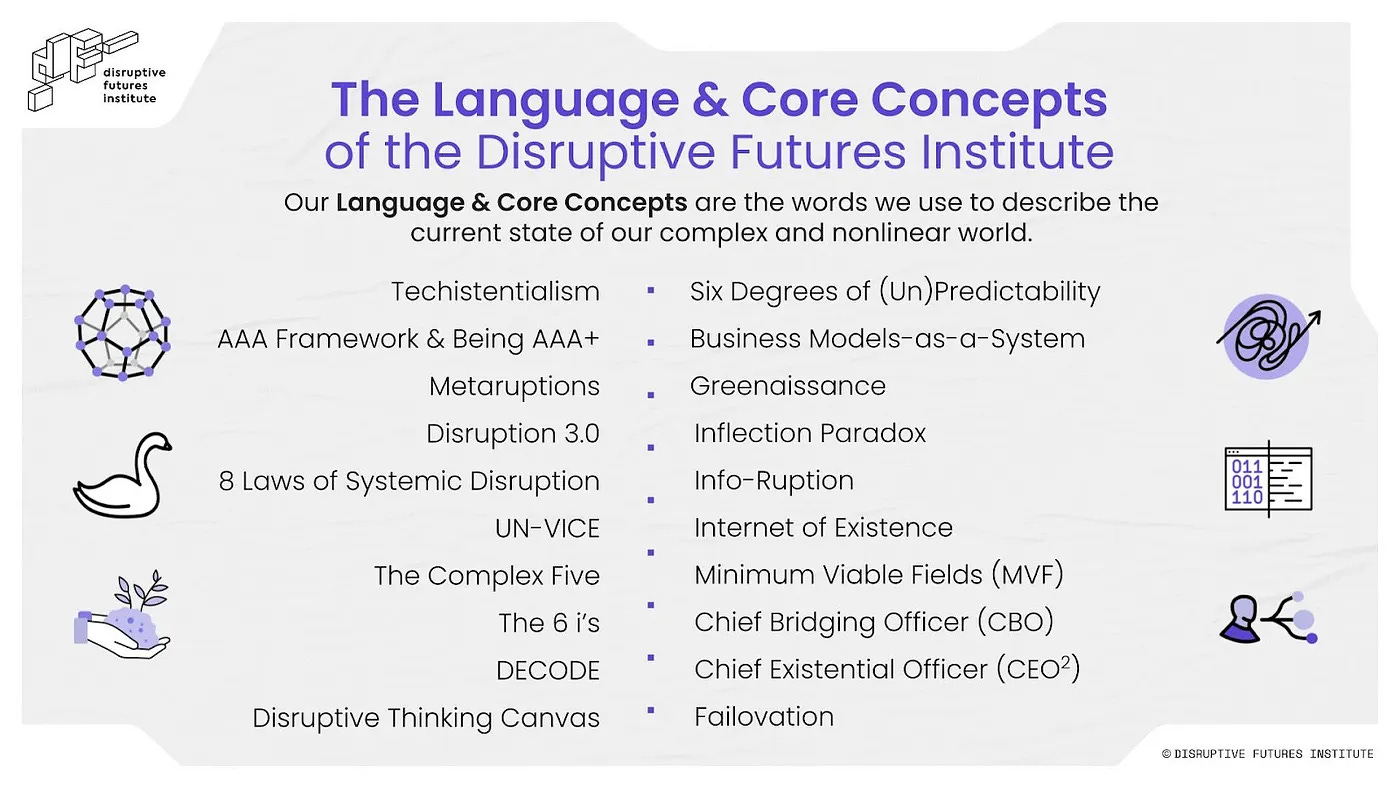
At the Disruptive Futures Institute, our Language and Core Concepts are the words we use to describe and operate in the current state of our complex and nonlinear world. These range from the tangible, such as the Chief Bridging Officer, a proposed C-suite position, to the philosophical, like Techistentialism, the study of human decision-making in our technological world.
This collection of terms and concepts is designed to help you build fluency with the evolving language of systemic disruption, complexity, and unpredictability. The Disruptive Futures Institute helps you master this language.
This article provides a high-level overview of the language and core concepts that are foundational to the Disruptive Futures Institute. To explore each of these concepts in greater depth, refer to the books, publications, articles, education programs, and keynote talks by Roger Spitz and the Disruptive Futures Institute. These resources develop our ideas and frameworks in detail including through practical applications, real-world examples, and case studies.
We hope that this overview provides a useful introduction to unique themes and proprietary methodologies of the Disruptive Futures Institute.
Introducing the Language and Core Concepts of the Disruptive Futures Institute
These words and core concepts are ordered intentionally within this article. At the top of this list are the most primary core concepts created by the Disruptive Futures Institute. We use these foundational concepts often, and occasionally reference them in other terms later on the list. While you will find some concepts grouped around similar ideas, the language of disruption is as interconnected as our complex world. No word on this list exists in a vacuum.
Techistentialism: Studies the nature of human beings, existence, and decision-making in our technological world
The AAA Framework and Being AAA+: Explores the traits that must be developed to remain relevant in the age of systemic disruption.
Metaruptions: A multidimensional family of systemic disruptions that cause widespread and self-perpetuating effects that extend beyond their initial disruptions.
UN-VICE (UNknown, Volatile, Intersecting, Complex, and Exponential): An updated way of capturing the state and velocity of the world, to replace VUCA.
The Complex Five: Five animals that represent a matrix of highly impactful events according to their degrees of uncertainty.
The 6 i’s: Unlock the mindsets necessary to embrace uncertainty — keys to not just surviving, but thriving.
Disruption 3.0: Omnipresent and systemic disruption, a constant that establishes entirely new paradigms, which themselves will evolve.
The 8 Laws of Systemic Disruption: Reframing and defining disruption in a world that is no longer linear, where patterns become increasingly hard to interpret.
Greenaissance: An era of renewal with momentous innovation and investment opportunities, with the common objective of sustainable energy transition.
The Disruptive Thinking Canvas: A dynamic process to design, implement, and drive disruption for yourself, your projects, or your organization.
Business Models-as-a-System (BMaaS): How to design a living business model as an adaptable, evolving piece in a larger ecosystem.
The Inflection Paradox: The conflicting drivers and cognitive biases that contribute to a failure to spot inflection points.
Info-ruption: A pervasive and radical change in worldwide data dynamics, with cascading effects on how information will be interpreted, used, and misused.
Internet of Existence (IoE): The integration of internet-connected technology into previously disconnected areas, bringing biology, geology, and physics online.
Minimum Viable Fields (MVF): Technology, energy, and media drive all companies, which replace the conventions of “sectors”.
Chief Bridging Officer (CBO): Proposed C-suite position responsible for reconciling the long-term goals of an organization with impactful and relevant everyday actions.
Chief Existential Officer (CEO²): Proposed C-suite position responsible for acting upon the increasing number of low-probability but very high-consequence existential risks.
Six Degrees of (Un)Predictability: A set of filters you can use to critically evaluate assumptions and stakeholder incentives.
Failovation: A model for the sort of failure that generates innovation (potentially prompting a standing ovation).
DECODE: Techistential’s foresight framework to structure our visions, imagine pathways, and connect the shifting dots to develop anticipatory mindsets.
It’s Time to Update our Understanding of Disruption
This article is a part of a larger series that shares updated knowledge and understanding of the Disruptive Futures Institute’s work on change and uncertainty through our frameworks, tools, and concepts:
The first article, titled “The Frameworks, Tools, and Language of the Disruptive Futures Institute”, provides an “executive summary” overview of the purpose and impact of the Disruptive Futures Institute’s work and contributions.
In article 2, titled “The Disruptive Futures Institute’s Frameworks & Methodologies”, we outline our proprietary structures and techniques. These foundational FRAMEWORKS help you understand, anticipate, and navigate change — as well as drive and thrive on disruption.
In article 3, titled “The Toolkits of the Disruptive Futures Institute”, we illuminate specific step-by-step toolkits you can apply directly to your life and projects. These TOOLS are applicable standalone, but often support our overarching frameworks.
In this article 4, titled “Language & Core Concepts of the Disruptive Futures Institute”, we define the words we use to describe the current state of our complex and nonlinear world. We help you master the LANGUAGE of change, uncertainty, and unpredictability.
Next, let’s dive into the Disruptive Futures Institute’s language and core concepts.
1. TECHISTENTIALISM
Definition of Techistentialism
Techistentialism, a play on the terms technology and existential, studies the nature of human beings, existence, and decision-making in our technological world. Today, we face both technological and existential conditions that can no longer be separated. We define this phenomenon as Techistentialism.
Techistentialism broadens the definition of technology’s “existential risks” to include the curtailment of human agency. This brings the discussion back to a core meaning of “existential,” beyond physical threats, to consider the deep importance of meaningful human autonomy. Instead of treating AI primarily as a speculative future danger, Techistentialism also focuses on immediate, human-centric vulnerabilities, advocating for the cultivation of human capabilities — Antifragile, Anticipatory, and Agility — as essential for relevance in the 21st century.
Roger Spitz’s strategic foresight practice is called Techistential. Techistential is a global Foresight Strategy & Futures Intelligence advisory practice based in San Francisco.
Artificial Intelligence and Human Decision-Making
Our existential condition is an uncertain one, considering the inherent dualities and paradoxes of life. Our techistential condition is no different.
The paradox of technology — its magic and hazards — gives it a unique status. As Heidegger suggests, technology “drives out every other possibility of revealing.” Technology is so dominant that it can eclipse all other ways we understand the world.
Existentially, we each have the agency to explore contingency — the idea that possible events are uncertain. Choice exists because of contingency. Our freedom as individuals is determined through our choices. If everything were predetermined, fixed by design, we would lack choice and power. But if technology is determining outcomes on our behalf, our agency is curtailed and our choices may be beyond our control.
Technology is shaping society by influencing decision-making and enabling manipulation at scale (for instance, through social media and misinformation). Through AI, technology is challenging us in a realm historically specific to humans. As AI develops, machines will become increasingly autonomous in making decisions. Here, the use of technology confronts the existential dimension. Here, we stand on the edge of our free will. Computationally rational technology is no longer neutral because it drives away contingency and choice.
Techistentialism studies the nature of human beings, existence, and decision-making in our technological world.
Read the full section on Techistentialism as a foundational framework of the Disruptive Futures Institute in “The Disruptive Futures Institute’s Frameworks & Methodologies”, an earlier article in this series.
Learn More About Techistentialism
The Techistential Center for Human & Artificial Intelligence conducts research, provides education, and advises on AI’s impacts, governance, and ethics, exploring the future of artificial intelligence and decision-making in our technological world.
In Leadership for the Future, Cambridge Scholars Publishing, Rauli Westerstrand (Nykänen) and Roger Spitz wrote a chapter that explores the philosophy of Techistentialism, called “An Existential Framework for the Future of Decision-Making in Leadership”.
Roger Spitz explores Techistentialism and “superstupidity” in his Association of Professional Futurists article, “Techistentialism: Could Superstupidity be as Dangerous as Superintelligence?”
Roger Spitz with Lidia Zuin unpack the implications of exponential technologies in The Definitive Guide to Thriving on Disruption, Volume I, Chapter 7: “It’s Alive: Technology, Innovation & Unintended Consequences”.
Disrupt With Impact applies Techistentialism in its analysis of the next-order implications of technologies, and the 10 features of technology that make it uniquely powerful.
Roger Spitz illuminates Techistentialism in the context of The Complex Five in World Economic Forum article “5 strategies to activate your agency and stay relevant in the age of AI”.
Podcasts on Techistentialism
On the Futures Intelligent Leadership Podcast, Roger Spitz and Rauli Westerstrand (Nykänen) discuss the implications of artificial intelligence on leadership and decision-making in complex environments.
On this thought-provoking episode of Thriving on Overload, Ross Dawson and Roger Spitz dive deep into decision-making in the disruptive 21st century.
Two years after their initial podcast recording, Roger Spitz updates Peter Hayward’s FuturePod on how to thrive on disruption in an age of complexity and decision-making AI.
On the Machine Ethics Podcast with Ben Byford, Roger Spitz ponders: What is AI and its role in disruption? Is AI an existential risk? How can we tell the difference between potential disaster and limitless opportunity in the age of exponential technologies?
On this episode of the AI Asia Pacific Institute Podcast, Roger Spitz discusses Techistentialism and how it relates to the future of the Pacific Islands.
Roger Spitz joins host Ben Cattaneo on The Decision-Making Studio Podcast Ep. 239, on How to Disrupt With Impact, to discuss systemic disruption and decision-making in the age of artificial intelligence.
2. AAA FRAMEWORK AND BEING AAA+
Definition of the AAA Framework and Being AAA+
The AAA Framework is a cornerstone for organizations thriving amid chaos. Designed to help individuals and organizations stay relevant in the 21st century, the AAA Framework offers the tools and mindset to build Antifragile foundations, develop the capabilities to be Anticipatory, and use emergent and strategic Agility to bridge the short-term with long-term decision-making.
In Disrupt With Impact and The Definitive Guide to Thriving on Disruption, we also expand the AAA Framework into Being AAA+, which recognizes the importance of Agency and Alignment. Being AAA+ is a dynamic, ever-evolving state of mind designed to inspire constant imagination rooted in aligned visions, values, and goals, for the ultimate purpose of exercising choice in defining and crafting our futures.
Why We Developed the AAA Framework and Being AAA+
We developed the AAA Framework to define the skills and capabilities we must develop for an unpredictable asymmetric world, because standard playbooks become increasingly ineffective. In today’s era of systemic disruption, becoming futures-savvy and resilient is a requirement, and the AAA Framework provides pathways towards this.
There are many drivers of systemic disruption, which collectively demand an adaptive approach to addressing them. These drivers include exponential technologies such as artificial intelligence. Today, AI is taking over areas previously thought too important to entrust to machines. Thus far, humans have excelled at decision-making, but our comparative advantage may not last. In our increasingly automated world, algorithms make decisions for us constantly. In the years ahead, this scope could evolve even further.
The AAA Framework explores the traits that humans should develop to improve their abilities as machines are learning fast. The AAA Framework offers the tools and mindset to build Antifragile foundations, develop the capabilities to be Anticipatory, and use emergent and strategic Agility to bridge the short-term with long-term decision-making. However, no matter how antifragile, anticipatory, and agile we are, the AAA Framework is ineffective unless you exercise Agency to make choices with Alignment. One must be aligned internally, with external forces, and our environment. That is when you become AAA+.
The AAA Framework and Being AAA+ — An Overview
Our AAA Framework is designed for humans to stay relevant in today’s era of complexity and systemic disruption:
Antifragile: Build foundations to be resilient and able to take advantage of any eventuality.
Anticipatory: Improve the capacity for anticipatory mindsets to navigate uncertainty, and go beyond short-termism, linear assumptions, and singular outcomes.
Agility: Develop the agility to respond to whatever futures emerge, while reconciling our preferred vision of the futures with today’s unpredictable reality.
In addition, to complete the AAA framework, we add two more essential ingredients, Agency and Alignment;
Agency: The confidence, the mindset, the proactiveness, the belief that you have choice.
Alignment: The values you must have to be aligned both internally and externally.
All five of these foundational pillars are required to take action and use the AAA framework to thrive in our dynamic, multistakeholder world.
Read the full section on the AAA Framework as a foundational methodology of the Disruptive Futures Institute in “The Disruptive Futures Institute’s Frameworks & Methodologies”, an earlier article in this series.
Learn More About the AAA Framework and Being AAA+
The AAA Framework features prominently in The Definitive Guide to Thriving on Disruption, Volume II: Essential Frameworks for Disruption and Uncertainty. In addition to its own Chapter 3, “AAA Framework Fundamentals: Antifragile, Anticipatory, Agility”, each of the component “A’s” is unpacked in its own corresponding chapter.
The AAA Framework and its impacts on human decision-making is explored in Disrupt With Impact in Chapter 10: “Our AAA framework: A survival guide for staying relevant in the age of AI”.
Learn more about the AAA Framework as it pertains to leadership in Roger Spitz’s chapter titled “The AAA Framework: Responsible Leadership for Sustainable Futures” in Anticipatory Governance: Shaping a Responsible Future, edited by M. Stephens. R. Awamleh, and F. Sicre.
Roger Spitz covers the AAA Framework alongside his proposed board position, the Chief Bridging Officer, in World Economic Forum article, “How anticipatory governance can help us with unpredictability”
Roger Spitz joins Dr. Lawrence Jones on Edison Electric Institute’s (EEI) Influential Minds Series. Together, they discuss incentives, mindsets, and the AAA Framework.
On the Gartner Futures Lab Podcast with host Marty Resnick (Lead Gartner Futures), Roger Spitz explores how we can apply the AAA Framework in the age of AI.
3. METARUPTIONS
What are Metaruptions?
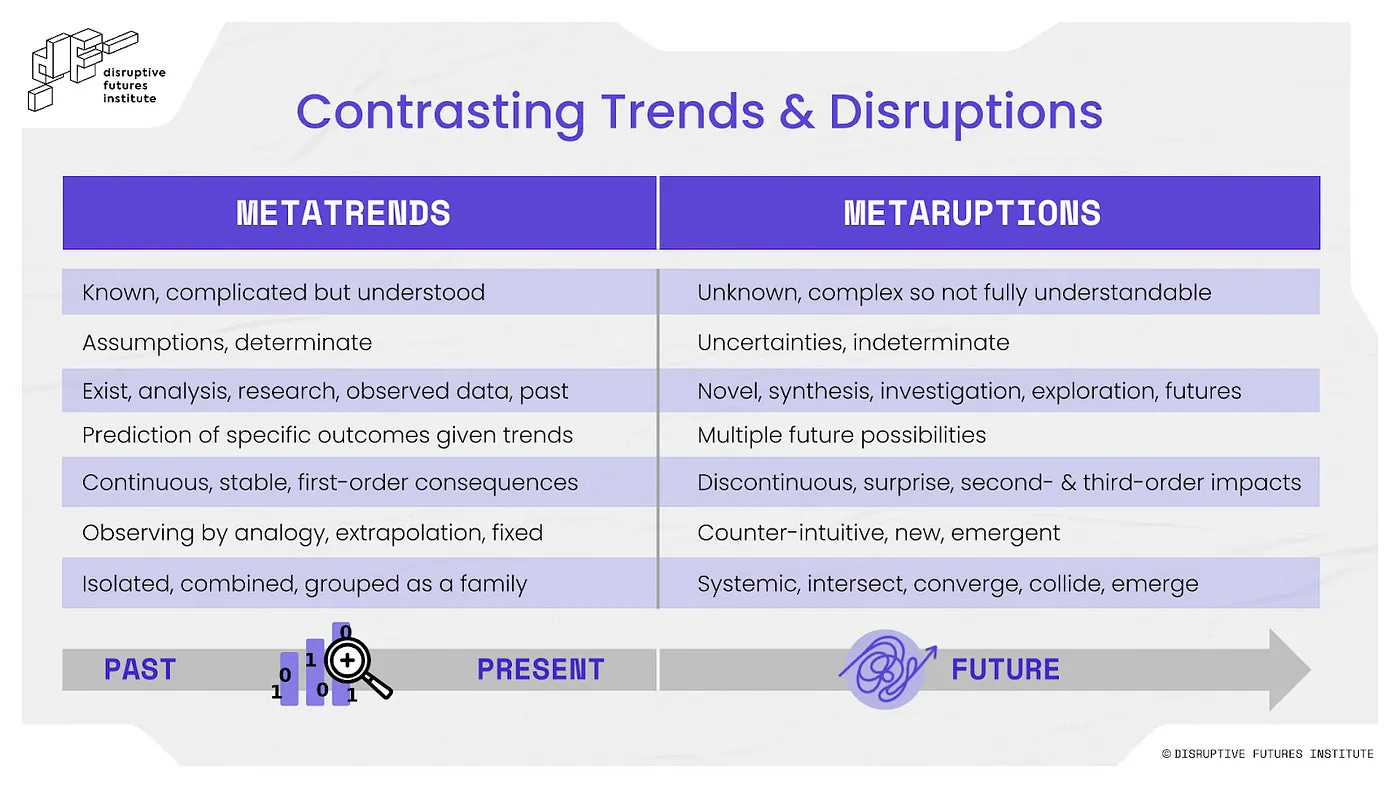
The term metaruptions is an abbreviation of disruption with the prefix “meta.” A metaruption is a multidimensional family of systemic disruptions, including shifts in the notion of disruption itself. Metaruptions are characterized by the dynamic interactions of subordinate drivers of change. These are complex, self-reinforcing disruptions that transcend mere trends — unpredictable forces that redefine industries, rewrite rules, and demand a new mindset.
Metaruptions cause widespread and self-perpetuating effects that extend beyond their initial disruptions. As initial changes spill over, these impacts combine to propagate and modify other elements within the system, ultimately disrupting the disruption itself.
Why We Developed the Concept of Metaruptions
In his 1982 book Megatrends, John Naisbitt defined megatrends as large, transformative processes with global reach and dramatic impact. Today, a megatrend is a slow-to-form, long-lasting, large-scale evolution resulting from a combination of individual trends. Similarly, metatrends are beyond individual evolutions; they represent a transformative global impact from a confluence of drivers. The prefix “meta” represents a higher level of abstraction, transcending silos.
Trend analysis can be useful, but trends only describe our past, implying some degree of continuity. Many trends die out, replaced by newer, equally ephemeral ones. Because humans are wired to extrapolate linearly, it can be challenging to have a fresh view of the world from trend analysis.
Trends are not disruptions. Systemic disruption forces us to acknowledge unpredictability. Disruption unlocks many futures, as cascading consequences follow the initial shifts. New insights emerge from the knock-on effects of change because cross-impacts determine outcomes.
Metaruptions in Quotes, Reviews & Citations
“In view of the radical global changes currently under way (growing importance of China and other actors in the Global South, etc.), which have in turn led to more upheaval in recent years, a ‘metaruption’ (Spitz, 2024) caused by the United States would probably have serious direct and indirect repercussions (functioning of international organisations; pressure to increase the defence budgets of European countries, etc.).” — Stephan Klingebiel & Max-Otto Baumann, “Trump 2.0 in Times of Political Upheaval?”, IDOS Policy Brief №24/2024
“While Roger Spitz mentions John Naisbitt’s notion of Megatrends as an earlier awareness of a polycrisis, he makes a convincing case for the concept of a “metacrisis” instead.” — Jim Dator, “Thoughts on Thoughts About the Polycrisis”, APF Compass Magazine April 2025 Welcome to the Polycrisis
“Spitz is particularly compelling on the concept of the “metaruption,” which he describes as “a multidimensional family of systemic disruptions, including shifts in the notion of disruption itself.” These “metaruptions” defy all the rules, and here, as elsewhere, the author itemizes the opportunities that can accompany the “unparalleled messiness” of change.” — Kirkus Reviews, on Disrupt With Impact
“…trends are reflections of the past, and extrapolating them can be perilous. Disruption marks the end of trends, compelling us to confront unpredictability. Here, imagination is a superior tool.” — Sebastian Petric, Scenario planning, foresight, and the power of imagination: Navigating an uncertain future, The Business Times, Singapore
“Disruption is not sporadic; it’s now our constant reality. With metaruptions, the degree of surprise we face depends on our mindset toward change. An anticipatory mindset with critical thinking diminishes astonishment for any potentiality.” — Roger Spitz, “How to Prepare for the 10 Key Drivers of Disruption”, Kogan Page
“The term ‘metaruptions’ describes a multidimensional family of systemic disruptions with widespread and self-perpetuating effects.” — From Prediction to Strategic Foresight, National Preparedness Commission (UK)
“Spitz dissects each concept while providing his unique lens and approach to understanding change. Spitz also identifies five primary ‘metaruptions,’ his way of describing the most complex types of disruptions with the most widespread impacts.” — James Holcombe, Association of Professional Futurists (APF) COMPASS Magazine
“The concept of ‘metaruptions,’ coined by the Disruptive Futures Institute, describes multidimensional systemic disruptions that extend beyond initial impacts. Understanding these disruptions requires a creative approach, because conventional data analysis falls short.” — Sebastian Petric, “Scenario Planning, Foresight, and the Power of Imagination: Navigating an Uncertain Future”, Enterprising Investor, CFA Institute
“Metaruptions cause widespread and self-perpetuating effects that extend beyond their initial disruptions.” — Roger Spitz, quote from Disrupt With Impact: Achieve Business Success in an Unpredictable World
Learn More About Metaruptions
Roger Spitz introduces and explores the concept of Metaruptions in The Definitive Guide to Thriving on Disruption, Volume I: Reframing and Navigating Disruption, in Chapter 4: “Constants and Drivers of Disruption”. In this chapter, you will also find details on the underlying Drivers of Disruption and overarching Disruption Networks.
Roger Spitz unpacks the levels of uncertainty and the power of foresight in his World Economic Forum article, “Why shifting from prediction to foresight can help us plan for future disruption”.
Dr. Lawrence Jones discuss Metaruptions, foresight, and the Energy Transition with Roger Spitz on Edison Electric Institute’s (EEI) Influential Minds Series.
In an interview article with Dongmi Choi in South Korea, Roger Spitz dissects the concept of Metaruptions and how they relate to our constantly shifting landscape.
Listen to Roger Spitz’s interview on the Seeking Delphi podcast, with host Mark Sackler, to learn more about why metaruptions matter.
In 2023, the Cascade Institute launched its new polycrisis website, which includes the Disruptive Futures Institute in its Inter-Systemic Polycris.org Stakeholder Mapping. Roger Spitz analyzes the polycrisis in the context of metaruptions in article “Polycrisis or Polyprepared? Welcome to Metaruptions”, which was published in the April 2025 APF Compass Magazine issue Welcome to the Polycrisis (Association of Professional Futurists — APF).
4. UN-VICE
Definition of UN-VICE
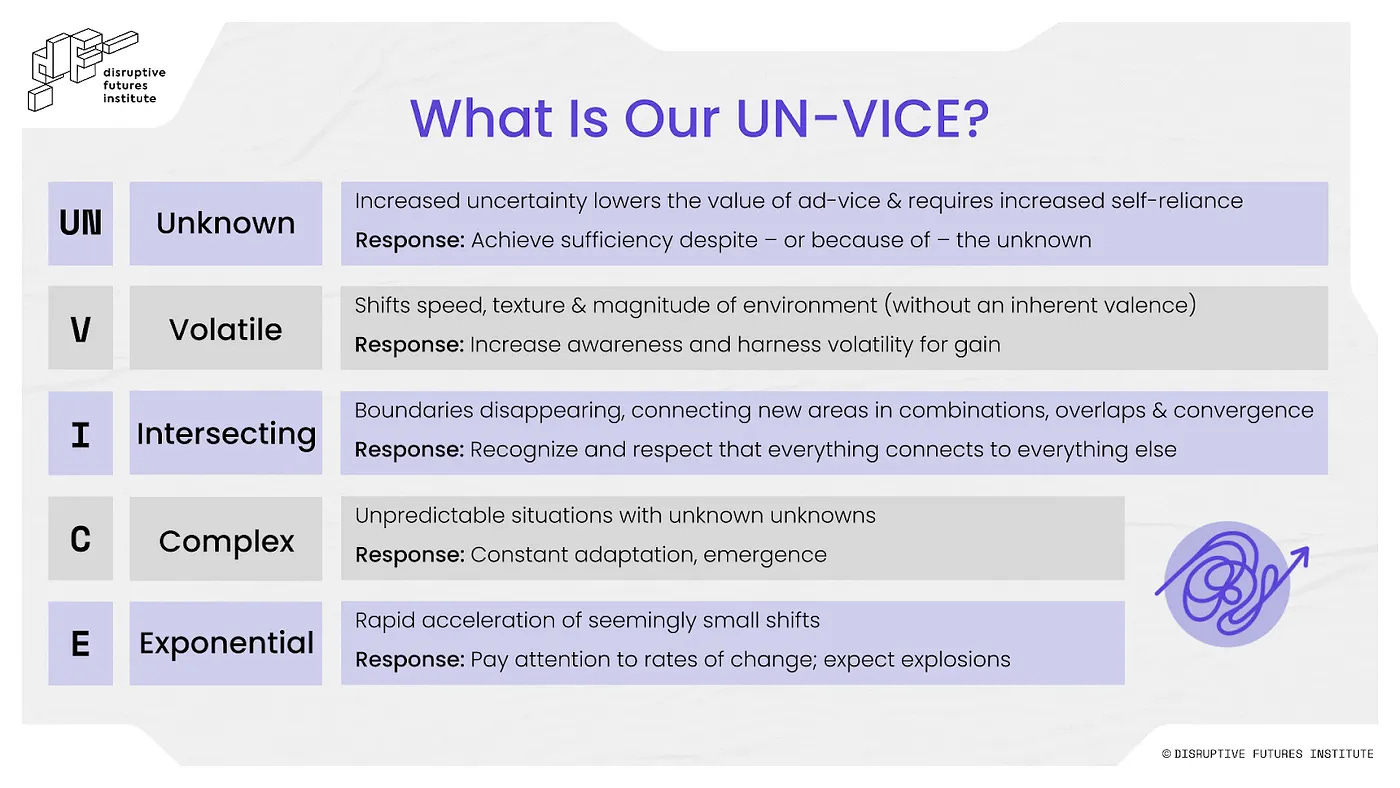
Many organizations and militaries use VUCA (Volatile, Uncertain, Complex, Ambiguous) as an acronym to describe the disruptive state of the world, given its Volatility, Uncertainty, Complexity, and Ambiguity. UN-VICE is an updated way of capturing the state and velocity of the world, with our acronym for UNknown, Volatile, Intersecting, Complex, and Exponential.
Why We Developed UN-VICE as a Replacement for VUCA
“VUCA” spread across the military’s leadership from the 1980s. Twenty years later, it made its way to business strategists. But despite its popularity, the world remains intent on behaving as if structure, control, and predictability are still dominant. For a VUCA environment, our tools and systems are becoming ineffectual, from education to governance.
There are many other variations of VUCA. While we do not need additional acronyms, we do need improved and updated methods of understanding our environment to improve future-preparedness and resiliency.
Our world is facing new tensions, contradictions, complexities, and uncertainties. This new reality is the basis for our own version of VUCA, updated with two additional features: Intersecting and Exponential. In an UN-VICE world, these concepts are as important as UNknown, Volatile, and Complex. We must go beyond automatically relying on advice and start forming our own UN-VICE to survive. Proposing yet another acronym is risky — we hope the acronym police will be merciful.
What is UN-VICE?
UN-VICE is an updated way of capturing the state of the world. Framing the dynamics of systemic disruption as UNknown, Volatile, Intersecting, Complex, Exponential enables an empowering response. We are not helpless victims unable to make decisions. With UN-VICE, we have the power to shape our own futures.
UNknown: Uncertainty becomes our comfort zone. Recognize you can’t know anything perfectly and many decisions are based on assumptions.
Volatile: Harness change for gain. Our world, and change itself, is evolving faster than ever before. Volatility is not new; we simply can’t ignore its impact.
Intersecting: Everything connects to everything else. The broader our lens, the greater the insights gained from realizing how boundaries are disappearing.
Complex: Notice emergent properties and adapt. In complex environments, inputs do not map clearly to outputs. Such systems require critical thinking, experimentation, and judgment.
Exponential: Pay attention to nonlinear types of change that increase in growth rate. Notice rapid acceleration of seemingly small shifts. Monitoring early on will mean fewer surprises.
UN-VICE in Quotes, Reviews & Citations
“His concept of UN-VICE (Unknown, Volatile, Intersecting, Complex, and Exponential) resonates strongly, effectively capturing the essence of our current era and the imperative for new approaches to leadership and decision-making.” — Frank Diana, Reimagining the Future, Managing Partner and Principal Futurist at Tata Consultancy Services (TCS)
“Management in fact, given its limited cognitive capabilities, in most cases simplifies complex and/or complicated strategic situations (Simon, 1987)… or making decisions based on extrapolating the past with linear predictions (Spitz, 2020).” — Roberto Biloslavo, David Edgar, Erhan Aydin, Cagri Bulut, “Artificial intelligence (AI) and strategic planning process within VUCA environments: a research agenda and guidelines”, Management Decision
“Spitz urges readers to stop relying on known precedents and reliable advice. In an UN-VICE world, new strategies must emerge.” — James Holcombe, Association of Professional Futurists (APF) COMPASS Magazine
“The book emphasizes developing new mindsets and offers helpful frameworks like UN-VICE, which posits that everything is Unknown, Volatile, Intersecting, Complex, and Exponential. This concept resonates deeply with the media landscape we’re navigating.” — Ezra Eeman, Strategy & Innovation Director at NPO
“Binary, analogical, and one-dimensional thinking, motivated by deep-rooted convictions, is ineffective in understanding an intrinsically fluid, non-linear, and often ambiguous political environment in which uncertainty prevails (Spitz and Zuin 2022). If the understanding of these phenomena is flawed, the resulting foreign policy decisions might be suboptimal or even disastrous in some cases.” — Eugenio V. Garcia, “Technology for Whom and for What? A Global South View of Tech Diplomacy”
“Experts and their advice are less helpful now than they’ve ever been, and their helpfulness continues to decrease.” — Roger Spitz with Lidia Zuin, quote from The Definitive Guide to Thriving on Disruption: Vol. I. Reframing and Navigating Disruption
“As Spitz explains: ‘we must go beyond automatically relying on advice and start forming our own UN-VICE to survive… with intersecting, cross-impacts determining outcomes. The more connected everything is, the more combinatorial effects will interact…’” — James Balzer, Australian Climate and Sustainability Policy Practitioner, Illuminem
“An acronym that should help make sense of the multiple layers of unpredictability and more importantly, what you can do about them.” — Noah Ackland, “Predicting the Unpredictable in Business with Roger Spitz”, Hult International Business School Blog
Learn More About UN-VICE
Volume I of The Definitive Guide to Thriving on Disruption introduces UN-VICE in a dedicated Chapter: “Our Best ‘UN-VICE’ for the Disruptive Futures”.
In his exploration of systemic disruption, Roger Spitz deconstructs his UN-VICE to contrast experts’ ad-vice in Disrupt With Impact: Achieve Business Success in an Unpredictable World.
On Edison Electric Institute’s (EEI) Influential Minds Series, Roger Spitz outlines the differences between VUCA and UN-VICE to host Dr. Lawrence Jones.
In this Youtube Short excerpt from the IBM Business of Government Hour podcast, Roger Spitz discusses why UN-VICE is the opposite of ad-vice.
5. THE COMPLEX FIVE
Definition of The Complex Five
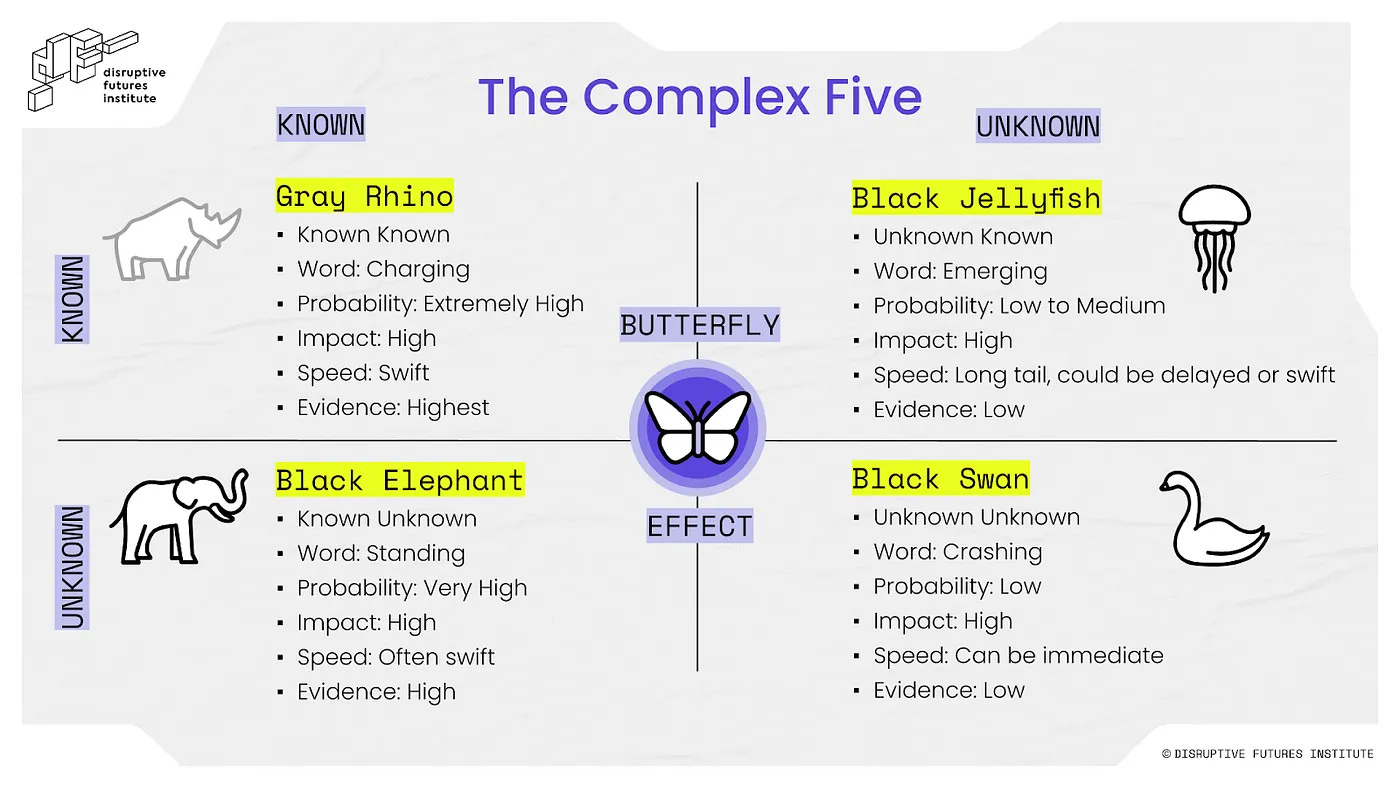
The Complex Five are five animals that represent a matrix of highly impactful events according to their degrees of uncertainty; namely Black Elephant, Black Jellyfish, Black Swan, Gray Rhino, and the Butterfly Effect.
Why Did We Develop The Complex Five?
Today, surprise is often the result of not listening well enough. Beyond scanning for discernable signals and to inform scenario development, there are additional ways to better prepare for the surprises ahead. We constantly need to assess what is knowable (what you could know, but don’t) and what is unknowable (what you cannot actually know).
Nassim Nicholas Taleb uses the famous example of Black Swans to describe unforeseeable events with extreme impacts. This term originates from the old European belief that all swans were white until the first encounter with a black swan challenged that. Similarly, Michele Wucker defines Gray Rhino events as highly probable and obvious, yet despite clear warning signs, we still fail to respond.
Our UN-VICE environment is not as binary as either Black Swans appearing out of nowhere, or predictable Gray Rhinos. We must appreciate the variability, nuances, and textures within the spectrum of these two extremes. As such, we developed The Complex Five.
What are the Features of The Complex Five?
Recognizing the different types of uncertainty is a prerequisite to better anticipate unknown futures. The Complex Five embody these levels of uncertainty, and provide us with pathways to address them:
Known Knowns (Gray Rhino): For things we know that we know, we use author Michele Wucker’s definition of “Gray Rhino.” There is no uncertainty with Gray Rhinos; we might treat them as contingent or unknown, but they are outright certain.
Insight: To avoid being trampled by the Gray Rhino, anticipate the impacts, rather than muddling along and panicking when it’s too late.
Unknown Knowns (Black Jellyfish): Things that we think that we know, but it transpires that we may not actually understand them when they manifest. Here, situations that we believe we initially understand, and might even expect, can become far more complex, as small changes drive larger and less predictable impacts. To describe such unknown knowns, Postnormal Times uses the term “Black Jellyfish.”
Insight: To respond to Black Jellyfish, consider snowballing effects by asking how reverberations could cascade further, and even become irreversible.
Known Unknowns (Black Elephant): Things we know we don’t know, including new diseases, unfolding impacts of climate change, and geopolitical events triggering mass migration. These are obvious, highly likely threats, but with few willing to acknowledge or see them. We call these known unknowns “Black Elephants,” based on a term attributed to the Institute for Collapsonomics.
Insight: Black Elephants require mobilizing action, aligning stakeholders, and understanding the changes throughout our complex systems. In specific situations, own your response. Don’t let Black Elephants blindside you, or they will morph into Gray Rhinos and charge.
Unknown Unknowns (Black Swan): Things that we don’t know that we don’t know. For these unpredictable “outliers,” we use Taleb’s “Black Swans.”
Insight: Responses to Black Swans include building antifragile foundations and paying attention to rare events with profound impacts. However unpredictable Black Swans are, we can still be anticipatory, while implementing guardrails for the randomness of our world.
Butterfly Effects: The flapping wings of one majestic insect brings these animals together. The “Butterfly Effect,” defined by meteorologist Edward Lorenz, describes how small changes can have significant and unpredictable consequences. To illustrate, Lorenz described a butterfly flapping its wings influencing tornado formation elsewhere.
Insights: Build resilience, action adaptive strategies, and expect the unexpected.
The Complex Five in Quotes, Reviews & Citations
“The author presents a compelling typology of risks associated with the development and deployment of artificial intelligence (AI). Drawing on vivid animal metaphors, the author categorizes these risks into three distinct types: Black Jellyfish, Black Elephants, and Black Swans. Each category represents a unique set of challenges and potential consequences that demand our attention and proactive responses.” — Abhivardan, Indic Pacific Legal Research and Indian Society of Artificial Intelligence & Law
“In addition to the Gray Rhino, the book introduces other forms of disruption. The Black Jellyfish represents “unknown knowns” — seemingly minor issues that, if left unchecked, can spiral into unpredictable crises. The Black Elephant stands for “known unknowns” — major risks widely recognized but often ignored, like the proverbial elephant in the room. Finally, the Black Swan symbolizes “unknown unknowns” — highly improbable, unpredictable events with far-reaching consequences, only understood in hindsight. These metaphors underscore the need for vigilance and adaptive strategies in facing diverse and complex threats.” — Dongmi Choi, Korea’s Leading LinkedIn Influencer & Global Women of Influence Award 2024
“Combining strategic foresight and systems dynamics principles, ‘Disrupt with Impact’ offers a framework and tools for confidently moving ahead in an uncertain world. Readers will find value in case studies on business themes from bluetech to open banking, lessons from successes and failures, and new opportunities. This book will help you to harness gray rhino challenges ahead in order to become a disruptive force for good — instead of being trampled.” — Michele Wucker, author of The Gray Rhino, on Disrupt With Impact
Learn More About The Complex Five
Read about The Complex Five in Chapter 5, “Anticipatory: The Capacity to Prepare for Constant Disruption”, in The Definitive Guide to Thriving on Disruption, Volume II: Essential Frameworks for Disruption and Uncertainty.
Learn the core drivers of unpredictability and how to generate effective responses to The Complex Five in Disrupt With Impact.
On the Gartner Futures Lab Podcast with host Marty Resnick (Lead Gartner Futures), Roger Spitz explains Gray Rhinos, Black Swans, and alignment in the future.
Roger Spitz explores the implications of AI through the lens of The Complex Five in “5 strategies to activate your agency and stay relevant in the age of AI”, in the World Economic Forum.
6. THE 6 i’S
The 6 i’s, Explained
The language of disruption is rooted in action. Unlock the mindsets necessary to embrace uncertainty with the 6 i’s — keys to not just surviving, but thriving:
Intuition: Explore ambiguous environments without straightforward answers by tapping into curiosity, avoiding preconceptions.
Inspiration and Imagination: Encompassing broader futures, be inspired by asking profound questions and breaking from the present.
Improvisation: Experiment through improvisation, mistakes, and ambiguity, seeking authenticity.
Invention: Nothing is predetermined. We have an open canvas to create our futures.
Impossible: With the courage to wander and fail, you can stumble upon — and achieve — the impossible.
These are our 6 i’s to thriving on disruption: Intuition, Inspiration, Imagination, Improvisation, Invention, Impossible.
Read the section on the 6 i’s Toolkit in “The Tools & Toolkits of the Disruptive Futures Institute”, an earlier article in this series.
Learn More About the 6 i’s
In Disrupt With Impact, Chapter 2: “Embracing new mindsets for thriving on uncertainty and disruption”, Roger Spitz shares how we can use the 6 i’s to cultivate new mindsets and capabilities crucial for thriving amidst ambient disruption.
On the IBM Business of Government: Special Leadership Edition Roger Spitz discusses with host Michael Keegans how we can use the 6 i’s to stay relevant.
The Definitive Guide to Thriving on Disruption, Volume II: Essential Frameworks for Disruption and Uncertainty explores the 6 i’s in great detail, across a number of chapters with applied case studies and insights.
7. DISRUPTION 3.0
Definition of Disruption 3.0
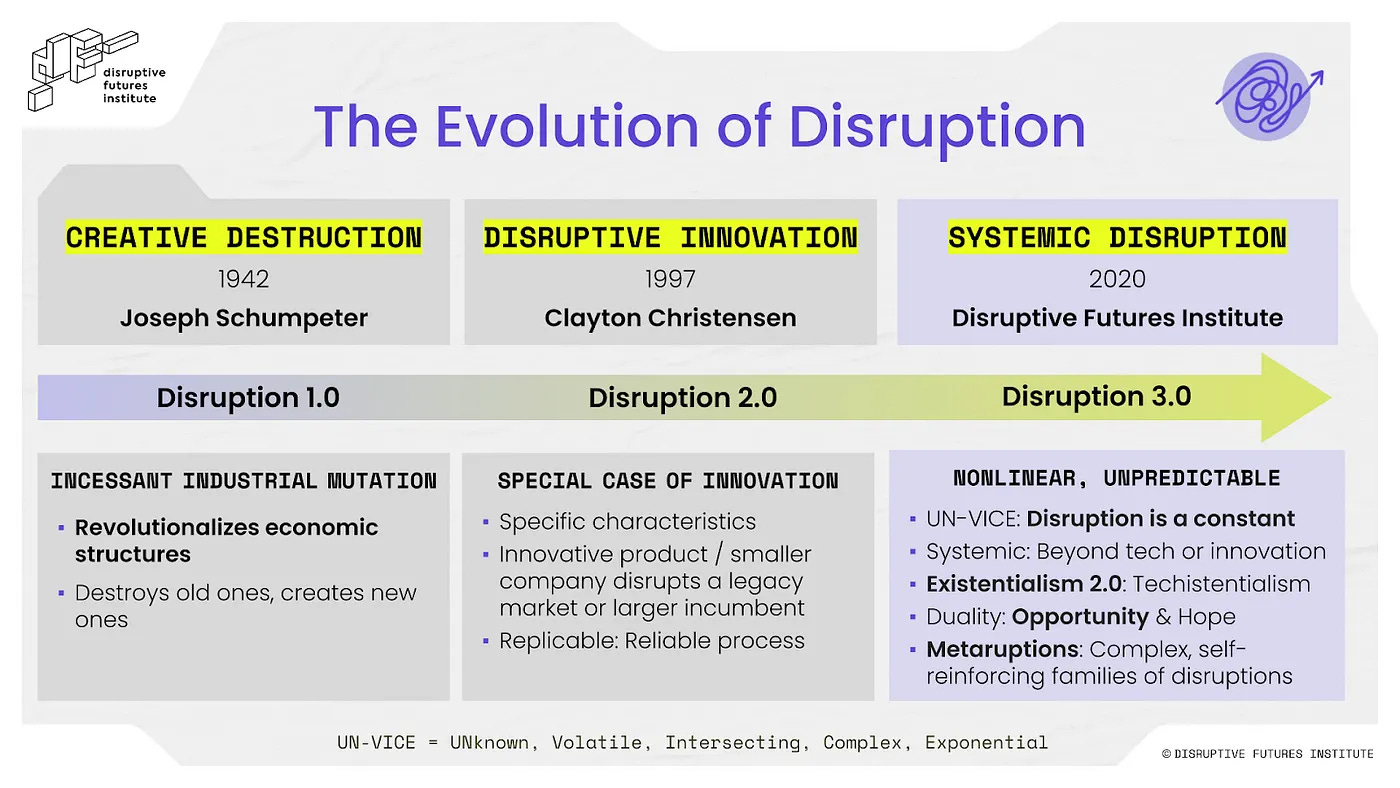
We define Disruption 1.0 as the implementation of “Creative Destruction,” the term coined by Joseph Schumpeter, which describes the process by which a new industrial mutation destroys an old paradigm.
Clayton Christensen developed the concept of “Disruptive Innovation,” which describes the specific characteristics of how an innovative product typically disrupts an old market by following a reliable process. We use this definition as Disruption 2.0.
Disruption 3.0 is omnipresent and systemic — it is a constant which establishes entirely new paradigms, which themselves will evolve.
Why We Coined the Term “Disruption 3.0”
The single most dangerous mistake is looking at disruption as isolated cases or independent episodic events. The complex network of interconnected forces driving disruption reinforces the inherent dislocations, paradoxes, and diversity of perspectives, problems, and responses.
This environment conjures a new type of disruption, omnipresent and systemic. It establishes entirely new paradigms, which themselves will evolve. We label this Disruption 3.0.
Omnipresent disruption is a constant, in which entirely new paradigms are forged and reshaped. Here, systemic disruptive effects are compounded, as both hazards and opportunities interact multiplicatively. We define this era as “Disruption 3.0.”
Disruption 3.0 in Quotes, Reviews & Citations
“Today, we face what Spitz refers to as Disruption 3.0. Disruption is no longer limited to global pandemics, economic recessions, and technological breakthroughs. Disruption is holistic. Disruption is omnipresent. Disruption is unavoidable.” — James Holcombe, Association of Professional Futurists (APF) COMPASS Magazine
“His exploration of systemic disruption, or what he terms “Disruption 3.0,” is particularly insightful, as he points out the significance of the cascading effects of interconnected changes that defy traditional linear thinking.” — Chris Mayer, Director of Philosophy, United States Military Academy at West Point, Futures Empowered
“Disruption 3.0 is a breeding ground for Butterfly Effects.” — Roger Spitz, quote from Disrupt With Impact: Achieve Business Success in an Unpredictable World
“[The article] highlights the concept of systemic disruption, which refers to the cascade of constant disruptions across our interconnected world, making it difficult to predict future events.” — From Prediction to Strategic Foresight, National Preparedness Commission (UK)
“Through each chapter, Spitz invests considerable time into breaking down the issue and why Disruption 3.0 requires a deep understanding of each problem. Organizations must utilize systems thinking to navigate these novel problems.” — James Holcombe, Association of Professional Futurists (APF) COMPASS Magazine
“[Roger] said that disruption has always existed, but how we reframe it and analyze its nature can help us with strategic decision making. Through anticipatory thinking, we can mitigate the negative impacts of disruptions and navigate different levels of uncertainty.” — Lawrence Jones, Edison Electric Institute Senior VP of International Programs, Navigating Uncertainty: The Clean Energy Transition
“Systemic disruption goes beyond industry boundaries; we need to widen the aperture to explore the fringe.” — Roger Spitz, quote from Disrupt With Impact: Achieve Business Success in an Unpredictable World
Learn More About Disruption 3.0
In Volume IV of The Definitive Guide to Thriving on Disruption, Roger Spitz with Lidia Zuin outline the evolution of disruption, from Disruption 1.0 to Disruption 3.0.
Roger Spitz connects the dots between Disruption 3.0 and our complex world in Disrupt With Impact: Achieve Business Success in an Unpredictable World.
Roger Spitz defines Disruption 3.0 in this clip from the Seeking Delphi podcast with Mark Sackler.
On the IBM Business of Government Hour Podcast with host Michael Keegan, Roger Spitz discusses Disruption 3.0 and its connections with UN-VICE.
8. THE 8 LAWS OF SYSTEMIC DISRUPTION
Definition of the 8 Laws of Systemic Disruption
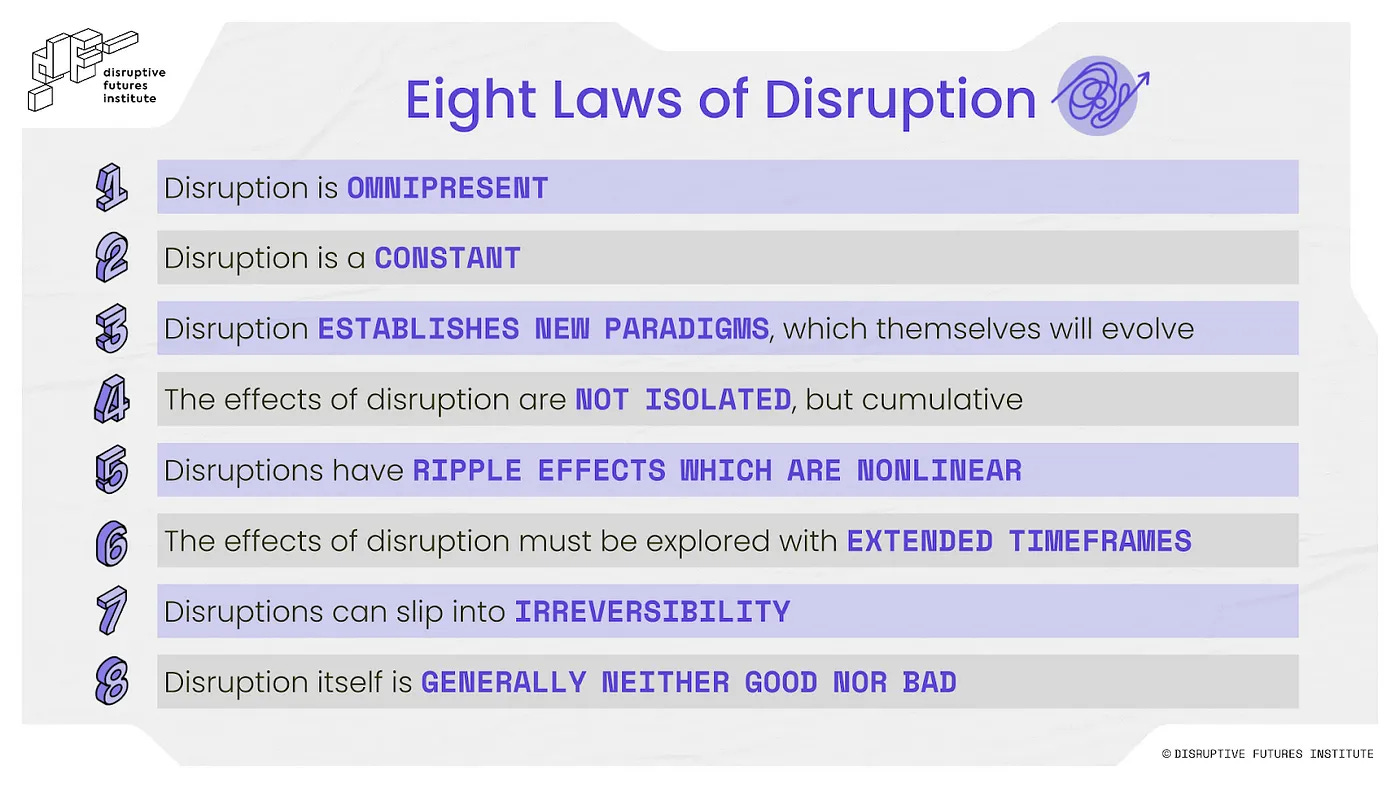
In an unpredictable world where patterns become increasingly hard to interpret, we need to reframe disruption itself. These are the 8 Laws of Systemic Disruption:
Disruption is omnipresent, affecting everyone, everything, everywhere. While disruption is not only technology-driven, technology permeates every facet of our world, so disruption and technology are often interlinked.
Disruption is a constant. It is no longer merely a single event but a steady state.
Systemic disruption establishes new paradigms, which themselves will evolve, sometimes morphing without warning.
Effects are combinatory and cumulative — not isolated. Disruptions interact as hyperconnected networks.
Systemic disruptions have nonlinear ripple effects. The initial disruption (input) can ricochet into amplified higher-order effects (output).
Disruption’s effects must be explored with extended timeframes. The consequences of change only become apparent over time.
Left unchecked, disruptions can slip into irreversibility.
Disruption itself is generally neither good nor bad; its impact depends on one’s perspective, degree of preparation, and nature and timing of response.
Why We Defined 8 Laws of Systemic Disruption
Systemic disruption forces us to acknowledge unpredictability. Disruption unlocks many futures, as cascading consequences follow the initial shifts. New insights emerge from the knock-on effects of change because cross-impacts determine outcomes.
Systemic disruptions cause ripple effects that ricochet into new, counterintuitive, or even revolutionary changes. The inability to understand the implications of the initial impact is why disruption becomes apparent only in hindsight. Systemic disruption means there may be no measurable data to substantiate our emerging understanding. Here, imagination outshines analysis.
“[Disrupt With Impact] is not just a guide for navigating business in a fast-changing world; it’s a profound exploration of foresight, systemic disruption, and innovation.” — Dimitris Dimitriadis, Member Researcher at Special Secretariat for Strategic Foresight, Presidency of the Greek Government
Learn More About the 8 Laws of Systemic Disruption
Roger Spitz defines the 8 Laws of Systemic Disruption in The Definitive Guide to Thriving on Disruption, Volume I, Chapter 4: “Constants and Drivers of Disruption”.
Disrupt With Impact outlines the 8 Laws of Systemic Disruption in his exploration of the evolution of disruption.
Roger Spitz joins host Doug Noll on the Listening with Leaders Podcast to discuss systemic disruption, decision-making in uncertain environments, and the existential risks that face our society.
9. GREENAISSANCE
Definition of Greenaissance
An era of renewal with momentous innovation and investment opportunities, aligned across fields with the common objective of sustainable energy transition.
Why We Use the Term “Greenaissance”
“This is a moment in time to invest and develop innovative solutions to enable net-zero and regenerative transformations. There is no greater innovation challenge for the defining decade ahead than to rethink and reconfigure towards sustainable growth.” — Roger Spitz with Lidia Zuin, quote from The Definitive Guide to Thriving on Disruption: Vol. IV. Disruption as a Springboard to Value Creation
The Renaissance was a period of philosophical, literary, artistic, cultural, and economic “rebirth” after the Middle Ages. We use the term Greenaissance to describe an era of renewal with momentous innovation and investment opportunities, aligned across fields with the common objective of sustainable energy transition.
This emerging Greenaissance era is an unprecedented opportunity to develop innovative solutions to the climate crisis.
Sustainable structural transformations are now expected by many regulators, investors, and the next generation of customers. As decarbonization scales, it can reach a virtuous inflection point, becoming more cost-effective. The economic benefits could then exceed the transition costs.
Greenaissance in Quotes, Reviews & Citations
“Every organization must become an energy organization in the face of climate change. The ‘Greenaissance’ era is the opportunity for unprecedented investment in new energy models. Apocalypse is not unavoidable, but transforming our habits, values, and markets is required. We can create public-private accountability mechanisms by reimagining traditional business models and corporate metrics while allowing industry to thrive. Spitz provides a comprehensive list of emerging green technologies that he expects to be critical innovations for combatting climate change.” — James Holcombe, Association of Professional Futurists (APF) COMPASS Magazine
“Chapter 7 moves into global systems (the chapter is called Greenaissance) and takes a similarly readable approach to the complex elements interplaying in the global ecosystem.” — Charles Brass, Chair, The Futures Foundation, Future News, on Disrupt With Impact
“Having known him from Singularity University, I have seen firsthand his ability to inspire and challenge leaders to think deeply about sustainable futures. His book ‘Disrupt With Impact’ is a vital resource for anyone aiming to navigate and thrive amidst disruption.” — Pinak Kiran Vedalankar, Global Technology Leader, on Disrupt With Impact
“To avoid the ‘Commercialization Valley of Death,’ ClimateTech has to problem-solve, then deploy, interact, and scale in an emergent manner in the context of a hyperconnected systemic real world.” — Roger Spitz, “ClimateTech: system innovation (versus point solutions)”, illuminem
“Addressing critical challenges like sustainability, AI, geopolitics, and cybersecurity, [Disrupt With Impact] serves as a compass for exploring the uncharted waters of the future.” — Manoj K Raut, CEO & Secretary-General, Institute of Directors, India, Director Today
Learn More About Greenaissance
The Definitive Guide to Thriving on Disruption, Volume IV: Disruption as a Springboard for Value Creation devotes a full chapter to Greensiassance, elaborating upon this unprecedented opportunity to develop innovative solutions to the climate crisis.
Greenaissance is a core theme of Disrupt With Impact: Achieve Business Success in an Unpredictable World, and features prominently as the primary topic of Chapter 7: “Greenaissance: Value creation for sustainable futures”.
On this episode of the CitiesFirst Podcast with host Scott Shepard, Roger Spitz applies his experience as a venture capitalist investing in the future of mobility to discuss how emerging technologies and artificial intelligence can help cities build resilience in the context of the mounting climate crisis.
Host Jonathan Hackett (Head of Energy Transition at BMO Capital Markets) and Roger Spitz discuss the future of sustainability and the role of companies, investors, and technology in addressing the climate crisis, on the BMO Sustainability Leaders Podcast episode “What a Futuristic Mindset Means for Sustainability”.
On this episode of Upside & Impact: Investing for Change, Roger Spitz and host Elysabeth Alfano discuss whether or not we can have a sustainable future.
10. DISRUPTIVE THINKING CANVAS
What is the Disruptive Thinking Canvas?
The Disruptive Thinking Canvas is a personalized roadmap designed to help you thrive in today’s shifting environments. By identifying unexplored opportunities, you can invent the future, whether for yourself, your projects, or your organization. The Canvas offers a step-by-step guide to navigate disruption and create impact, equipping you with the mindset and tools needed to succeed.
We created our proprietary Disruptive Thinking Canvas as a dynamic roadmap — a process to design, implement, and drive disruption for yourself, your projects, or your organization. It’s not just a canvas; it’s your actionable toolkit to uncover and create disruptive futures on your terms, with tools designed to develop new mindsets for generating impact.
We outline below the six steps of the Disruptive Thinking Canvas:
Step 1 — Reframing Disruption: Redefine disruption to realize how positive opportunities can be found in disruptive times.
Step 2 — Scanning and Mapping: Anticipate, identify, and investigate potential disruptions ahead.
Step 3 — Ideating: Embrace new mindsets to harness uncertainty; imagine untapped opportunities to problem-solve our complex challenges and spur transformations.
Step 4 — Dissent and Alignment: Increase alignment and overcome resistance while challenging the status quo.
Step 5 — Decision-Making and Driving Change: Understand decision-making in deeply uncertain environments, and how to effect change in a systemic context.
Step 6 — Iterating: Apply changes, assess impacts, incorporate new information, and utilize feedback to adapt continuously.
Read the outline section on the Disruptive Thinking Canvas as a foundational framework of the Disruptive Futures Institute in “The Disruptive Futures Institute’s Frameworks & Methodologies”, an earlier article in this series.
Learn More About the Disruptive Thinking Canvas
Disrupt With Impact explores the Disruptive Thinking Canvas in great detail, outlining specific practitioner frameworks you can use to apply the Canvas to your life and projects.
On the IBM Business of Government Hour Podcast with host Michael Keegan, Roger Spitz outlines the tools and frameworks leaders can use to navigate constant uncertainty, and strategies to unleash our disruptive thinking, to imagine, invent, and prototype our futures.
11. BUSINESS MODELS-AS-A-SYSTEM (BMaaS)
What are Business Models-as-a-System?
System-level innovation acknowledges how everything is interconnected. In perpetually evolving environments, there is an inherent need to act and respond with novel options.
Hardwired models only change periodically — if at all. To be relevant in today’s UN-VICE world, business models must adapt to paradigm shifts with agility. Dynamic business models support experimentation, catalyze innovation, and create shared value for the entire ecosystem, providing deeper complementarities between participants.
We define these ecosystems as Business Models-as-a-System (BMaaS), which emerge thanks to three key elements: Eco, Co, and Ecosystems.
“Eco” is Eco-friendly: New opportunities, jobs, and industries for those creative enough to shift to more sustainable ecosystems across agriculture, energy, transportation, real estate, retail, and more.
“Co” refers to Collaboration: Co-created, Co-evolving, Connected, and Consumers.
“Ecosystems” live and breathe dynamic changes: They are systemic, in flux, interdependent, and generate feedback loops to emerge with something new.
Read the full section on the BMaaS Toolkit in “The Tools & Toolkits of the Disruptive Futures Institute”, an earlier article in this series.
Learn More About Business Models-as-a-System (BMaaS)
Roger Spitz describes how BMaaS can fit into the broader ClimateTech ecosystem in illuminem article, “ClimateTech: system innovation (versus point solutions)”
The Definitive Guide to Thriving on Disruption, Volume IV: Disruption as a Springboard for Value Creation, devotes a chapter to the exploration of BMaaS: “Chapter 3. Ecosystem Innovation: Platform Evolution 2.0 & Business Models-as-a-System (BMaaS)”
Roger Spitz outlines how BMaaS can help business leaders innovate and address complex challenges in Disrupt With Impact: Achieve Business Success in an Unpredictable World.
12. INFLECTION PARADOX
“One issue which exacerbates the Inflection Paradox is that innovations are often explored in isolation, within distinct fields. In reality, breakthroughs occur across fields as impacts intersect and converge.” — Roger Spitz with Lidia Zuin, quote from The Definitive Guide to Thriving on Disruption: Vol. II. Essential Frameworks for Disruption and Uncertainty
Definition of the Inflection Paradox
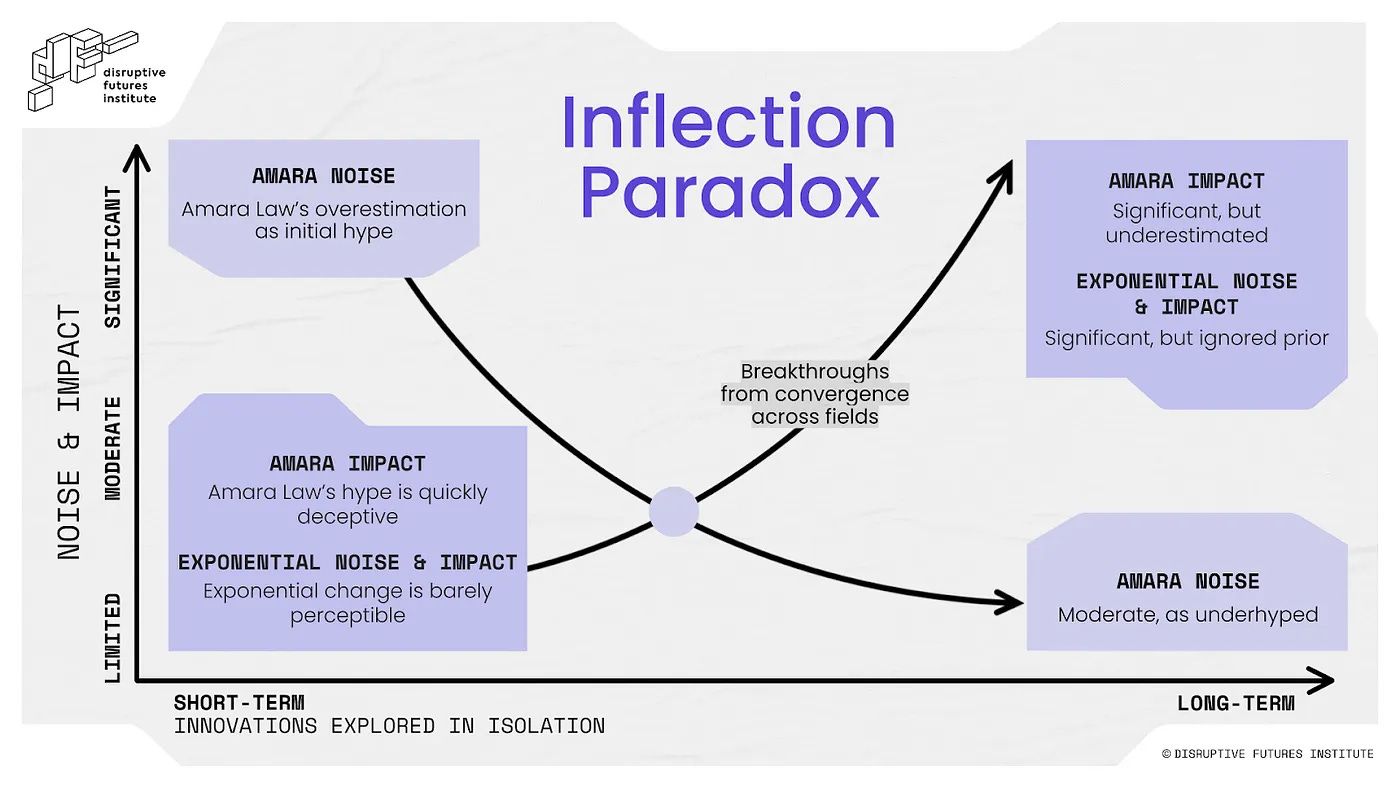
The conflicting drivers and cognitive biases that contribute to a failure to spot inflection points. In the early stages, exponential changes may be imperceptible while noise from emerging technology can be dismissed as hype (Amara’s Law). Later on, we may recognize an inflection point’s dramatic effects only after it has passed.
Why We Coined the Inflection Paradox
Change may be slow, but the tempo of disruption is fast. Even when we carefully monitor innovations, we may fail to recognize the patterns of change. Inflection points, or tipping points, mark transformative shifts from one stage to another. These pivotal moments emerge when minor changes converge, giving rise to watershed transitions that redefine paradigms.
We miss inflection points for two contradictory reasons. We call this the “Inflection Paradox”:
Amara’s Law: In the early stages, one may be tempted to dismiss overhyped emerging technology. Then, after the prolonged wait, we underestimate its long-term impacts.
The shape of exponential change: Despite the noise, early developments are barely perceptible. Even explosive growth only becomes apparent after some time. Longer-term, we completely underestimate the dramatic effects of exponential change.
“Exponential change is initially slow; our cognitive biases expect it to continue linearly. This deceptive nature causes people to miss inflection points as the change accelerates.” — Chris Mayer, Director of Philosophy, United States Military Academy at West Point, Futures Empowered
Learn More About the Inflection Paradox
The Inflection Paradox can be found in The Definitive Guide to Thriving on Disruption, Volume IV, Chapter 8: “Disruptive Futures Leadership Workbook: Reinventing Governance & Strategic Decision-Making”.
In Disrupt With Impact, Roger Spitz explains how we can use the Inflection Paradox for navigating and anticipating disruptions.
On the Seeking Delphi podcast with host Mark Sackler, Roger Spitz expands upon the Inflection Paradox as a tool for foresight practitioners.
Live from São Paulo, Brazil, Roger Spitz discusses the Inflection Paradox and its implications on humanity with host Cynthia Michels on the Tá na Área! Podcast.
13. INFO-RUPTION
Definition of Info-Ruption
“Info-ruption” is a pervasive and radical change in worldwide data dynamics, with cascading effects on how information is interpreted, used, and misused.
Why We Coined the term “Info-Ruption”
“Na era da “Info-Ruption”, a informação se tornou uma ameaça existencial para a democracia. A crescente quantidade de informações, juntamente com a desinformação e manipulação de dados, desencadeia uma guerra invisível e não declarada. [In the era of ‘Info-Ruption’, information has become an existential threat to democracy. The increasing amount of information, coupled with disinformation and data manipulation, triggers an invisible and undeclared war.]” — Roger Spitz in EconomiaSC interview, “Futurista Roger Spitz revela estratégias para enfrentar os desafios do futuro empresarial”
Information is the understanding of data in context — the message conveyed — to provide knowledge. Disinformation is false information designed to mislead, while misinformation is inaccurate information.
In this context, we call “info-ruption” a pervasive and radical change in data dynamics, with cascading effects on how information is interpreted, used, and misused.
Driven by the growth of giants like Google, Facebook, and TikTok, digital services increasingly require user data access. Data extraction fuels their operations, commodifying consumer attention. Many view this exchange as “free,” unaware that “if you’re not paying for the product, you are the product.” However, the true cost lies in the invisible extraction of our information.
“Among other strategies, Spitz stresses that data literacy, Socratic questioning, and valuing diverse viewpoints are ways in which we can teach people to counter insidious Info-Ruption.” — James Holcombe, Association of Professional Futurists (APF) COMPASS Magazine
Learn More About Info-Ruption
Info-ruption features as a core topic in The Definitive Guide to Thriving on Disruption, Volume I: Reframing and Navigating Disruption, in Chapter 9, “Info-Ruption: The Internet of Existence & Cyber Insecurity”.
In Chapter 11 of Disrupt With Impact, titled “Info-Ruption: The internet of existence, cyber insecurity, and information disrupted”, Roger Spitz reviews this pervasive and radical change in data dynamics.
On the IBM Business of Government: Special Leadership Edition with host Michael Keegan, Roger Spitz explores the concept of info-ruption in our current era of cyber insecurity.
With host Demetrios Brinkmann on the Are You a Robot? Podcast, Roger Spitz posits that information and misinformation are the main causes for radical change and disruption.
14. INTERNET OF EXISTENCE (IoE) AND COGNITIVE SYSTEMS OF EXISTENCE (CoEx)
What is the Internet of Existence (IoE)
The Internet of Existence (IoE) integrates pervasive networks into previously disconnected domains - biological, societal, technological, geological, physical, and informational - to form emergent digital ecosystems of existence. These adaptive systems interconnect, digitize, and cognify all facets of existence through artificial intelligence, enabling intelligent, responsive, and perceptive living systems that sustain, renew, and continuously evolve.
Nothing is off-limits when it comes to digitization, not even our homes, bodies, or thoughts. The integration of networked data into previously disconnected areas enables the digitization of biology and humanity, creating the Internet of Existence (IoE). The IoE is enhanced by the miniaturization of devices and internet-enabled sensors.
We are witnessing a rapid expansion of networked human bodies and minds. To adapt to the Internet of Existence, should data be taught in schools as a language?
“The reference to a kinda less mainstream term, i.e., Inforuption, by the author in the eleventh chapter of [Disrupt With Impact], seems as intriguing to me as the revelation to the idea of the Internet of Existence (IoE) was.” — Abhivardan, Indic Pacific Legal Research and Indian Society of Artificial Intelligence & Law
Learn More About the Internet of Existence
To read more about the implications of the Internet of Existence, read The Definitive Guide to Thriving on Disruption, Volume I, Chapter 9, “Info-Ruption: The Internet of Existence & Cyber Insecurity”.
Roger Spitz explores the Internet of Existence in detail throughout Chapter 11, “Info-Ruption: The internet of existence, cyber insecurity, and information disrupted”, in Disrupt With Impact.
The Evolution of the Internet of Existence
In the 2020s, the Internet of Existence (IoE) shifted from digitization and networking to Cognitive Systems of Existence (CoEx), as embedded intelligence increasingly dissolved the distinction between matter and mind. At the Disruptive Futures Institute, we reevaluated the IoE to reflect this ontological shift. Here, we recognize CoEx as cognitive assemblages in which inorganic substrates interlace with human biology, and evolve from digitized tools into autonomous systems that perceive, decide, and co-evolve.
What are Cognitive Systems of Existence (CoEx)
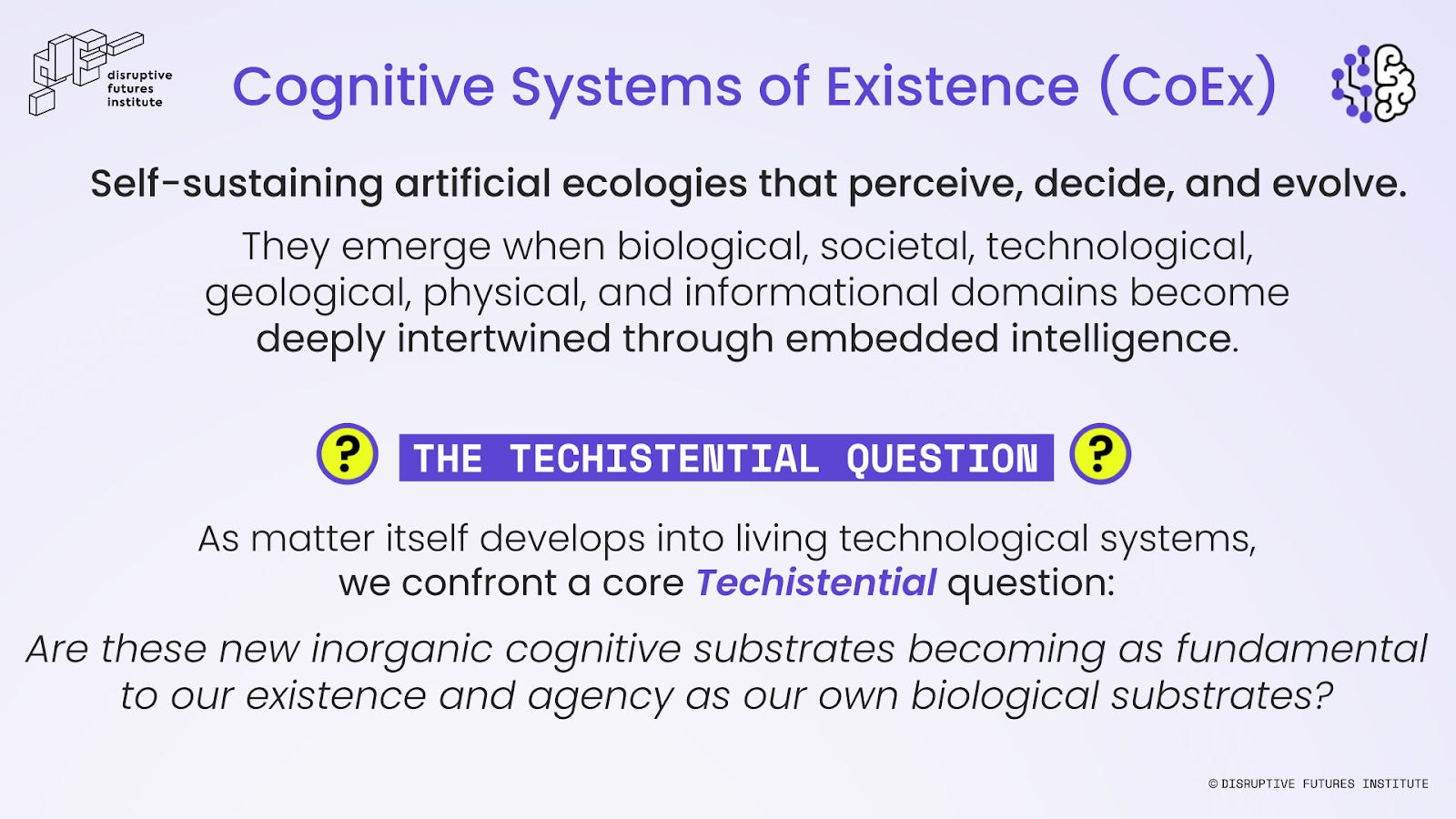
Cognitive Systems of Existence (CoEx) are self-sustaining artificial ecologies that perceive, decide, and evolve. They emerge when biological, societal, technological, geological, physical, and informational domains become deeply intertwined through embedded intelligence.
As matter itself develops into living technological systems, we confront a core Techistential question: Are these new inorganic cognitive substrates becoming as fundamental to our existence and agency as our own biological substrates?
15. MINIMUM VIABLE FIELDS (MVF)
Definition of Minimum Viable Fields (MVF)
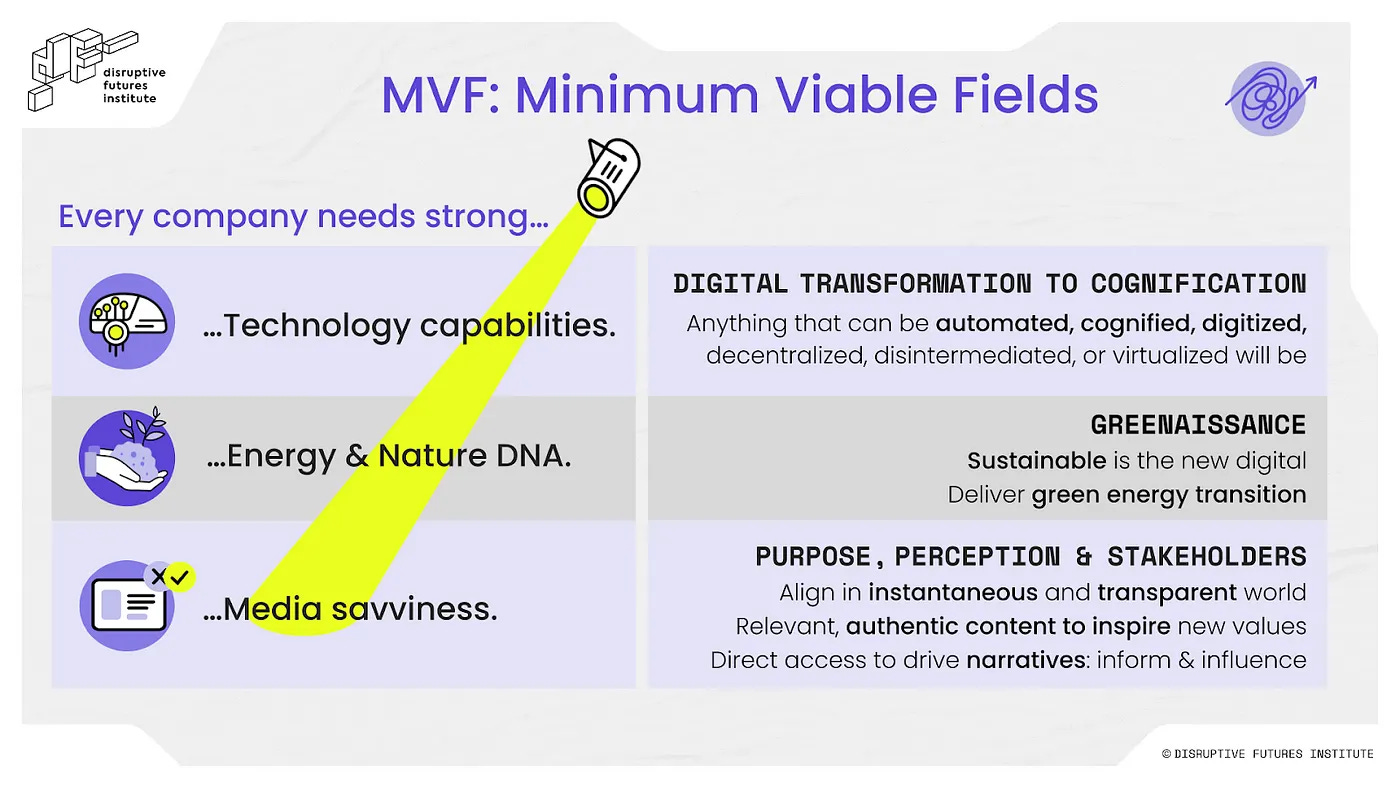
Technology, energy, and media drive all companies. These major themes replace the conventions of sectors. Every company needs strong DNA in these three areas. We call this combination the minimum viable fields (MVF).
What are Minimum Viable Fields (MVF)?
“Tecnologia, energia e mídia impulsionam todas as empresas: esses grandes temas substituem as convenções dos setores. Toda empresa precisa de um DNA forte nessas três áreas. [Technology, energy, and media drive all companies: these major themes replace the conventions of sectors. Every company needs strong DNA in these three areas.]” — Roger Spitz, “O futuro das indústrias na era da disrupção sistêmica”, MIT Technology Review Brasil
Every organization’s minimum viable fields (MVF) are Technology, Energy, and Media. MVF is a proficiency for every company, not a sector.
Technology and AI — Digital transformation to cognification: To remain competitive, organizations should already be building deep technology capabilities, embracing AI’s journey from “automation” to radical “transformation.” Digital transformation is no longer the panacea, but the starting point.
Energy and Nature — Greenaissance era: Every company will need to become innovative in energy transition because “green” is the new digital. To mitigate climate change and deliver decarbonization, sustainability will transform every activity (procurement, production, distribution, after-sales) and redefine business models like digital did in the past few decades.
Media and Storytelling — Purpose, perception, and stakeholders: With increased connectivity, companies need to have media DNA. Direct access to stakeholders can help inform, influence, and drive narratives. Aligning in an instantaneous world requires impactful storytelling. With AI raising concerns about manipulation and bias, genuine narratives become even more crucial. Storytelling that resonates with authenticity can inspire societal values and demonstrate accountability, aligning human aspirations with a transparent, responsible future.
“‘Our starting point is to appreciate that everything becomes public,’ Roger Spitz, futurist, author and President of consultancy Techistential, told the ICAEW Climate Summit in November 2023. ‘Absolutely nothing remains private and confidential, whether it’s bank statements or wealth management teams. And the digressions will stand out…This is our context of radical transparency, traceability and accountability.’” — “The role of accountants in disrupting the system”, The Institute of Chartered Accountants in England and Wales (ICAEW)
Learn More About Minimum Viable Fields
The concept of Minimum Viable Fields is explored in Chapter 8 of Disrupt With Impact, titled “The next chapter of digital disruption: Industries converge and new fields emerge”.
The Definitive Guide to Thriving on Disruption, Volume IV: Disruption as a Springboard to Value Creation applies Minimum Viable Fields to the idea that industries as we know them are ending.
16. CHIEF BRIDGING OFFICER (CBO)
Definition of the Chief Bridging Officer (CBO)
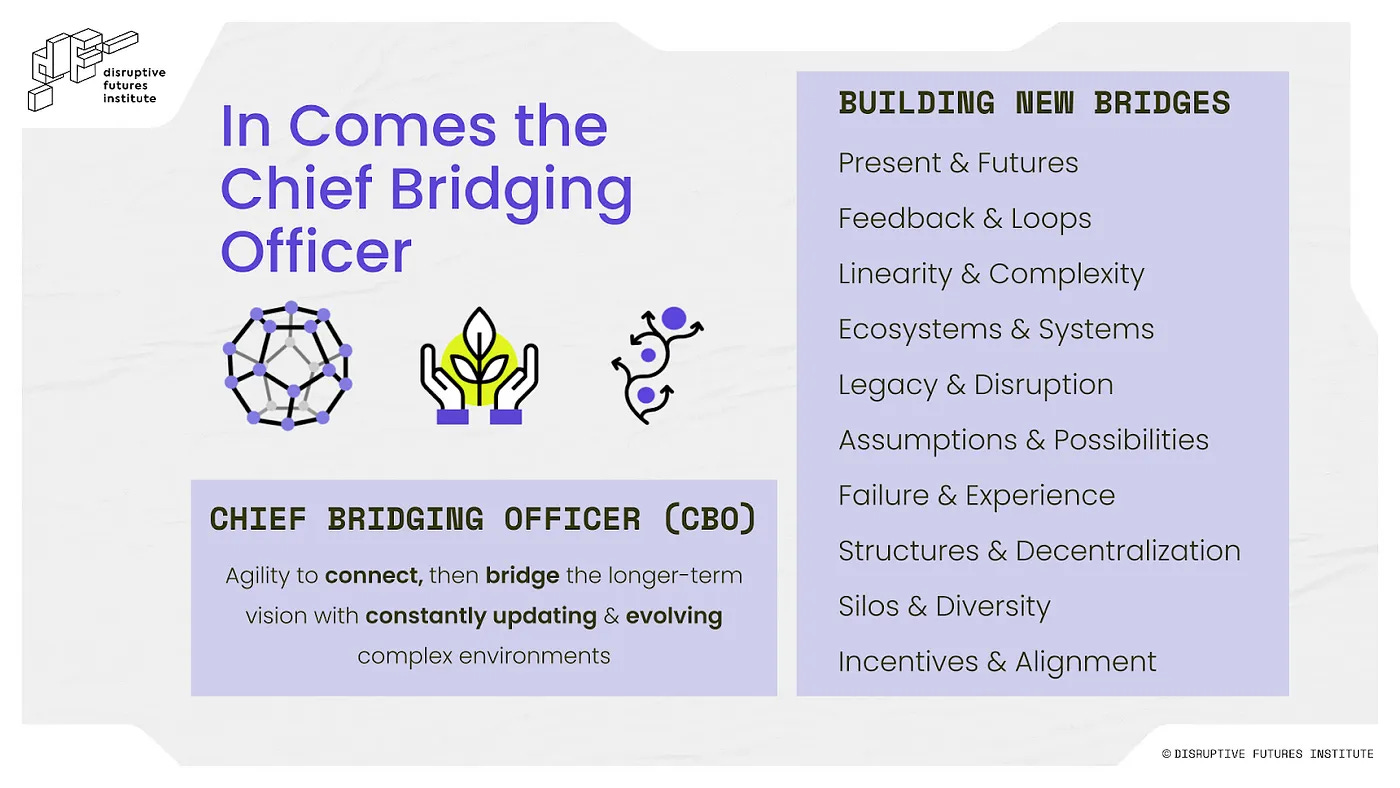
A proposed C-suite position responsible for reconciling the long-term goals of an organization with impactful and relevant everyday actions without getting bogged down by “firefighting.” Must have the agility to connect and then bridge the vision with constantly updating and evolving complex environments.
Why We Propose the Role of a Chief Bridging Officer
The present is ephemeral — it is here now, then dissipates. While strategic plans are the future, they will never exist because we are only ever in the present. With a constantly accelerating present, the C-suites of hierarchical, top-down organizations risk getting absorbed in the day-to-day, never able to translate today into the longer-term vision. Additionally, those tasked with longer-term vision may not be living and breathing what is required in the present to sail to the future. This requires the agility to glide across chasms where bridges have yet to be built.
Poor coordination throughout organizations can cause strategies to falter. Complexity can be counterintuitive when compared to well-established, linear ways of thinking.
We imagine the Chief Bridging Officer (CBO), whose role is to bridge the vision of the future with constantly updating complex environments.
The Chief Bridging Officer in Quotes, Reviews & Citations
“The CBO’s role is a journey of discovery, with the agility to constantly respond to changes in the external environment.” — Roger Spitz, Thinking Across Different Time Horizons for Sustainable Value Creation, Global Peter Drucker Forum
“Roger proposes the role of ‘Chief Bridging Officer’, whose role is to build bridges to cross the chasms between: Present and Future; Legacy and Disruption; Assumptions and Possibilities; Incentives and Alignment. This of course requires extraordinary agility.” — Ross Dawson, Futurist, Keynote Speaker, Entrepreneur, Author
“With our agility to drive emergence today, we build bridges to the future.” — Roger Spitz with Lidia Zuin, quote from The Definitive Guide to Thriving on Disruption: Vol. II. Essential Frameworks for Disruption and Uncertainty
“The transition in the past five years or so from shareholder primacy to stakeholder capitalism has brought greater expectations of transparency and accountability. “‘You’re interacting with much broader ecosystems, where the lines between responsibility in the legal sense and expectations may be becoming more blurred,’ Spitz said.” — “The role of accountants in disrupting the system”, The Institute of Chartered Accountants in England and Wales (ICAEW)
Learn More About the Chief Bridging Officer
Roger Spitz explores the CBO alongside the AAA Framework in World Economic Forum article, “How anticipatory governance can help us with unpredictability”
Roger Spitz develops the role of the CBO in Volume II, Chapter 6: “Agility: Bridging Short- and Long-Term Decision-Making”, and Volume IV, Chapter 2: “Anticipatory Governance: Multistakeholder Strategy for Leadership & Boards”, of The Definitive Guide to Thriving on Disruption.
Disrupt With Impact applies the role of the CBO to his exploration of how to drive systems innovation and transformational change.
17. CHIEF EXISTENTIAL OFFICER (CEO²)
Definition of the Chief Existential Officer (CEO²)
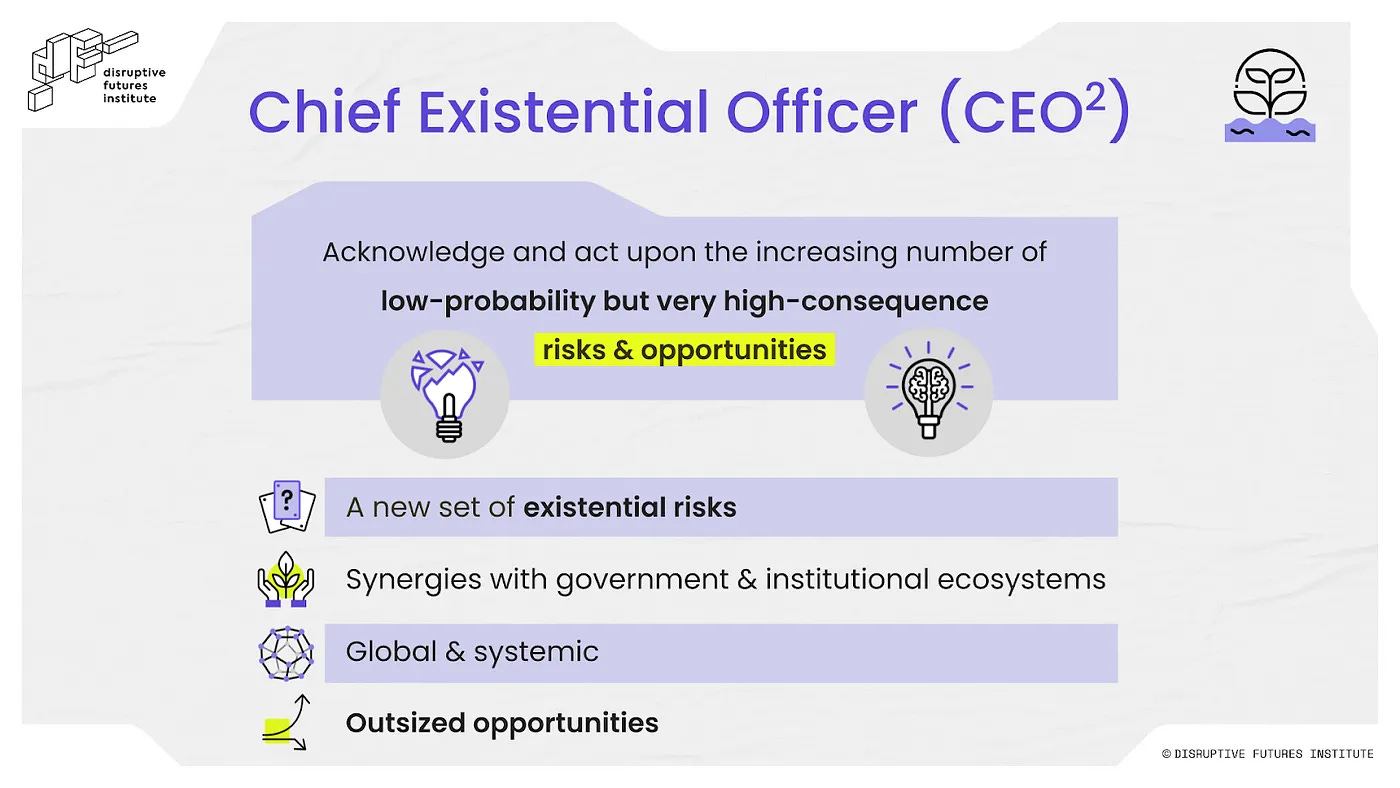
A proposed C-suite position responsible for acknowledging and acting upon the increasing number of low-probability but very high-consequence existential risks, as well as synergizing with government and institutional ecosystems.
Why We Propose the Role of a Chief Existential Officer
“We often discount the dangers of low-likelihood events, even when their magnitude would be catastrophic.” — Roger Spitz, quote from Disrupt With Impact: Achieve Business Success in an Unpredictable World
Given the asymmetry of low-probability but very high consequence risks, organizations and their governance bodies must put forth a greater effort to define and manage existential risks. In addition to climate, organizations can no longer ignore cybersecurity and infrastructure risks (like energy and data centers), as well as geopolitical tensions and even space risks (such as satellites and communications infrastructure). Bad actors regularly test the limits of our systems — a prolonged breakdown of our infrastructure is conceivable.
With an increasing number of asymmetric risks and opportunities, organizations need a Chief Existential Officer (CEO²) more than a Chief Risk Officer. While the Chief Risk Officer focuses on conventional regulatory, compliance, and technology risks, the CEO² acknowledges and acts upon a new set of extreme risks that stretch past typical planning cycles.
Existential risks go beyond day-to-day business risks. They include AI, biosecurity, climate, cybersecurity, geopolitical, and societal paradigm shift risks, which display asymmetric outcomes that could jeopardize the future of humanity altogether. Despite this, outsized opportunities often accompany the risks.
Learn More About the Chief Existential Officer
In The Definitive Guide to Thriving on Disruption, Volume I, Chapter 10: “Existential & Climate Risks as the Ultimate Catalysts” proposes the CEO² as a way forward to integrate existential risks and opportunities.
Roger Spitz introduces the Chief Existential Officer in Disrupt With Impact in the context of antifragility and asymmetric risks.
On the Machine Ethics Podcast, episode “Taming Uncertainty with Roger Spitz”, Roger Spitz and host Ben Byford discuss the role of the CEO².
18. SIX DEGREES OF (UN)PREDICTABILITY
Definition of the Six Degrees of (Un)Predictability
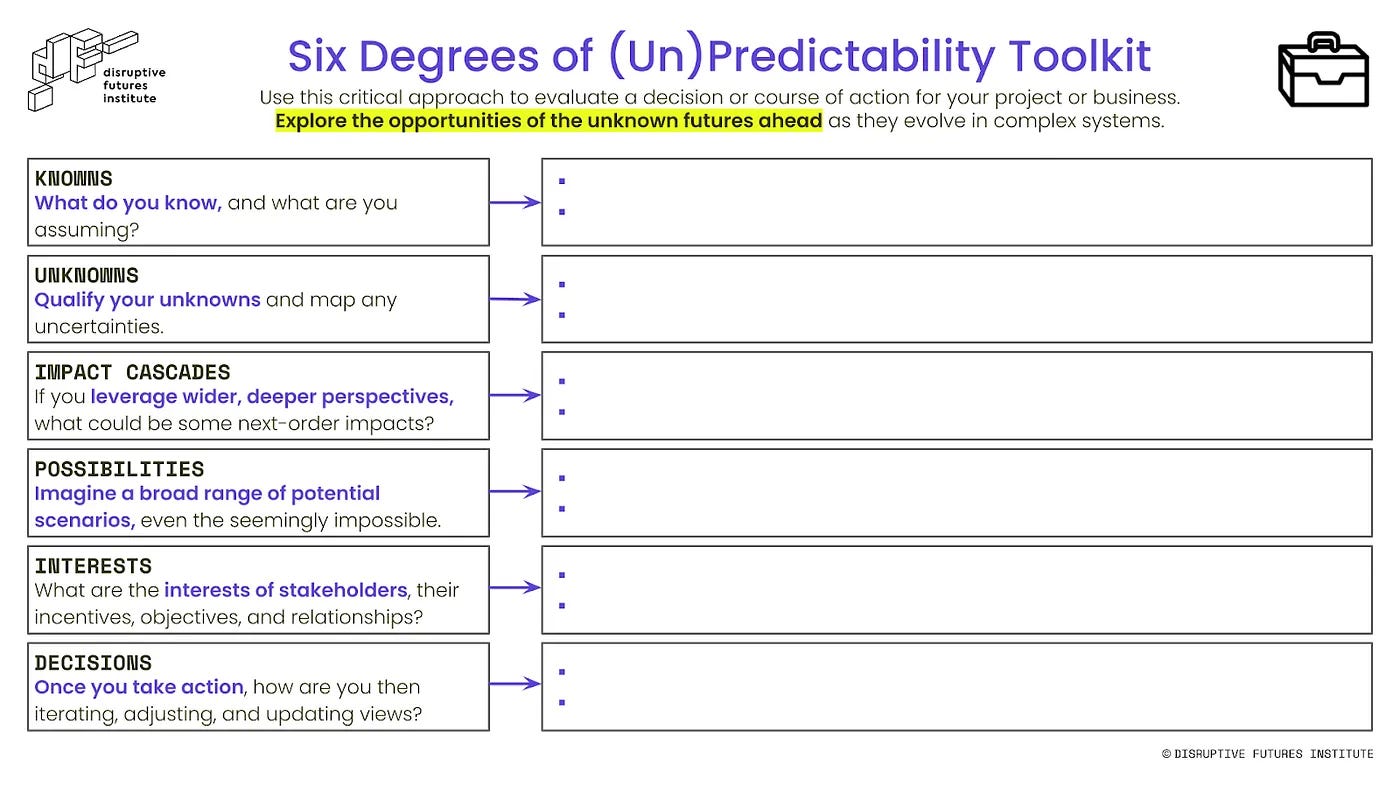
The Six Degrees of (Un)Predictability are a set of filters you can use to critically evaluate assumptions and stakeholder incentives:
Know your knowns. Critically assess the drivers of any predictions to ascertain the ratio of assumptions to knowledge.
Qualify your unknowns to map uncertainties. Challenge the validity of assumptions, of what is not certain.
Consider impact cascades. Consider systemic interconnections and next-order implications from initial change.
Imagine the broad range of possibilities. Seek a fresh perspective by asking questions instead of relying on answers.
Assess stakeholders and interests. Ascertain stakeholder incentives, biases, and track records.
Inform decisions and take action. Be agile in decision-making — there may be no right answers.
Why We Developed the Six Degrees of (Un)Predictability
How can we make decisions in deep uncertainty? Given the features of our complex, uncertain, and nonlinear world, any decisions should be carefully evaluated. Some consultants, analysts, and forecasters claim to have data-driven predictive capabilities. However, they simply extrapolate the past, or at best, the present. To avoid arbitrary decision-making, we developed the “Six Degrees of (Un)Predictability” as an agile frame for decision-making.
“Our UN-VICE in relation to predictions involves combining data, expert advice, non-expert advice, forecasting, diverse perspectives, and extensive imagination to prepare for the possible futures. But none of these individually is the panacea.” — Roger Spitz with Lidia Zuin, quote from The Definitive Guide to Thriving on Disruption: Vol. II. Essential Frameworks for Disruption and Uncertainty
Learn More About the Six Degrees of (Un)Predictability
The Six Degrees of (Un)Predictability feature in The Definitive Guide to Thriving on Disruption, Volume II, Chapter 5: “Anticipatory: The Capacity to Prepare for Constant Disruption”.
Roger Spitz unpacks the levels of uncertainty and the power of foresight in his World Economic Forum article, “Why shifting from prediction to foresight can help us plan for future disruption”.
In a featured article in the Institute of Directors, India publication Director Today, Roger Spitz applies the Six Degrees of (Un)Predictability to understanding stakeholder incentives.
In addition to an explanation in the body of the Disrupt With Impact, Roger Spitz includes the Six Degrees of (Un)Predictability in step 5 of his Disruptive Thinking Canvas: decision-making and driving change.
19. FAILOVATION
What is Failovation?
We call “failovation” the sort of failure that generates innovation (potentially prompting a standing ovation).
Failure on an organizational scale can feel even more foundational than as an individual. Sometimes, organization-level failures can be catastrophic. Even if failures occur in relatively isolated teams within an organization, their effects can still resonate across departmental boundaries. However, failure isn’t something to be afraid of. In fact, failures can be some of the greatest teachers, and can even be the breeding grounds for innovations and value creation.
“By developing an internal model for failure, organizations can capitalize on failures rather than be disrupted by them.” — Roger Spitz, quote from The Definitive Guide to Thriving on Disruption: Vol. IV. Disruption as a Springboard to Value Creation
As a business, organization, or individual, you want foundations that experience more upside from shocks that might arise, even if those shocks are from errors or failures. Antifragile foundations flourish on mistakes. The testing mode enables experimentation, discovery, and learning. Similar to Darwin’s natural selection, trial and error triages and retains the surviving ideas.
Read the full section on the Failovation Toolkit in “The Tools & Toolkits of the Disruptive Futures Institute”, an earlier article in this series.
Learn More About Failovation
Learn the foundations and practical applications of the Failovation Toolkit in The Definitive Guide to Thriving on Disruption, Volume IV, Chapter 9: “Disruptive Technology & Innovation Workbook: Invent the Future”.
Roger Spitz explores Failovation in the context of the 6 i’s Toolkit — and achieving the impossible — in Disrupt With Impact: Achieve Business Success in an Unpredictable World.
On this episode of The New Abnormal podcast, produced in partnership with the Copenhagen Institute for Futures Studies (CIFS), Roger Spitz and host Sean Pillot de Chenecey discuss how to unlock the power of failure and innovation.
On the Reframe & Reset Your Career Podcast, Roger Spitz and host Harsha Boralessa speak about why it is so critical to rethink our relationship with failure.
20. DECODE
What is DECODE, Techistential’s Foresight Framework?
Techistential’s Foresight Framework (DECODE) is designed to help explore signals of change (including weak signals at the fringe, scanning, and emerging issues), uncover patterns, calibrate the dimensions of uncertainty, probability, and risk, and think in different time horizons.
While the future is not knowable, DECODE can help us structure our vision of possible futures, imagine evolutions or pathways, and connect the shifting dots to develop more anticipatory mindsets:
Become future-savvy by analyzing impacts through next-order implications.
Explore potential core emerging changes to develop scenarios, including unintended consequences.
Use stakeholder analysis as a valuable addition to explore the dynamics for decision-makers and other stakeholders who can support or jeopardize our preferred options.
Establish our vision to design and implement plans.
The strategic foresight framework offers a process to structure the different phases to expand awareness, harness critical insights, and drive meaningful outcomes. The collaborative foresight process combines many of the methods reviewed, including visioning and preparing, understanding the nature of different events and phenomena, assessing potential impacts, imagining and building scenarios.
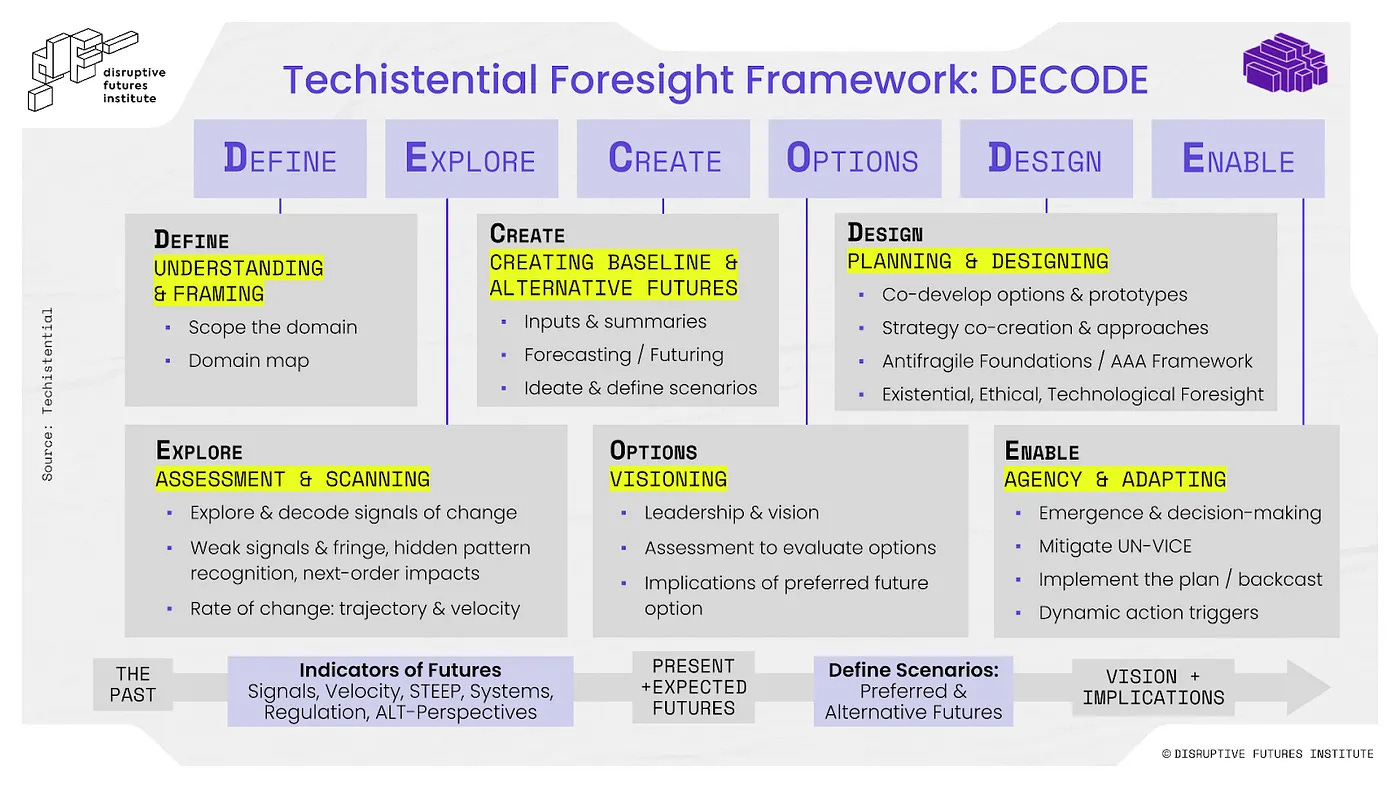
Read the full section on the DECODE as a foundational methodology of the Disruptive Futures Institute in “The Disruptive Futures Institute’s Frameworks & Methodologies”, an earlier article in this series.
Learn More About DECODE
The Definitive Guide to Thriving on Disruption, Volume II: Essential Frameworks for Disruption and Uncertainty introduces Techistential’s DECODE framework in two primary places:
Chapter 5. Anticipatory: The Capacity to Prepare for Constant Disruption
Chapter 11. Futures Frameworks & Foresight Fundamentals Workbook
Curated Glossary: Definition of the Disruptive Futures Institute’s Language & Core Concepts

This article has provided a high-level overview of the Disruptive Futures Institute’s language and core concepts, Below is a concise glossary of the definitions of selected terms.
6 i’s
Our 6 i’s to thriving on disruption — Intuition, Inspiration, Imagination, Improvisation, Invention, and Impossible — comprise a toolkit that provides relevant perspectives to investigate and create your preferred futures, and drive disruption to your advantage:
Intuition: Avoid preconceptions; trust yourself, and improve your judgment.
Inspiration: Explore, be curious, and spur yourself to greatness.
Imagination: Nothing is predetermined; we manifest our own futures.
Improvisation: Experiment with authentic spontaneity and serendipity.
Invention: If the solution doesn’t yet exist, create it.
Impossible: Wander, stumble, and fail in order to achieve the (seemingly) impossible.
8 Laws of Systemic Disruption
In a world of constant change that is no longer linear, where patterns become increasingly hard to interpret, we need to reframe disruption itself. These are the 8 Laws of Systemic Disruption:
Disruption is omnipresent, affecting everyone, everything, everywhere. While disruption is not only technology-driven, technology permeates every facet of our world, so disruption and technology are often interlinked.
Disruption is a constant. It is no longer merely a single event but a steady state.
Systemic disruption establishes new paradigms, which themselves will evolve, sometimes morphing without warning.
Effects are combinatory and cumulative — not isolated. Disruptions interact as hyperconnected networks.
Systemic disruptions have nonlinear ripple effects. The initial disruption (input) can ricochet into amplified higher-order effects (output).
Disruption’s effects must be explored with extended timeframes. The consequences of change only become apparent over time.
Left unchecked, disruptions can slip into irreversibility.
Disruption itself is neither good nor bad; its impact depends on one’s perspective, degree of preparation, and nature and timing of response.
AAA Framework
The AAA Framework is a cornerstone for organizations thriving amid chaos. Designed to help individuals and organizations stay relevant in the 21st century, the AAA Framework offers the tools and mindset to build Antifragile foundations, develop the capabilities to be Anticipatory, and use emergent and strategic Agility to bridge the short-term with long-term decision-making. In Disrupt With Impact and The Definitive Guide to Thriving on Disruption, we also expand the AAA Framework into Being AAA+, which recognizes the importance of Agency and Alignment.
Being AAA+
Being AAA+ is a framework that encapsulates Agency, Alignment, Antifragility, Anticipation, and Agility. It is a dynamic, ever-evolving state of mind designed to inspire constant imagination rooted in aligned visions, values, and goals, for the ultimate purpose of exercising choice in defining and crafting our futures.
Business Models-as-a-System (BMaaS)
To be relevant in today’s UN-VICE world (UNknown, Volatile, Intersecting, Complex, Exponential), business models must adapt to paradigm shifts with agility. Dynamic business models support experimentation, catalyze innovation, and create shared value for the entire ecosystem, providing deeper complementarities between participants. We define these ecosystems as Business Models-as-a-System (BMaaS), which emerge thanks to three key elements: Eco, Co, and Ecosystems.
“Eco” is Eco-friendly: New opportunities, jobs, and industries for those creative enough to shift to more sustainable ecosystems across agriculture, energy, transportation, real estate, retail, and more.
“Co” refers to Collaboration: Co-created, Co-evolving, Connected, and Consumers.
“Ecosystems” live and breathe dynamic changes: They are systemic, in flux, interdependent, and generate feedback loops to emerge with something new.
Chief Bridging Officer (CBO)
A proposed C-suite position responsible for reconciling the long-term goals of an organization with impactful and relevant everyday actions without getting bogged down by “firefighting.” Must have the agility to connect and then bridge the vision with constantly updating and evolving complex environments.
Chief Existential Officer (CEO²)
A proposed C-suite position responsible for acknowledging and acting upon the increasing number of low-probability but very high-consequence existential risks and opportunities, as well as synergizing with government and institutional ecosystems.
Complex Five
Five animals that represent a matrix of highly impactful events according to their degrees of uncertainty; namely Black Elephant, Black Jellyfish, Black Swan, Gray Rhino, and the Butterfly Effect.
Disruption 3.0
We define Disruption 1.0 as the implementation of “Creative Destruction,” the term coined by Joseph Schumpeter, which describes the process by which a new industrial mutation destroys an old paradigm.
Clayton Christensen developed the concept of “Disruptive Innovation,” which describes the specific characteristics of how an innovative product typically disrupts an old market by following a reliable process. We define this as Disruption 2.0
Disruption 3.0 is omnipresent and systemic — change here is a constant which establishes entirely new paradigms, which themselves will evolve.
Disruptive Thinking Canvas
The Disruptive Thinking Canvas is a personalized roadmap designed to help you thrive in today’s shifting environments. By identifying unexplored opportunities, you can invent the future, whether for yourself, your projects, or your organization. The Canvas offers a six-step guide to navigate disruption and create impact, equipping you with the mindset and tools needed to succeed:
Step 1 — Reframing Disruption: Redefine disruption to realize how positive opportunities can be found in disruptive times.
Step 2 — Scanning and Mapping: Anticipate, identify, and investigate potential disruptions ahead.
Step 3 — Ideating: Embrace new mindsets to harness uncertainty; imagine untapped opportunities to problem-solve our complex challenges and spur transformations.
Step 4 — Dissent and Alignment: Increase alignment and overcome resistance while challenging the status quo.
Step 5 — Decision-Making and Driving Change: Understand decision-making in deeply uncertain environments, and how to effect change in a systemic context.
Step 6 — Iterating: Apply changes, assess impacts, incorporate new information, and utilize feedback to adapt continuously.
Failovation
The sort of failure that generates innovation (potentially prompting a standing ovation). Failure → Innovation = Failovation.
Greenaissance
An era of renewal with momentous innovation and investment opportunities, aligned across fields with the common objective of sustainable energy transition.
Inflection Paradox
The conflicting drivers and cognitive biases that contribute to a failure to spot inflection points. In the early stages, exponential changes may be imperceptible while noise from emerging technology can be dismissed as hype (Amara’s Law). Later on, we may recognize an inflection point’s dramatic effects only after it has passed.
Info-Ruption
“Info-ruption” is a pervasive and radical change in worldwide data dynamics, with cascading effects on how information will be interpreted, used, and misused.
Internet of Existence (IoE)
The Internet of Existence (IoE) integrates pervasive networks into previously disconnected domains — biological, societal, technological, geological, physical, and informational — to form emergent digital ecosystems of existence. These adaptive systems interconnect, digitize, and cognify all facets of existence through artificial intelligence, enabling intelligent, responsive, and perceptive living systems that sustain, renew, and continuously evolve.
Metaruptions
Multidimensional family of systemic disruptions, including shifts in the notion of disruption itself. Metaruptions are characterized by the dynamic interactions of subordinate drivers of change. They cause widespread and self-perpetuating effects that extend beyond their initial disruptions.
Minimum Viable Fields (MVF)
Technology, energy, and media drive all companies. These major themes replace the conventions of sectors. Every company needs strong DNA in these three areas. We call this combination the minimum viable fields (MVF).
Six Degrees of (Un)Predictability
The Six Degrees of (Un)Predictability are a set of filters you can use to critically evaluate assumptions and stakeholder incentives:
Know your knowns. Critically assess the drivers of any predictions to ascertain the ratio of assumptions to knowledge.
Qualify your unknowns to map uncertainties. Challenge the validity of assumptions, of what is not certain.
Consider impact cascades. Consider systemic interconnections and next-order implications from initial change.
Imagine the broad range of possibilities. Seek a fresh perspective by asking questions instead of relying on answers.
Assess stakeholders and interests. Ascertain stakeholder incentives, biases, and track records.
Inform decisions and take action. Be agile in decision-making — there may be no right answers.
Techistentialism
Techistentialism studies the nature of human beings, existence, and decision-making in our technological world. Today, we face both technological and existential conditions that can no longer be separated. We define this phenomenon as Techistentialism.
UN-VICE
Many organizations and militaries use VUCA as an acronym to describe the disruptive state of the world, given its Volatility, Uncertainty, Complexity, and Ambiguity. UN-VICE is an updated way of capturing the state and velocity of the world, with our acronym for UNknown, Volatile, Intersecting, Complex, and Exponential:
UNknown: Recognizing that you can’t know anything perfectly, and that many of our decisions are based on assumptions. Increased uncertainty lowers the value of ad-vice and requires increased self-reliance.
Volatile: Our world, and change itself, is evolving faster than ever before. Volatility is not inherently good or bad; it is simply impactful. In volatility we see shifting speed, texture, and magnitude of the changing environment.
Intersecting: The broader our filters, the more we realize that what we observe overlaps with other things. Boundaries are disappearing, connecting new areas through combinations.
Complex: These more-than-complicated systems have unreliable input-output relationships and cannot be summarized or modeled without losing their essence. Unpredictable situations with unknown unknowns.
Exponential: A nonlinear type of change that increases in its growth rate. To an observer, this change may happen gradually, then suddenly. Rapid acceleration of seemingly-small shifts.
Learn the Language of Disruption with the Disruptive Futures Institute’s Publications
“Essential reading for any CEO, leadership team, board member, or investor.” — Sebastian Bihari, Venture Capitalist, General Partner at Vektor Partners
The language of disruption is rooted in action. The concepts and terms explored throughout this list represent the foundational core of the Disruptive Futures Institute’s lexicon. But it’s just the beginning.
Throughout The Definitive Guide to Thriving on Disruption and Disrupt With Impact: Achieve Business Success in an Unpredictable World, we dive into these concepts in great depth, connecting the dots between them and numerous real-world case studies and practical applications. If you’re ready to master the language of disruption, read more about our publications:
The Definitive Guide to Thriving on Disruption: A comprehensive four-volume series packed with proprietary frameworks, tools, and strategies.
Disrupt With Impact: Achieve Business Success in an Unpredictable World: Roger Spitz’s latest bestseller, your compass for exploring the uncharted waters of the future. Disrupt With Impact is the winner of the 2024 Chanticleer International Best Book Awards, Harvey Chute Category Winner (Non-Fiction Business & Enterprise), winner of the 2024 Foreword Indies Book of the Year Award — Bronze, Business & Economics, and was named finalist in the 2025 International Book Awards (IBA) for both General Business and Management & Leadership.
Through pioneering frameworks developed in Disrupt With Impact, Roger Spitz’s work is redefining how organizations and leaders navigate disruption and unpredictability. His innovative models, such as the AAA Framework (Antifragile, Anticipatory, Agility), the UN-VICE paradigm, and Techistentialism, provide actionable strategies for thriving amid systemic, nonlinear change and the growing influence of AI. From futures studies and systems thinking to sustainable development and foresight strategy, Roger Spitz’s books serve as a trusted compass for staying relevant and resilient amid systemic change.
Both The Definitive Guide to Thriving on Disruption and Disrupt With Impact: Achieve Business Success in an Unpredictable World are now available to order, on Amazon or wherever books are sold.
Disruptive Futures Institute Social Media Links & Resources
Websites & Resources
Homepage: Disruptive Futures Institute Homepage
LinkedIn Page: Disruptive Futures Institute LinkedIn
Youtube Channel: Disruptive Futures Institute Youtube Channel
Latest book (reviews, media, synopsis…): Disrupt With Impact Webpage
Instagram
Twitter / X
Read the first article of this four-part series:
Learn the Disruptive Futures Institute’s Language of Systemic Disruption in this 4-Part Series Exploring Its Methodologies, Toolkits, and Core Concepts
All four articles can be found here:
Article 1 — Introduction: “The Frameworks, Tools, and Language of the Disruptive Futures Institute” [1/4]
Article 2 — Frameworks: “The Disruptive Futures Institute’s FRAMEWORKS & Methodologies” [2/4]
Article 3 — Toolkits: “The TOOLKITS of the Disruptive Futures Institute” [3/4]
Article 4 — Language: “LANGUAGE & Core Concepts of the Disruptive Futures Institute” [4/4]
Press Release:
Disruptive Futures Institute Reveals the Secrets Behind Global Impact in New Article Series
Metadata & Citations
Article 1:
The Disruptive Futures Institute’s Frameworks, Tools, and Language [1/4]
DOI: 10.13140/RG.2.2.16265.30562
Citation:
Spitz, R. “The Disruptive Futures Institute’s Frameworks, Tools, and Language [1/4]”. Disruptive Futures Institute Medium, August 8, 2025.
Synopsis:
In this four-article series, we outline Disruptive Futures Institute’s frameworks, toolkits, and concepts, now consolidated in one place for your convenience. This first article provides an overview of the purpose and impact of the Disruptive Futures Institute’s work.
URL:
Article 2:
The Disruptive Futures Institute’s Frameworks & Methodologies [2/4]
DOI: 10.13140/RG.2.2.29687.07845
Citation:
Spitz, R. “The Disruptive Futures Institute’s Frameworks & Methodologies [2/4]”. Disruptive Futures Institute Medium, August 8, 2025.
Synopsis:
The Disruptive Futures Institute’s Frameworks and Methodologies are structured approaches designed to help you understand, anticipate, and navigate change. This article provides a high-level overview of the core frameworks that are foundational to the Disruptive Futures Institute.
URL:
Article 3:
The Toolkits of the Disruptive Futures Institute [3/4]
DOI: 10.13140/RG.2.2.22976.19208
Citation:
Spitz, R. “The Toolkits of the Disruptive Futures Institute [3/4]”. Disruptive Futures Institute Medium, August 8, 2025.
Synopsis:
The Disruptive Futures Institute’s Tools are practical step-by-step processes you can apply directly to your life and projects. This article provides a high-level overview of the Disruptive Futures Institute’s toolkits, which support our foundational frameworks.
URL:
Article 4:
Language & Core Concepts of the Disruptive Futures Institute [4/4]
DOI: 10.13140/RG.2.2.36397.96481
Citation:
Spitz, R. “Language & Core Concepts of the Disruptive Futures Institute [4/4]”. Disruptive Futures Institute Medium, August 9, 2025.
Synopsis:
At the Disruptive Futures Institute, our Language and Core Concepts are the words we use to describe and operate in the current state of our complex and nonlinear world. This article provides a high-level overview of the Disruptive Futures Institute’s foundational language and core concepts.
URL:
Discussion about this post